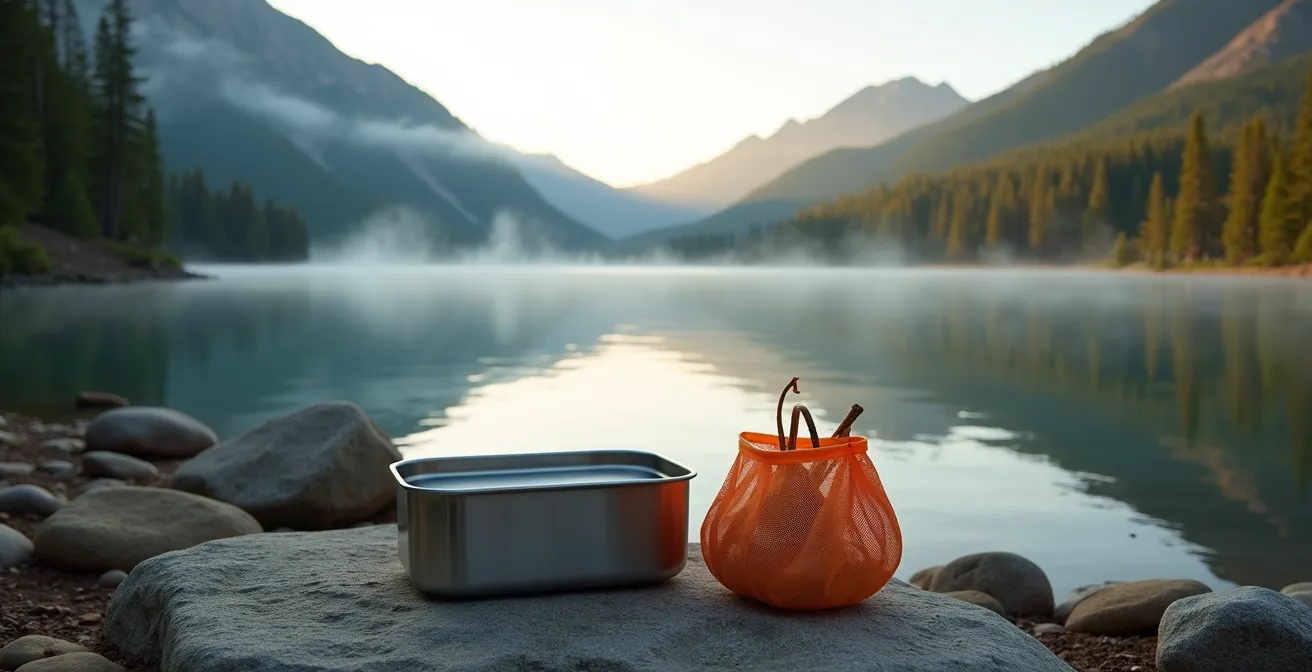
True zero-waste camping goes far beyond packing out wrappers; it’s about eliminating the invisible micro-contaminants that cause real, lasting harm to Canadian ecosystems.
- “Biodegradable” soaps can poison pristine lakes with phosphorus, fueling toxic algal blooms.
- Tiny food crumbs and residues attract wildlife, creating dangerous and unnatural habituation cycles.
Recommendation: Adopt a “systemic cleanliness” mindset. Design your entire camping process to prevent micro-waste at every step, from dishwashing to meal prep, to become a true steward of the wild.
Every Canadian who loves the outdoors knows the golden rule: “pack it in, pack it out.” We dutifully carry out our food wrappers, used containers, and gear, leaving our campsites looking pristine. But what if the most significant damage we cause is invisible? What if the real challenge of zero-waste camping isn’t the visible trash, but the microscopic trail of crumbs, soap residue, and food particles left behind?
As a zero-waste lifestyle coach, I’ve seen countless well-intentioned campers who believe they are leaving no trace, yet are unknowingly contributing to a slow, cumulative degradation of the very wilderness they cherish. The common advice—use reusable bags, buy in bulk—is a great start, but it doesn’t address the nuanced reality of backcountry ecosystems. The truth is, a single dropped bread tag or the wrong kind of soap can set off a chain reaction that harms wildlife and pollutes waterways.
This guide moves beyond the basics. We’re going to dive into the world of micro-contaminants and systemic cleanliness. The goal is to shift your mindset from just “cleaning up” to proactively designing a camping system that prevents these invisible threats from ever occurring. We will explore the hidden dangers of “biodegradable” products, the science behind why a single crumb matters, and the specific techniques required to achieve a level of environmental stewardship that truly honours Canada’s wild spaces.
This article provides a comprehensive framework for mastering the art of zero-waste camping. You will learn the precise methods for handling everything from greywater to food scraps, ensuring your footprint is as close to zero as humanly possible. Let’s explore the practical steps to elevate your commitment to conservation.
Summary: The Complete Guide to Eliminating Micro-Waste in Canadian Camping
- The Strainer Method: How to Dispose of Dishwater Without Attracting Animals?
- Biodegradable Soap: Why Can’t You Use It Directly in the Lake?
- Reusable vs. Disposable: How Many Trips to Breakeven on Silicone Bags?
- The Crumb Danger: How Do Micro-Particles Attract Rodents to Your Tent?
- Dehydrated vs. Fresh: Which Creates Less Waste to Pack Out?
- Why Is “Boondocking” in National Parks Strictly Prohibited and Fined?
- Giardia Risk: Why You Must Filter Even Clear Wetland Water?
- Donating to Nature: How Can Tourists Support Canadian Conservation Charities?
The Strainer Method: How to Dispose of Dishwater Without Attracting Animals?
One of the biggest sources of micro-contaminants at a campsite is dishwater. Even after you’ve scraped your plate, the “greywater” is still loaded with tiny food particles, oils, and scents. Simply tossing this water into the bushes near your tent is an open invitation to rodents, bears, and other wildlife, teaching them to associate humans with food. This process, known as wildlife habituation, is dangerous for both animals and future campers. The goal isn’t just to get rid of the water, but to disperse the scent and remove every last food morsel.
The most effective technique is the Strainer Method, promoted by organizations like Leave No Trace Canada. It involves physically separating the solid food particles from the water before disposal. A simple, fine-mesh strainer is all you need. After straining, the captured food bits must be packed out with your other garbage. Don’t be fooled into thinking these tiny scraps will just decompose; as one backcountry camper in Ontario’s Frontenac Provincial Park noted, finding micro-garbage like bread tags and wrapper corners ruins the pristine environment and proves that even the smallest items persist and attract animals.
The strained water itself must then be handled correctly. Carry it far away from any water source and your campsite—the official recommendation is at least 60 metres (or 70 adult paces). Then, scatter it broadly, like you’re flinging seeds, over a wide area. This helps it evaporate quickly and dissipates the odour so it doesn’t create a single, concentrated “smell hotspot” for curious animals to investigate. In designated bear country, an even more cautious approach of digging a “sump hole” for the greywater is recommended.
Biodegradable Soap: Why Can’t You Use It Directly in the Lake?
The term “biodegradable” on a bottle of camp soap is one of the most dangerously misunderstood labels in the outdoor community. It creates a false sense of security, leading many to believe it’s safe to use directly in a lake or stream. The shocking truth is that these soaps, when introduced into an aquatic environment, can act as a poison. The core issue is that they contain phosphates and other nutrients that trigger a devastating process called eutrophication, or nutrient-pollution.

These excess nutrients act like fertilizer for algae. The result is massive, explosive algal blooms that choke the waterway, deplete oxygen, and kill fish and other aquatic life. In Canada, this isn’t a theoretical problem; according to research on the deterioration of Lake Winnipeg from phosphorus, this process has led to increasingly frequent and toxic blooms that threaten entire communities and industries. Even a small amount of soap from one camper contributes to this cumulative degradation. As the Environmental Literacy Council explains, the term itself is the problem:
“Biodegradable” means that a substance can be broken down by living organisms, primarily bacteria. However, this process generally requires soil. The microorganisms in the water and lack of oxygen and other soil components in the lake environment break it down much more slowly, if at all.
– The Environmental Literacy Council, Environmental Guide
Essentially, the soil acts as a natural filtration system. When you use soap 60 metres away from the water’s edge, the soil bacteria have time to break it down into harmless components before it ever reaches the lake. Using it directly in the water bypasses this crucial step, delivering a direct hit of pollutants to a fragile ecosystem. There is no such thing as a “lake-safe” soap.
Reusable vs. Disposable: How Many Trips to Breakeven on Silicone Bags?
Shifting from single-use Ziploc bags to reusable silicone alternatives is a cornerstone of zero-waste living, but for a camper, the decision involves more than just waste reduction. It’s a calculation of durability, upfront cost, and long-term value. A common hesitation is the initial price of high-quality silicone bags. The key is to reframe it not as an expense, but as an investment with a clear “break-even” point, after which you are actively saving money and resources.
Consider this: a premium silicone bag might cost as much as several boxes of disposable ones. However, its lifespan is exponentially longer. According to data from Canadian outdoor retailer MEC on their partnership with Stasher, a single food-grade silicone bag can replace an average of 260 single-use plastic bags per year. If you go on just a handful of multi-day camping trips a year, you could easily hit this break-even point within a single season. After that, every trip is a net positive for your wallet and the planet.
Furthermore, reusables offer superior performance in the demanding Canadian backcountry. For challenging routes like British Columbia’s West Coast Trail, where relentless moisture can destroy flimsy disposable bags, the robust, waterproof seal of a platinum silicone bag with a Pinch-Loc® seal is a functional necessity. They protect your food from the elements and prevent leaks, contributing to the “systemic cleanliness” we’re aiming for. The choice becomes clear: disposables are a recurring cost with high failure rates, while reusables are a one-time investment in reliability and waste elimination.
The Crumb Danger: How Do Micro-Particles Attract Rodents to Your Tent?
Of all the micro-contaminants, the most overlooked and potentially dangerous is the humble crumb. A few stray bits of granola, a smear of peanut butter on the grass, or the dust from a crushed cracker might seem insignificant, but to the highly sensitive nose of a rodent, bear, or raccoon, it’s a powerful beacon. This is the root of negative human-wildlife interactions: we inadvertently train animals that our campsites are a source of high-calorie food. This habituation leads them to become bolder, more aggressive, and ultimately puts them at risk of being relocated or destroyed.
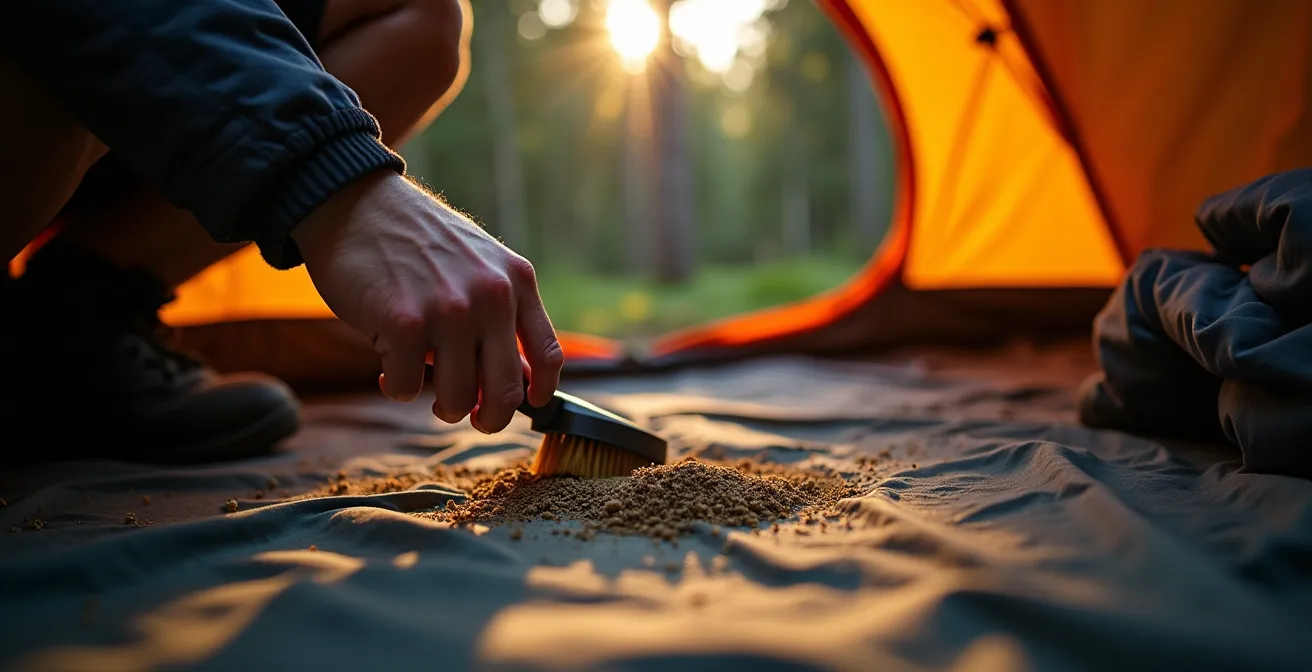
Your tent becomes a primary target. The fabric can absorb odours, and even microscopic food particles left in a vestibule or just outside the door are enough to attract a mouse or chipmunk. These small creatures might chew through expensive gear to get to the source of the smell, creating an entry point for water and insects. A larger animal, like a bear, attracted by the same smells, poses a much more serious threat. Managing crumbs isn’t just about cleanliness; it’s a critical safety protocol.
The solution is to create a “Crumb Capture System.” This isn’t a single tool, but a disciplined process for containing every food particle. It involves creating a designated eating area and having a method to meticulously clean it after every meal. The goal is to make your campsite an “odour dead zone,” giving wildlife no reason to investigate.
Your Action Plan: Implementing the Crumb Capture System
- Designate a lightweight ground cloth or emergency blanket as your ‘kitchen floor’ and eat all meals over it.
- After each meal, carefully funnel all captured micro-crumbs from the cloth into a sealed trash bag.
- Perform a 360-degree check of your tent perimeter for any forgotten food particles before nightfall.
- Store all food, cookware, and any crumb-contaminated items in certified bear-proof containers or a proper bear hang overnight.
- Pack out every last food particle, including coffee grounds and pasta water solids, to prevent long-term wildlife habituation.
Dehydrated vs. Fresh: Which Creates Less Waste to Pack Out?
The choice between packing dehydrated meals and fresh food is a classic camping dilemma, and from a zero-waste perspective, there’s no single right answer. The best option depends entirely on the context of your trip, specifically its length, location, and your mode of transport. The decision requires a holistic look at the entire lifecycle of your food, from packaging to organic waste to the water needed for preparation. Each approach has a different waste footprint, and your job as a zero-waste camper is to choose the one with the lowest overall impact for your specific adventure.
Fresh food, purchased from a farmer’s market with your own reusable containers, seems like the obvious winner. It generates zero packaging waste. However, it creates a significant amount of organic waste—apple cores, vegetable peels, rinds—all of which is heavy, prone to smelling, and must be meticulously packed out. It’s also heavy due to its high water content, making it less suitable for long-distance hiking. On the other hand, pre-packaged dehydrated meals create packaging waste (typically a single foil pouch), but they produce absolutely no organic waste and are incredibly lightweight.
The following table breaks down the trade-offs, using examples relevant to iconic Canadian parks to illustrate the best use cases.
| Aspect | Dehydrated (e.g., Happy Yak) | Fresh (e.g., Farmers Market) |
|---|---|---|
| Packaging Waste | Single foil pouch per meal | Zero with reusable containers |
| Organic Waste | None | All peels/cores must be packed out |
| Water Requirements | 500-700ml per meal | None (high water content foods) |
| Weight for 5-day trip | 2-3 kg total | 8-10 kg total |
| Best Use Case | Alpine treks (Tombstone Park, YT) | Canoe trips (Killarney Park, ON) |
A strenuous, multi-day trek in the Yukon’s Tombstone Territorial Park demands the lightweight efficiency of dehydrated meals. In contrast, for a canoe trip in Ontario’s Killarney Provincial Park where weight is less of an issue, the benefits of fresh food with zero packaging might outweigh the hassle of packing out peels and cores. The key is strategic planning based on your specific trip’s constraints.
Why Is “Boondocking” in National Parks Strictly Prohibited and Fined?
“Boondocking,” or random camping outside of designated sites, might seem like the ultimate expression of freedom, but within Canada’s National Parks, it is strictly forbidden for a critical ecological reason: the principle of concentrated impact. The entire conservation strategy for our national treasures, from Banff to Gros Morne, relies on containing human activity to small, carefully chosen, and hardened areas. This allows the vast majority of the park’s wilderness to remain truly wild and undisturbed.
As Parks Canada states, their policy is to “concentrate human impact into small, hardened areas, thereby preserving the vast majority of the park’s wilderness in a pristine state.” A designated campsite is designed to withstand repeated use. It has reinforced tent pads, established fire pits, and is located where its impact is minimized. When a camper sets up a tent in a pristine alpine meadow, they crush delicate vegetation that can take decades to recover. They create new trails, disturb soil, and increase the risk of spreading invasive species. If thousands of visitors did this, the park would be crisscrossed with scars, its ecological integrity destroyed.
This isn’t just a suggestion; it’s the law. The prohibition on random camping is enforceable with significant fines under the Canada National Parks Act General Regulations. This legal framework exists to protect the parks for all future generations. By staying in designated campgrounds—whether front-country or backcountry—you are not limiting your freedom; you are actively participating in the collective effort to preserve Canada’s natural heritage. The fee you pay for a site is a direct investment in the infrastructure that makes this preservation model possible.
Giardia Risk: Why You Must Filter Even Clear Wetland Water?
There is no more dangerous myth in the Canadian backcountry than the idea that clear, cold, fast-moving water is safe to drink. A pristine-looking mountain stream in the Rockies can be teeming with microscopic parasites, with the most notorious being Giardia lamblia. This protozoan causes giardiasis, an intestinal illness affectionately (and miserably) known in Canada as “Beaver Fever.” It’s a risk that must be taken seriously on every single trip.
According to Health Canada, Giardia is endemic in Canadian wildlife, particularly in hosts like beavers and muskrats. These animals can contaminate entire water systems, from sluggish wetlands to seemingly pure alpine springs. The parasite’s cysts are incredibly resilient and can survive for long periods, even in cold water. Believing that altitude will protect you is a fallacy; high-altitude animals like marmots and pikas can also carry and transmit the parasite. The clarity of the water is completely irrelevant, as the cysts are invisible to the naked eye. Drinking unfiltered water is a roll of the dice with your health and can ruin a trip or cause long-term health issues.
Therefore, treating all water from natural sources is not optional; it’s a mandatory part of your safety system. You have two primary, effective methods: filtration and boiling. A reliable water filter is the most common tool for backpackers. It is essential to use a filter specifically rated for parasite removal, such as one with a pore size of 0.2 microns or smaller, which is effective against both Giardia and Cryptosporidium. Boiling is also a foolproof method. Following a strict water treatment protocol is the only way to guarantee your hydration is safe.
Essential Protocol: Safe Water in the Canadian Backcountry
- Always filter or boil water from any natural source, regardless of its appearance, altitude, or flow rate.
- Use a water filter with an absolute pore size of 0.2 microns or smaller to effectively remove Giardia and Cryptosporidium.
- If boiling, bring water to a rolling boil for at least one minute at sea level, adding one minute for every 1000m of elevation gain.
- Never trust the “altitude myth”; high alpine sources are frequently contaminated by wildlife.
- Store your treated water in clean, clearly marked containers to prevent cross-contamination with untreated water.
Key takeaways
- True zero-waste camping focuses on eliminating invisible “micro-contaminants” like crumbs and soap residue, not just visible trash.
- “Biodegradable” soap is harmful to aquatic ecosystems; it must be used on soil at least 60m away from any water source to be broken down safely.
- Meticulous crumb control and proper greywater disposal are critical safety protocols to prevent dangerous wildlife habituation in Canadian parks.
Donating to Nature: How Can Tourists Support Canadian Conservation Charities?
Practicing perfect zero-waste camping is a powerful act of personal responsibility. It is the baseline of “doing no harm.” But what if you want to go a step further? The ultimate expression of environmental stewardship is to move from a passive, neutral presence to an active, positive force for conservation. This means contributing to the systemic health of the wild places you love. Supporting the organizations that conduct research, advocate for policy change, and protect Canadian land is how you can have an impact that lasts long after your footprints have faded.
The impact of these organizations is tangible. A powerful Canadian example is the IISD Experimental Lakes Area (ELA) in Northern Ontario. Originally established in 1968 to investigate what was causing algal blooms, research from the ELA proved that phosphorus was the key culprit. This groundbreaking discovery directly led to transformative water policy around the world, including the mandated removal of phosphates from laundry detergents and soaps. Your support for organizations like this funds the science that protects our environment on a national and global scale.
Contributing is easier than you think and can be tailored to your means and interests. You can support national advocacy groups, contribute to the maintenance of a specific trail you love, or buy a park pass. Each action helps fund the vital work of preserving Canada’s natural legacy. Here are some avenues to consider for becoming an active steward:
- National Scope: Organizations like the Nature Conservancy of Canada (NCC) and the Canadian Parks and Wilderness Society (CPAWS) work across the country to protect vast natural areas and advocate for wilderness.
- Provincial/Park-Specific: Groups like the Friends of Algonquin Park focus their efforts on the health and conservation of a single beloved park.
- Regional/Trail-Specific: The Bruce Trail Conservancy is a prime example of an organization dedicated to maintaining a specific, iconic footpath for public enjoyment and ecological integrity.
- Direct Support: Simply purchasing a Parks Canada Discovery Pass or park-specific merchandise often directs funds back into conservation and visitor services.
Your journey into the Canadian wilderness is an opportunity not just for adventure, but for impact. By adopting these advanced zero-waste principles and becoming an active supporter of conservation, you transform your role from a simple tourist into a true steward of the wild. Start applying these strategies on your next trip and become part of the solution for preserving Canada’s natural heritage for generations to come.