
In summary:
- Mastering the boreal forest’s “coniferous physics”—not just buying expensive gear—is the key to warmth at -20°C.
- Prioritize dead, standing tamarack or jack pine for high-heat, low-spark fires essential for hot tenting.
- Manage moisture by understanding “active-static transitions”; vent layers before you stop moving to prevent flash freezing.
- Use the environment as a resource, from identifying safe pine needles for Vitamin C to using snow for insulation.
- Always conduct a “widowmaker check” for hazardous dead branches before setting up any shelter.
The profound silence of a Canadian boreal forest under a blanket of snow is an experience unlike any other. The air is so cold it feels sharp, and every sound is muffled by the powder. For the adventurous camper, this is the ultimate test of skill and spirit. Many believe the solution to staying warm at -20°C is simply a matter of buying a warmer sleeping bag or a thicker jacket. They follow the common advice: layer your clothes, eat fatty foods, and stay dry. While these principles are not wrong, they are dangerously incomplete for the unique challenges of a coniferous wilderness.
The boreal forest operates under its own set of rules—a kind of “coniferous physics” that dictates how you truly survive and thrive in extreme cold. The sticky resin that coats everything, the specific way pine and spruce wood burn, and the constant threat of moisture from both inside and outside your clothing system create a complex thermal puzzle. Relying on generic advice is a recipe for a miserable, and potentially hazardous, trip. The real key to warmth is not just resisting the cold, but understanding and working with the environment around you.
This is where the knowledge of a survivalist diverges from that of a casual camper. It’s about seeing the forest not as an obstacle, but as a system of resources and risks. It’s about knowing which dead tree will provide a hot, long-lasting fire versus one that will throw dangerous sparks onto your tent. It’s about mastering the subtle art of moisture management during the critical moments you stop moving. This guide will take you beyond the basics, providing the instructor-level knowledge needed to transform a formidable environment into a place of profound beauty and adventure.
To navigate this challenge, this guide breaks down the essential skills and knowledge required. From selecting the right firewood and shelter to managing your clothing and packing critical safety gear, each section is designed to build your expertise for thriving in the Canadian winter wilderness.
Summary: A Survival Instructor’s Guide to Boreal Forest Winter Camping
- Pine vs. Spruce: Which Wood Pops Less and Burns Hotter?
- The Widowmaker Check: How to Spot Dead Branches in Coniferous Trees?
- Hammock vs. Hot Tent: Which Is Better for Snowy Pine Forests?
- Resin Removal: How to Clean Sticky Sap Off Your Down Jacket Safely?
- Pine Needle Tea: How to Identify Safe Species for Vitamin C?
- How to Dress for “Freeze-Thaw” Cycles Without Overheating?
- Yurt vs. Cabin: Which Offers Better Insulation for a Fall Retreat?
- Exploring Yukon’s Wilderness: The Safety Gear You Must Pack
Pine vs. Spruce: Which Wood Pops Less and Burns Hotter?
In a hot tent at -20°C, your fire is your lifeline. But not all wood is created equal. Understanding the unique “fuel signature” of boreal species is a critical survival skill. The primary difference lies in heat output (measured in BTUs) and spark production. Resinous softwoods like spruce and pine are plentiful, but they contain moisture and air pockets that turn to steam when heated, causing them to pop and throw sparks—a serious fire hazard for nylon tents. The goal is to find wood that is both dry and dense.
Your top priority should always be standing deadwood. A tree that has died but remains upright will be far drier than wood on the damp, snowy ground. Among Canadian boreal species, tamarack (larch) is the undisputed king of firewood. As a deciduous conifer, it has very low resin content when dead and dried, burns incredibly hot, and produces minimal sparks. Your second-best choice is jack pine, which offers excellent heat but comes with a moderate spark risk. Black spruce should be a last resort or used only for kindling; it’s notorious for its aggressive popping and crackling.
The ability to select the right fuel is a cornerstone of winter survival, a fact reinforced by deep experience in similar climates. For instance, lessons from 15 years of winter camping in northern Sweden’s boreal forest demonstrate that maintaining tent stove temperatures in extreme cold is fundamentally dependent on proper wood selection, with standing deadwood being essential. Look for trees with no needles, peeling bark, and a solid feel. This is the wood that will keep you warm through a long, cold night.
The Widowmaker Check: How to Spot Dead Branches in Coniferous Trees?
Before you even think about your shelter, your first action upon arriving at a potential campsite is to look up. The boreal forest is a dynamic environment, and one of its most immediate dangers comes from above. “Widowmakers”—large, dead branches caught in the upper canopy or dead trees leaning against others—are a lethal threat. Under the weight of fresh snow or in a strong wind, they can break free without warning. In a forest where the boreal forest contains about 20 tree species, learning to spot these hazards is non-negotiable.
Your check should be multi-sensory. First, perform a visual sweep of the canopy directly above your intended tent or hammock location. Look for branches that are broken, hanging precariously, or have a different colour and texture from the surrounding live limbs. A lack of needles or bark is a clear red flag. Conifers, especially, can hold large accumulations of snow, adding significant weight to already unstable branches.
Next, use your ears. On a windy day, stand still for a few minutes and listen. The creaking or groaning of wood under strain is an audible warning that a tree or branch is unstable. Finally, inspect the base of the surrounding trees. A tree leaning at a sharp angle, or one with significant rot or damage near the ground, is not a safe neighbour for your camp. This entire process, the “widowmaker check,” should take no more than five minutes, but it is the single most important safety procedure you will perform when setting up camp. Never skip it.
Hammock vs. Hot Tent: Which Is Better for Snowy Pine Forests?
Your shelter system is a key component of “environmental thermoregulation”—your strategy for managing the cold. In the snowy, often uneven terrain of a pine forest, the two dominant choices are the hot tent and the insulated hammock. Each has distinct advantages and disadvantages dictated by the physics of the environment. A hot tent creates a microclimate of warmth, allowing you to dry gear and escape the oppressive cold. However, it’s heavy and requires finding a flat, clear area large enough to set up safely away from low-hanging, snow-laden branches.
A winter hammock setup, by contrast, excels on the uneven ground typical of the boreal shield. Suspended between two sturdy trees, it keeps you off the cold, snowy ground entirely. The key to warmth in a hammock is a high-quality underquilt and topquilt system, which traps a layer of dead air around you, preventing the convective heat loss that would occur with a compressed sleeping bag. It’s a lightweight and mobile option, ideal for those covering long distances.
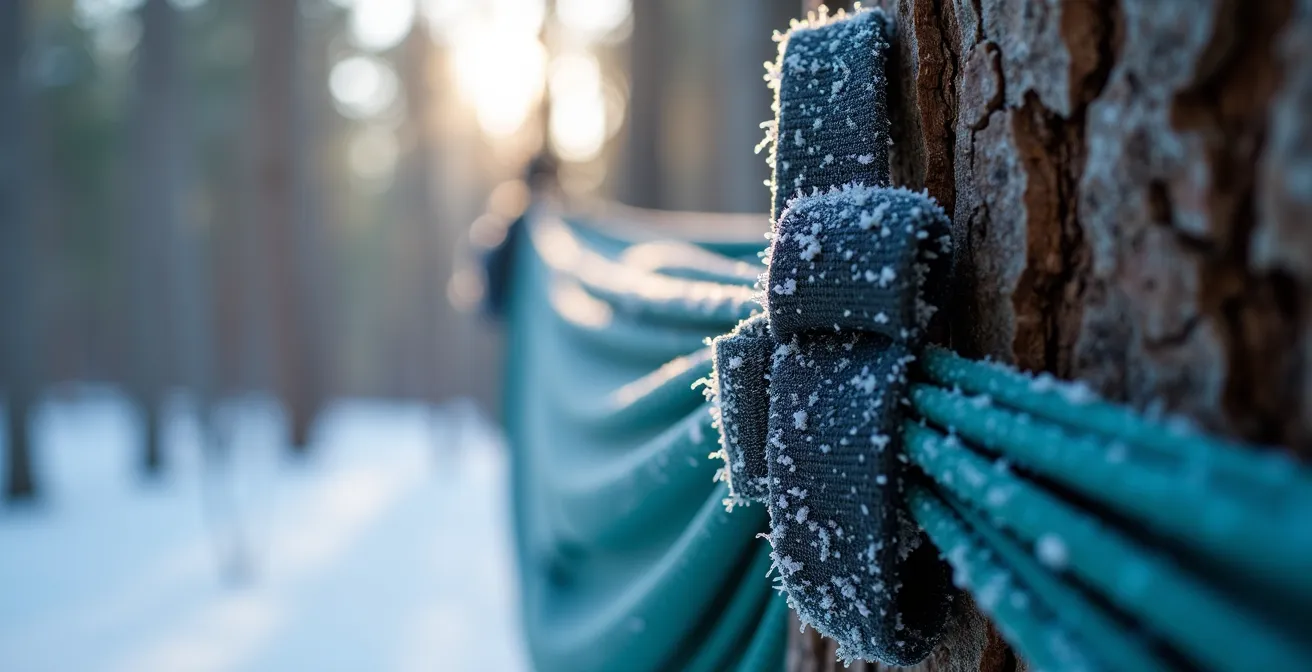
The choice ultimately depends on your mission. For a comfortable, static base camp where you can dry gear and wait out storms, the hot tent is superior. For fast-and-light travel through dense or hilly terrain, the hammock offers unmatched versatility. The following table breaks down the core trade-offs:
| Feature | Hot Tent | Hammock with Underquilt |
|---|---|---|
| Condensation Management | Excellent with stove heat | Moderate – requires ventilation |
| Setup on Uneven Ground | Challenging | Excellent |
| Gear Drying Capability | Superior with stove | Limited |
| Weight for Winter Setup | Heavy (15-20kg with stove) | Moderate (5-8kg) |
| Comfort in -20°C | Excellent with heat source | Good with proper insulation |
Resin Removal: How to Clean Sticky Sap Off Your Down Jacket Safely?
Traveling through a boreal forest means dealing with conifer resin, or sap. It will get on your hands, your gear, and inevitably, on your expensive down jacket. While it seems like a minor annoyance, sap can attract dirt, compromise the water-repellent (DWR) coating of your shell fabric, and be incredibly difficult to remove. The first rule of sap management is prevention. As experienced winter campers in the Canadian boreal forest know, a “sacrificial shell” strategy is highly effective. This involves wearing an inexpensive, lightweight windbreaker over your primary insulation layers when moving through dense spruce or pine stands. This cheap layer takes the brunt of the sap, protecting your valuable technical gear beneath.
When prevention fails, you need a field-expedient solution. Do not use harsh solvents, which can damage the delicate fabrics and coatings of technical apparel. The most effective and safest method utilizes a common item in any first-aid kit: alcohol-based hand sanitizer. The high alcohol content works to break down the sticky resin without harming the fabric.
Here is the protocol for safe removal:
- Freeze and Flake: If the sap is fresh, let the cold air freeze it solid. Often, you can then gently flake most of it off with a fingernail.
- Apply Sanitizer: For the remaining residue, apply a small amount of hand sanitizer (at least 60% alcohol) directly to the sap.
- Let it Dissolve: Allow it to sit for 30-60 seconds. You will see the sap begin to dissolve and liquefy.
- Blot, Don’t Rub: Use a clean cloth or pack towel to blot the area. Do not rub, as this can spread the sticky mess and grind it into the fabric. Repeat if necessary.
- Rinse if Possible: A final rinse with cold water will help remove any remaining residue from the sanitizer. This method is crucial for protecting the loft and performance of down insulation.
Pine Needle Tea: How to Identify Safe Species for Vitamin C?
In a long-term winter survival scenario, the forest itself can provide essential nutrients. Pine needle tea is a classic woodsman’s brew, famously rich in Vitamin C—a crucial nutrient for immune function and preventing scurvy. However, this is not a skill to be taken lightly. While many conifers are safe for consumption, some, most notably the Canada Yew (Taxus canadensis), are highly toxic. Correct identification is not just important; it’s a matter of life and death.
Safe species common in the Canadian boreal forest include White Pine, Jack Pine, and Balsam Fir. A key identifier for pine is that its needles grow in clusters of two to five from a single base. Fir needles are flat and attach singly to the branch. Spruce needles also attach singly, but they are four-sided and can be rolled between your fingers. The poisonous Canada Yew has flat, dark green needles that look somewhat similar to fir, but they lack the two white lines found on the underside of fir needles and have a distinct, fleshy red “berry” (an aril). If you have any doubt, do not consume it.

Once you have confidently identified a safe species, harvesting should be done ethically. Take only a small handful of needles from any single tree, preferably from a lower branch. To brew, simply chop the needles to help release their oils and steep them in hot (not boiling) water for 5-7 minutes. Boiling water can destroy Vitamin C and release more bitter tannins.
Action Plan: Safe Conifer Tea Identification
- Confirm Safe Species: Positively identify White Pine, Jack Pine, or Balsam Fir. Pine needles grow in clusters; fir needles are flat with two white lines underneath.
- Rule Out Lookalikes: Explicitly identify and avoid the Canada Yew (Taxus canadensis). Its needles are flat and dark green but lack the white lines of a fir. It is highly toxic.
- Consider Alternatives: Look for Labrador Tea, a common boreal shrub with leathery, oblong leaves that have fuzzy, rust-coloured undersides and rolled edges. It’s another excellent trailside tea option.
- Harvest Ethically: Take only a small amount of needles from several different trees to minimize your impact. Never strip a branch bare.
- Brew Correctly: Steep chopped needles in hot water (around 80°C) for 5-10 minutes. Avoid boiling to preserve the Vitamin C content.
How to Dress for “Freeze-Thaw” Cycles Without Overheating?
In winter camping, sweat is your enemy. The most common mistake beginners make is overdressing, sweating during periods of activity, and then having that moisture freeze the moment they stop, leading to rapid and dangerous heat loss. This is known as “flash-off hypothermia.” The key to dressing correctly is not just layering, but mastering the “active-static transition.” This means actively managing your layers to prevent sweating in the first place, especially during the freeze-thaw cycles of a sunny but cold winter day.
The experience of seasoned Canadian adventurers underscores this principle. Renowned outdoorsman Kevin Callan, during a -27°C trip in Algonquin Park, noted how moisture generated during the day can have severe consequences, with his boots and snowshoe bindings developing thick layers of ice overnight. This illustrates how trapped moisture becomes solid ice, rendering gear useless and creating a serious risk. Preventing this starts with a proactive layering strategy: be bold and start cold. You should feel slightly chilled at the beginning of any activity; your body will warm up within minutes.
Your clothing system should function like a thermostat. As you start to heat up, immediately vent your layers—unzip your jacket, take off your hat, or even remove a mid-layer. The most critical phase is the 5-10 minutes *before* you plan to stop. This is when you must begin shedding layers to cool down, preventing a final burst of sweat. The moment you stop for a break, immediately add back a heavy insulation layer, like a big down or synthetic puffy jacket, to trap the heat you’ve generated. This constant, proactive adjustment is the true art of winter layering.
Yurt vs. Cabin: Which Offers Better Insulation for a Fall Retreat?
While the title specifies a “fall retreat,” the principles of insulation and shelter performance are even more critical for a winter expedition. When you’re not in your own tent, many Canadian parks offer roofed accommodation like yurts and cabins. Understanding their thermal properties is key to choosing the right one for cold weather. The primary factors to consider are insulation (R-value), draftiness, and the structure’s ability to retain heat from a wood stove or heater.
Log cabins are the traditional gold standard for insulation. The high thermal mass of the logs means they absorb and radiate heat slowly, creating a stable and comfortable interior temperature with low firewood consumption. Their main weakness can be drafts from poorly sealed windows or doors, especially in older structures. Yurts, and their Canadian cousins like the Parks Canada oTENTik, are fabric structures. A modern yurt built for four-season use has a layer of reflective foil insulation sandwiched between the outer canvas and inner liner, giving it a respectable R-value and minimal drafts. However, they have low thermal mass, meaning they cool down very quickly once the heat source is off.
In Ontario, where several provincial parks offer year-round roofed accommodations, this choice is common. The oTENTik is a hybrid, often a wood frame with canvas walls, offering moderate insulation but potentially higher firewood consumption than a well-insulated yurt or a cabin. The following table compares these popular Canadian options.
| Factor | Parks Canada oTENTik | Provincial Park Yurt | Log Cabin |
|---|---|---|---|
| R-Value Insulation | Moderate (canvas walls) | Good (insulated fabric) | Excellent (log thermal mass) |
| Draft Issues | Minimal | Very minimal | Variable (age dependent) |
| Condensation Risk | Moderate | High | Low |
| Firewood Consumption | High | Moderate | Low |
| Sound Insulation | Poor | Poor | Excellent |
Key Takeaways
- True warmth comes from understanding the boreal environment, not just from your gear. Master fuel selection, moisture management, and site safety.
- Your first action at any campsite is a “widowmaker check.” Look up, listen, and inspect tree bases to ensure your site is safe from falling debris.
- Sweat is the enemy. Manage your layers proactively during “active-static transitions”—venting *before* you stop moving—to prevent flash freezing.
Exploring Yukon’s Wilderness: The Safety Gear You Must Pack
The principles of warmth and shelter are your foundation, but in the vast and truly wild landscapes of places like the Yukon, they must be supported by a non-negotiable layer of safety technology and wildlife awareness. The northern boreal mountains are not an empty wilderness; they host intact predator populations including gray wolf, wolverine, Canada lynx, and grizzly bear. While encounters are rare, being prepared is mandatory.
Your most critical piece of gear is a reliable satellite communication device. Cell service is non-existent. A Garmin inReach or ZOLEO with an active Canadian service plan is not a luxury; it is essential life insurance. It allows you to trigger an SOS in an emergency and communicate with contacts back home. Before you leave, you must file a detailed trip plan with a trusted contact, including your route, expected return time, and GPS waypoints.
Wildlife deterrents are the next priority. Bear spray is effective, but it has a critical weakness: it can freeze and become useless below -20°C. It must be kept in an insulated holster or warm on your person. For this reason, it’s wise to carry a non-freezing backup, such as an air horn, which can be a powerful deterrent for curious wildlife without escalating an encounter. Finally, if you are traveling by vehicle to your trailhead, a basic recovery kit including traction boards, a tow strap, and a shovel is crucial for self-rescue on remote, unplowed roads.
Now you have the instructor’s framework for thriving in the cold. The next step is to put this knowledge into practice. Begin by mastering these skills on shorter, less remote trips, building your confidence and testing your systems before committing to a deep wilderness expedition. Your warmth, comfort, and safety depend not on luck, but on your preparation.