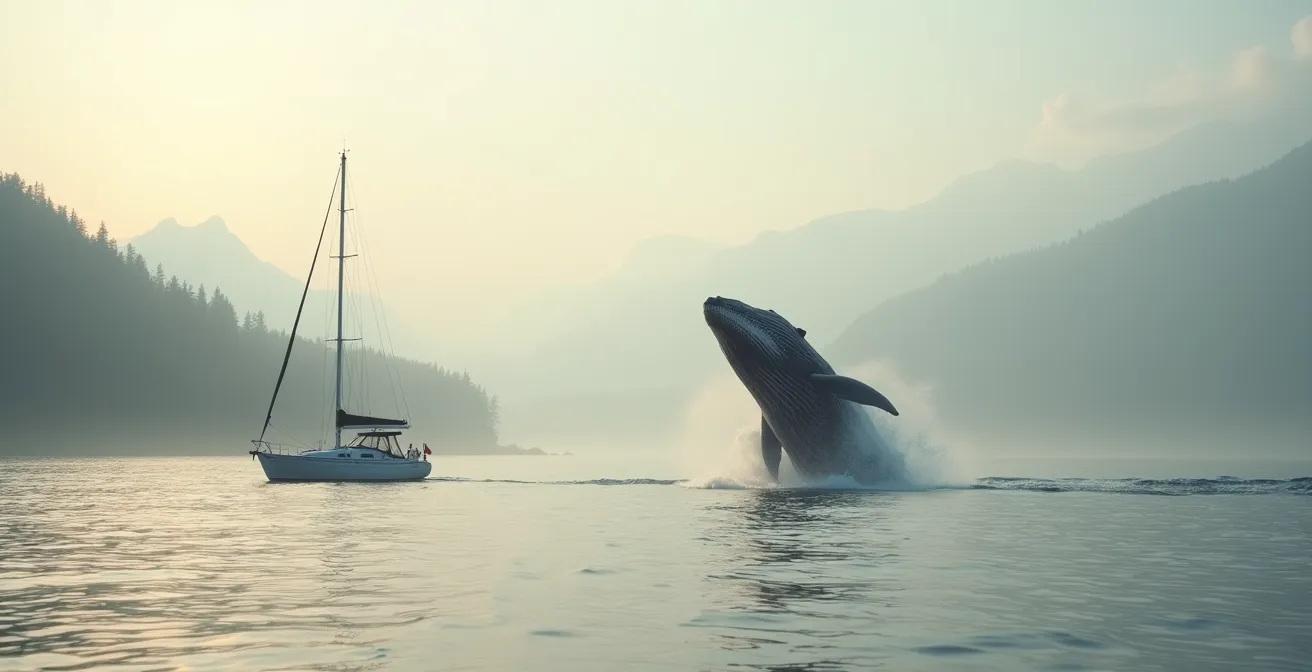
For recreational boaters in Canada, understanding whale watching laws goes far beyond a single distance rule. The key to a safe and legal encounter is managing your vessel’s overall impact—its speed, its course, and especially its underwater noise. This guide provides the official regulations and practical advice to ensure you can enjoy these magnificent animals without causing them harm or incurring significant fines.
As a recreational boater on the East Coast, there are few experiences as breathtaking as a whale surfacing near your vessel. It’s a moment of pure awe. But that thrill is often followed by a wave of uncertainty: Am I too close? Am I breaking the law? Many boaters believe staying 100 or 200 metres away is the only rule, but that’s a dangerous oversimplification. The reality of marine mammal protection in Canada is far more nuanced.
The core of responsible whale watching isn’t just about a number on your chartplotter; it’s about minimizing your vessel’s entire presence. Federal regulations under the Fisheries Act are designed to prevent disturbance, which includes not only proximity but also your speed, your movements, and your vessel’s underwater noise. Failing to manage this “footprint” can cause chronic stress to whales and lead to fines that can exceed $12,000 for recreational operators.
But what if the key to a successful encounter wasn’t just avoiding fines, but actively understanding how your actions affect these animals? This guide is written from my perspective as a marine patrol officer. It’s not just a list of rules. It’s a briefing to help you understand the *why* behind the laws. We will cover the critical impact of underwater noise, how to anticipate a whale’s behaviour, and what specific actions constitute illegal harassment under Transport Canada’s definition. My goal is to equip you with the knowledge to be a confident, respectful, and law-abiding observer of Canada’s incredible marine life.
This article breaks down the essential knowledge every boater needs. From understanding the science behind the rules to practical tips for different vessels and regions, the following sections will prepare you for your next encounter on the water.
Summary: A Boater’s Guide to Legal Whale Watching in Canada
- Why Does Underwater Noise Stress Whales More Than Boat Proximity?
- Breach Prediction: How to Spot the Surface Signs Before a Whale Jumps?
- Zodiac vs. Large Cruiser: Which Offers a More Stable Viewing Platform?
- The Strike Risk: What Speed Should You maintain in Whale Zones?
- Humpback Calendar: When Do Whales Arrive in Newfoundland?
- Pacific Buffet vs. Cafeteria: Is the All-You-Can-Eat Worth the Price?
- The Harassment Definition: What Actions Will Get You Fined by Transport Canada?
- Spotting Blue Whales in the St. Lawrence: Why Are They So Hard to Find?
Why Does Underwater Noise Stress Whales More Than Boat Proximity?
The first thing boaters worry about is distance, but from a whale’s perspective, your engine is often the biggest threat. Whales, dolphins, and porpoises live in a world of sound. They use it to navigate, find food, communicate across vast distances, and care for their young. Your vessel’s engine noise directly interferes with these essential life functions, creating an acoustic footprint that can be far more disruptive than your physical presence.
Sudden changes in engine RPM, high-pitched whines from outdrives, and the constant drone of a two-stroke engine can mask the subtle calls between a mother and calf or prevent a whale from hearing the sounds of its prey. This forces them to expend more energy to be heard and can cause chronic stress. In fact, research from the Bay of Fundy demonstrated that even a 6 dB reduction in underwater noise following 9/11 led to a measurable decrease in stress-related hormones in North Atlantic right whales. This is scientific proof that a quieter boat is a less stressful boat.
This is why regulations focus on more than just distance. Maintaining a slow, steady speed is not just about preventing collisions; it’s about creating a predictable and less disruptive sound profile. Putting your engine in neutral when a whale approaches, rather than shutting it off, is recommended because the restart of an engine creates a sudden, loud acoustic shock. A silent approach or a sudden start-up can be as startling to a whale as someone shouting in a quiet library. Managing your acoustic signature is a fundamental part of responsible and legal whale watching.
Breach Prediction: How to Spot the Surface Signs Before a Whale Jumps?
One of the most spectacular sights on the water is a whale breaching—launching its massive body into the air. While it can seem random, experienced mariners know there are often subtle clues that precede this behaviour. Learning to read these surface signs is key to predictive boating; it allows you to position your vessel safely and anticipate the animal’s movements, rather than just reacting to them.
A key indicator is a whale’s dive pattern. Humpback whales, for instance, often perform a series of shorter, shallow dives before a deep “sounding” dive to feed. This deep dive is often signaled by the whale arching its back steeply and raising its fluke (tail) high out of the water. When it descends, it leaves a distinct surface feature known as a “whale’s footprint.”
This footprint is a perfectly circular, glassy-calm patch of water created by the powerful fluke strokes that propelled the whale downward. It looks like a giant oil slick, but it’s just still water. This is your most reliable clue to where the whale went down and where it will likely resurface. For a humpback, a sounding dive can last 15-20 minutes. By noting the location of the footprint and keeping your distance, you can anticipate its return to the surface without having to move your boat suddenly.

Observing these signs—the fluke-up dive, the footprint, and the dive duration—transforms you from a passive spectator into an informed observer. It allows you to maintain the required legal distance while still being in the right place for a spectacular view, all while minimizing disturbance to the animal’s natural feeding patterns. This is the essence of respectful whale watching.
Zodiac vs. Large Cruiser: Which Offers a More Stable Viewing Platform?
The type of vessel you operate significantly impacts your ability to comply with regulations and ensure a safe experience for both you and the whales. A common question is whether a small, agile Zodiac has an advantage over a larger, heavier cruiser. While stability for viewing might seem like the main difference, the critical factors from a regulatory and safety standpoint are maneuverability and momentum.
A Zodiac or other rigid-hulled inflatable boat (RHIB) is highly maneuverable. It can change direction quickly and come to a stop with very little forward momentum. This agility is a major asset in a surprise encounter, for example, if a whale surfaces unexpectedly near your boat. You can react quickly, put the engine in neutral, and avoid a collision more easily. However, their low profile can make spotting whales from a distance more challenging, and in choppy seas, the ride is anything but stable.
A large cruiser, on the other hand, offers a much more stable viewing platform, often with a higher vantage point for better visibility. The trade-off is its limited maneuverability and significant momentum. A 40-foot cruiser has a wide turning radius and takes a much longer distance to come to a complete stop. This high physical footprint means you must be much more proactive in your navigation, anticipating a whale’s path well in advance to avoid getting too close. In the tight channels of the Saguenay-St. Lawrence Marine Park, this can be challenging, whereas in the open waters off Newfoundland, you have more room to operate.
The following table, based on guidance from conservation groups like the Strait of Georgia Marine Reference Guide, summarizes the key differences in vessel dynamics for whale watching.
| Vessel Type | Maneuverability | Strike Risk | Regulatory Compliance | Best Use Case |
|---|---|---|---|---|
| Zodiac | High agility, quick response | Low momentum, easier to stop | Easier to maintain 400m distance | Narrow channels (Tadoussac) |
| Large Cruiser | Limited, wide turning radius | High momentum, longer stopping distance | Challenging in surprise encounters | Open waters (Tofino, Newfoundland) |
Ultimately, the law does not differentiate. All vessels are required to maintain the same minimum approach distances. The responsibility falls on you, the operator, to understand your vessel’s limitations and handle it in a way that guarantees compliance and safety.
The Strike Risk: What Speed Should You maintain in Whale Zones?
The single greatest direct threat from a boat to a whale is a vessel strike. These collisions are often fatal for the whale and can cause catastrophic damage to your vessel. To mitigate this risk, speed is the most critical factor you control. The faster you go, the less time you have to react and the greater the force of impact. Federal law is unequivocal on this point: speed must be reduced in the presence of whales.
While general regulations require boaters to slow to less than 7 knots when within 400 metres of a whale, specific areas have even stricter, mandatory speed limits. For example, in parts of the Gulf of St. Lawrence, Transport Canada mandates a speed limit of 10 knots for much of the season to protect the endangered North Atlantic right whales. Similar “slow-down zones” are implemented in British Columbia for Southern Resident killer whales. These are not suggestions; they are legally enforceable speed limits, and violation can result in heavy penalties.
As a general rule for recreational boaters, you should always operate at a “no-wake” or displacement speed (typically under 7 knots) whenever you are within one kilometre of a known whale. This cautious speed serves two purposes: it drastically reduces the risk and severity of a collision, and it lowers your engine’s acoustic output, reducing stress on the animals as discussed earlier. Using tools like the Whale Alert app can provide real-time information on active whale areas and speed zones. Remember, the posted speed limit on land is a maximum; on the water, your speed should always be dictated by conditions, visibility, and the presence of wildlife. In a whale zone, slow is always the safest and most responsible speed.
Humpback Calendar: When Do Whales Arrive in Newfoundland?
Responsible whale watching begins before you even leave the dock. Knowing which species to expect and when they are most likely to be in your area is crucial for preparation and identification. Canada’s three coastlines host a diverse array of marine mammals, each with its own migratory schedule. For a boater in the Maritimes, the calendar is dominated by the arrival of humpbacks, fin whales, and minke whales.
Specifically for Newfoundland and Labrador, the whale watching season kicks off in late spring. Humpback whales, the most acrobatic and commonly sighted species, typically arrive in April and May. They travel north from their Caribbean breeding grounds to feed in the nutrient-rich waters of the North Atlantic. Their numbers peak from June through August, making this the prime time for sightings along the coast, particularly on the Avalon Peninsula’s “whale route.”
By late September and into October, the whales begin their long journey south again, and sightings become less frequent. While humpbacks are the main attraction, you may also encounter fin whales (the second-largest animal on earth), smaller minke whales, and occasionally, pods of orcas. Blue whales are rare but are most likely to be seen in the summer months. The following table provides a general overview of seasonal whale presence across Canada’s main whale-watching regions.
Understanding this calendar allows you to manage expectations and be more vigilant during peak season. During the summer months in Newfoundland, you should operate with the constant assumption that whales could be nearby, keeping your speed down and your eyes on the water.
| Species | Pacific (BC) | St. Lawrence (QC) | Atlantic (NL) |
|---|---|---|---|
| Humpback | May-October | May-October | April-October |
| Orca | Year-round (residents) May-Oct (transients) |
Occasional | Rare |
| Blue Whale | Rare | June-October | June-September |
| Beluga | Not present | Year-round | Seasonal |
| Right Whale | Not present | June-September | July-September |
Pacific Buffet vs. Cafeteria: Is the All-You-Can-Eat Worth the Price?
On the water, you’ll encounter two types of whale sightings, which can be thought of metaphorically. There’s the “all-you-can-eat buffet”—a large group of whales, perhaps a super-pod of dolphins or a group of humpbacks bubble-net feeding. Then there’s the “cafeteria”—a single whale or a mother-and-calf pair going about their business. From a patrol perspective, the temptation for boaters to crowd the “buffet” is a major source of disturbance and illegal activity.
When multiple whales are concentrated in one area, it’s often because they are engaged in a critical activity like cooperative feeding. The scene can be spectacular, but it also attracts numerous boats. This is where the risk of cumulative disturbance becomes incredibly high. Even if each boat individually maintains the minimum distance, the sheer number of vessels can create an overwhelming wall of sound and presence that disrupts the whales’ feeding efficiency, separates individuals, or causes them to abandon the area entirely. Chasing after the “buffet” is often a high-impact, low-quality encounter.
The more responsible, and often more rewarding, experience is the “cafeteria” sighting. Observing a single animal or a small, quiet group allows for a more intimate and less stressful encounter. By giving a lone whale ample space, you are more likely to observe its natural behaviours without influencing them. You become a true spectator, not part of the spectacle. This approach prioritizes the animal’s welfare over the boater’s desire for a dramatic photo. It reflects a deeper understanding of the principle behind the law: the goal is to observe, not to interact or interfere.
The price of chasing the “all-you-can-eat” experience is paid by the whales in the form of stress and disruption. The reward of patiently observing the “cafeteria” is a genuine, respectful connection with wildlife. As an operator, choosing the latter is always the right call.
The Harassment Definition: What Actions Will Get You Fined by Transport Canada?
The legal term for disturbing a marine mammal is “harassment,” and its definition under the Canadian Fisheries Act is broad and critical for every boater to understand. Harassment is not just about getting too close. It includes any action that is likely to disturb a marine mammal, including: feeding it, swimming with it, interacting with it, moving it, or enticing it to move. It also explicitly covers tagging it, marking it, or approaching it to do so. Essentially, any action that alters a whale’s natural behaviour can be considered harassment.
Actions that are frequently flagged by patrol officers include repeatedly repositioning your boat to intercept a whale’s path, separating a mother from her calf, or “leapfrogging” (speeding past a whale to get in front of it again). These are aggressive maneuvers that cause significant stress and are clear violations of the law. The consequences are serious. As Fisheries and Oceans Canada has made clear, enforcement is active and penalties are substantial. This was demonstrated when, as noted in a DFO report, a boater faced a significant penalty for their actions.
In 2022, a recreational boater in British Columbia was fined over $12,000 for getting too close to killer whales, demonstrating the seriousness of these regulations.
– Fisheries and Oceans Canada, DFO Enforcement Report 2022
One of the most challenging situations is when a whale approaches *you*. If a curious whale surfaces inside the minimum approach distance, you are not immediately in violation. However, your subsequent actions are critical. You cannot simply motor away, as this could lead to a collision. The law requires a specific protocol to be followed to de-escalate the situation safely.
Action Plan: Protocol When a Whale Approaches Your Boat
- Immediately put engine in neutral or idle to minimize noise and propeller risk.
- Do not attempt to move away rapidly or change course suddenly.
- Allow the animal to pass and determine its own course without interference.
- If you must move to avoid contact, slowly and cautiously back your vessel away from the whale’s path.
- Wait until the whale is well beyond the 400-meter zone before cautiously resuming normal operation.
- Report any accidental contact or incident to the DFO Observe, Record, Report line at 1-800-465-4336.
Key Takeaways
- The legal minimum approach distance (e.g., 200m for most whales in the Maritimes) is a baseline, not a target.
- Managing your vessel’s speed and underwater noise is as important as maintaining distance.
- Specific actions like boxing in, separating a calf, or leapfrogging constitute illegal harassment.
- Your vessel type (Zodiac vs. Cruiser) dictates how you must handle it to comply with regulations safely.
- If a whale approaches you, follow the specific protocol: put the engine in neutral and let the animal pass.
Spotting Blue Whales in the St. Lawrence: Why Are They So Hard to Find?
Of all the cetaceans in Canadian waters, the blue whale is the most elusive and revered. It is the largest animal to have ever lived, yet spotting one is an exceptionally rare event, even in known habitats like the St. Lawrence Estuary. This difficulty stems from a combination of their critically low population numbers, their unique physiology, and their deep-water feeding behaviour.
First and foremost, blue whales are an endangered species. Following decades of commercial whaling, their population remains a tiny fraction of its historic size. In the entire North Atlantic, research indicates that only fewer than 250 blue whales visit the St. Lawrence annually, making any encounter a matter of pure chance. Unlike humpbacks or minke whales that are relatively numerous, the scarcity of blue whales is the primary reason they are so hard to find.
Their behaviour further complicates sightings. Blue whales in the St. Lawrence are typically found feeding on deep concentrations of krill in the Laurentian Channel, a vast underwater valley. This means they spend the majority of their time on long, deep sounding dives, often lasting up to 20 minutes at depths of 100-200 meters. They spend very little time at the surface, and when they do, their profile is deceptively low in the water.
Case Study: Blue Whale Identification in St. Lawrence Waters
Unlike the high, bushy blow of a humpback, a blue whale’s blow is a tall, slender column that can reach 12 meters in height but dissipates quickly. The most telling feature is its dorsal fin. It is disproportionately tiny for its body size and located very far down its back. An observer will see the massive, mottled blue-grey back roll at the surface for what seems like an eternity before this small, falcate fin appears just moments before the whale begins another deep dive. This sequence is often the only confirmation of an identification.
The combination of a small population, deep-water habits, and subtle surface signs makes every blue whale sighting a truly special event. It requires immense patience, a keen eye, and a healthy dose of luck.
Your final check before casting off should be reviewing these regulations. Make them part of your pre-departure checklist. Being a responsible boater means being an ambassador for our marine wildlife, and that duty begins with knowledge. Operate safely, keep your distance, and report any incidents or violations. Your actions on the water make a difference.
Frequently Asked Questions About Whale Watching Regulations in Canada
Can Zodiacs get closer to whales than larger boats?
No, all recreational vessels must maintain the same minimum approach distances, such as the 400-meter distance from killer whales in southern BC waters, regardless of vessel type or size.
What flag allows closer approach to non-Southern Resident killer whales?
Vessels flying a purple ‘Authorized Vessel’ (AV) flag, typically research or professional eco-tour vessels that have met specific requirements, may be authorized to approach non-Southern Resident killer whales to 200 meters.
Which vessel type is safer if a whale surfaces unexpectedly?
Zodiacs and other small, agile boats can often react more quickly to an unexpected surfacing due to their high maneuverability and low momentum. Large cruisers require significantly more time and distance to alter course safely and must be operated with greater anticipation of whale movements.