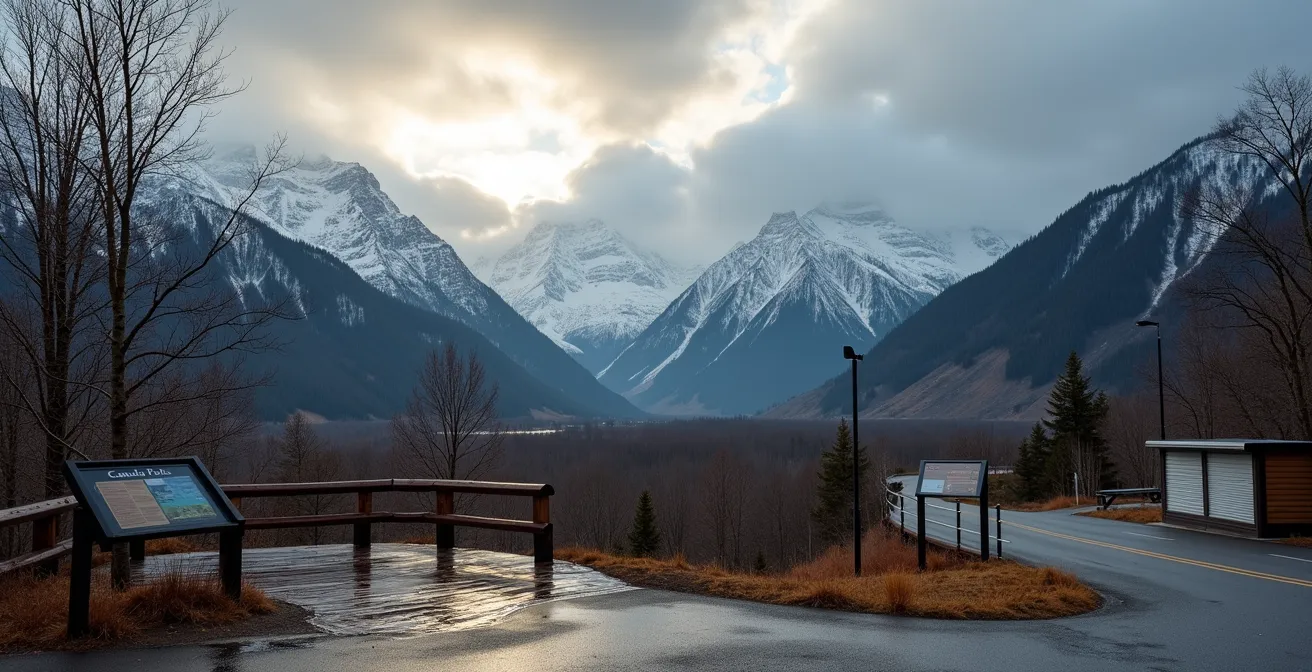
November travel in Canada isn’t cheap by accident; it’s a calculated opportunity for savvy travelers to leverage the “in-between” economy for maximum value.
- The price drop is driven by a predictable lull between the peak fall foliage and ski seasons, leading to widespread operational shutdowns and reduced demand.
- Success requires a strategic shift from fighting the conditions (cold, rain, short days) to embracing them as unique “atmospheric capital.”
Recommendation: Instead of a packed summer itinerary, adopt a “One Big Thing Per Day” philosophy, maximizing precious daylight for a key activity and planning cozy, indoor experiences for the evenings.
For the budget-conscious traveler, the allure of cheap November flights to Canada is undeniable. But the question that immediately follows the booking confirmation is often filled with apprehension: did I just make a mistake? Mainstream travel wisdom paints a bleak picture of the 11th month—a cold, dark, and damp period caught between the vibrant spectacle of autumn and the pristine white of ski season. It’s often seen as a time of closures, unpredictable weather, and limited options.
This perspective, while not entirely wrong, is fundamentally incomplete. It overlooks the core economic principle at play. As a travel economist, I argue that November’s affordability isn’t a flaw; it’s a feature. This is Canada’s “in-between” season, a predictable market lull that savvy travelers can exploit. The key isn’t to simply endure the off-season but to understand its underlying dynamics—the freeze-thaw cycles, the coastal rain systems, the science behind the fading leaves—and transform them into a strategic advantage.
This guide abandons the generic advice to “pack layers” and “visit museums.” Instead, we will dissect the economic and environmental logic of November travel. We’ll analyze why the industry slows down, how to master dressing for radical temperature swings, and what is realistically accessible from coast to coast. By the end, you will view November not as a compromise, but as a calculated investment in a quieter, more authentic, and uniquely atmospheric Canadian experience that summer tourists will never know.
This article provides a strategic framework for your off-peak Canadian adventure. Below is a summary of the key economic and practical considerations we will explore to help you maximize the value of your November trip.
Summary: A Strategic Guide to Canada in November
- Why Does the Tourism Industry Shut Down Between October and December?
- How to Dress for “Freeze-Thaw” Cycles Without Overheating?
- Late Autumn Hiking vs. Early Skiing: What is Actually Open in November?
- The Vitamin D Dip: How Short Days Affect Your Travel Energy in Winter?
- Planning a Winter Itinerary: How to Maximize the 8 Hours of Light?
- Why Does It Rain 3,000mm a Year on Vancouver Island’s West Coast?
- How Does Temperature Drop Trigger the Anthocyanin Production in Maples?
- Whistler vs. Big White: Which Ski Resort Offers Better Value for Families?
Why Does the Tourism Industry Shut Down Between October and December?
The dramatic price drop for November travel is a direct market response to a predictable slump in demand. This isn’t a random sale; it’s the core of the “in-between economy.” After the last leaf-peepers depart in October and before the ski crowds arrive in mid-to-late December, Canada’s tourism sector enters a deep operational hibernation. This slowdown is quantifiable; historical data from Statistics Canada often shows a significant dip in international arrivals during this period. One report, for instance, noted a 13.5% year-over-year decline in international arrivals for November, marking a consistent trend.
This decline triggers a cascade of economic decisions across the industry. Tour operators, particularly those focused on summer activities like whale watching or mountain hiking, find it unprofitable to maintain full operations. Many suspend services entirely. Similarly, hotels and lodges in resort towns like Banff or Mont-Tremblant either close for annual maintenance or operate with a skeleton crew and reduced capacity. Restaurants adjust their hours, and some seasonal businesses shut their doors completely until the first major snowfall signals the start of the lucrative winter season.
For the traveler, this translates to fewer crowds and lower prices for flights and accommodations—a clear case of shoulder season arbitrage. However, it requires a proactive planning mindset. You cannot assume summer-level services will be available. The smart November traveler checks operating hours meticulously, books accommodations well in advance to secure a spot in a partially open hotel, and confirms that their chosen activities are actually running. This period rewards planners, not spontaneous wanderers.
How to Dress for “Freeze-Thaw” Cycles Without Overheating?
Dressing for Canada in November is a science, not an art. The primary challenge is not the cold itself, but the “freeze-thaw” cycle, a phenomenon where temperatures fluctuate dramatically around the freezing point (0°C or 32°F) within a single day. A crisp, frosty morning can easily melt into a mild, sunny afternoon before plunging back into a windy, sub-zero evening. Generic advice to “wear layers” is insufficient because it fails to address the critical issue of moisture management during these swings. Overheating and sweating during the “thaw” part of the cycle is the fastest way to become dangerously cold when temperatures drop again.
The solution lies in a three-part technical layering system designed for performance, not just insulation. Each layer has a distinct function: a moisture-wicking base layer (merino wool or synthetic fabric) to pull sweat away from your skin, an insulating mid-layer (like fleece or down) to trap air and retain warmth, and a waterproof/windproof outer shell to protect you from the elements. The synergy between these layers is what allows you to adapt.

As the “A Day in Quebec City” case study illustrates, active adaptation is key. Starting a morning at -5°C might require all three layers. However, when walking uphill to the Citadelle in the afternoon sun, you might remove the mid-layer and open the shell’s ventilation zippers (pit zips) to dump heat and prevent sweat buildup. As evening falls and a cold wind picks up, you add all the layers back on, plus accessories like a neck warmer and insulated gloves. The efficiency of this system depends on choosing materials that dry quickly and garments designed with active ventilation in mind. This dynamic approach to layering is the secret to staying comfortable and safe through November’s unpredictable freeze-thaw dynamics.
Late Autumn Hiking vs. Early Skiing: What is Actually Open in November?
Navigating Canada’s recreational landscape in November requires managing expectations and verifying information relentlessly. The “in-between” season means that many activities are in a state of transition. High-elevation hiking trails may be closed due to snow and ice, while ski resorts are often still in the process of snowmaking, with limited terrain open, if any. Your travel plan must be built on the current reality, not on brochure promises of “early season” conditions.
The accessibility of activities varies dramatically by region. On the BC Coast, low-elevation rainforest trails remain open and are arguably more beautiful in the November mist, while ski resorts like Whistler are not yet operational. In the Rocky Mountains, only valley-bottom trails are generally accessible, and they are often treacherous with ice, making microspikes or ice cleats an absolute necessity. Ski resorts like Lake Louise may open mid-month, but typically with only a handful of runs. In Eastern Canada, provincial parks are technically open but with limited services, making urban exploration a more reliable choice until ski hills like Mont-Tremblant begin to open in late November.
This table provides a general overview, but conditions can change daily. The key is to check official sources, like the Parks Canada website for trail reports and individual ski resort websites for snow reports and open runs, right up until the day of your activity.
| Region | Hiking Status | Skiing Status | Best Activities |
|---|---|---|---|
| BC Coast | Low-elevation trails open | Not yet open | Rainforest walks, storm watching |
| Rocky Mountains | Valley trails only (icy conditions) | Limited runs mid-to-late November | Ice walks with microspikes |
| Eastern Canada | Provincial parks open, limited services | Opening late November | Urban exploration, museums |
| Prairies | Open but cold/windy | Not applicable | Wildlife viewing, northern lights |
Given this variability, building a resilient itinerary is paramount. Having a mix of indoor and outdoor plans allows you to pivot based on the weather. Don’t pin your entire trip on one weather-dependent activity. Instead, identify primary and secondary options, and always have a museum, gallery, or unique local experience as a backup.
Your Essential November Activity Planning Checklist
- Real-Time Conditions: Check the official Parks Canada website for real-time trail condition updates before heading out.
- Gear Check: Pack microspikes or ice cleats for any mountain hiking; trails can be dangerously icy even if they appear clear.
- Snow Reports: Monitor ski resort snow reports for actual open runs versus their advertised opening dates.
- Alternative Activities: Research alternatives like fat biking, storm watching on the coast, or northern lights tours further north.
- Indoor Backups: Pre-book indoor backup activities (museums, culinary tours, sports events) for days when the weather makes outdoor plans impossible.
The Vitamin D Dip: How Short Days Affect Your Travel Energy in Winter?
Beyond the logistical challenges of weather and closures, the most significant factor affecting a November trip to Canada is the lack of daylight. With the sun rising as late as 7:30 AM and setting as early as 4:30 PM in many parts of the country, you are working with roughly eight hours of usable light. This “Vitamin D dip” has a real physiological and psychological effect on travel energy. It can lead to lethargy and a feeling that the day is over before it has truly begun, a symptom often associated with Seasonal Affective Disorder (SAD).
The strategic traveler, however, doesn’t fight the darkness; they embrace it. This means reframing the day. The precious daylight hours are a resource to be maximized for outdoor activities and sightseeing that require light. The long, dark evenings are not dead time but an opportunity to invest in a different kind of travel experience—what I call “Atmospheric Capital.” This is the value derived from cozy, warm, and uniquely Canadian indoor experiences.

Instead of retreating to a hotel room at 5 PM, the evening becomes a core part of the itinerary. It’s the time for exploring the vibrant restaurant scene of Montreal, catching a hockey game in Toronto, or settling into a cozy pub in a Rockies town with a fireplace and a local craft beer. It’s about cultivating “hygge,” the Scandinavian concept of cozy contentment, in a Canadian context. This means seeking out cafes with warm lighting, finding comfort in a bowl of poutine or a butter tart, and enjoying the contrast between the cold, dark world outside and the warm, inviting one within. By planning for the darkness, you turn a potential negative into a memorable and restorative part of your trip.
Planning a Winter Itinerary: How to Maximize the 8 Hours of Light?
Effective itinerary planning in November hinges on a single principle: Daylight Optimization. With only about eight hours of light, attempting to replicate a packed summer schedule is a recipe for exhaustion and disappointment. The successful approach is to adopt a “One Big Thing Per Day” philosophy. This strategy focuses your energy and daylight hours on a single, high-priority outdoor activity, treating everything else as a bonus.
This means structuring your day with intention. The morning, when energy levels are typically highest and the light is fresh, should be dedicated to your anchor activity—be it a hike in a national park, exploring a historic district on foot, or a photography mission. The “Chasing Light” sample itinerary demonstrates this well: an outdoor activity is prioritized from sunrise until early afternoon. As the light begins to fade around 3:00 PM, the focus shifts to indoor cultural activities like museums or galleries. This structure ensures you get the most out of the daylight without feeling rushed.
Embracing the evening is the final piece of the puzzle. The early sunset opens up a long evening for activities that are unique to Canada and don’t depend on light. In late November, this could be visiting one of the first Christmas markets. Any time during the month, it could mean attending a live theatre performance, enjoying a multi-course dinner, or, for the quintessential Canadian experience, attending a professional hockey game. As one travel guide astutely notes, this approach can make for a uniquely rewarding trip.
November is an ‘underrated’ time to visit Canada. You can save money on hotels, tours, flights, and other amenities while visiting attractions without crowds.
– Canada Crossroads Travel Guide, Canada in November: An underrated time to visit
By treating daylight as a precious resource and the long evening as an opportunity, you transform the limitations of November into a template for a more focused and balanced travel experience.
Why Does It Rain 3,000mm a Year on Vancouver Island’s West Coast?
The west coast of Vancouver Island, home to destinations like Tofino and Ucluelet, has a reputation for being wet, and November is the heart of its rainy season. This isn’t just a bit of drizzle; the region is a temperate rainforest, and the rainfall is extreme. The reason lies in a classic meteorological phenomenon known as orographic lift. Moist, mild air from the Pacific Ocean is forced to rise as it encounters the Vancouver Island Ranges. As the air rises, it cools, condenses, and releases its moisture as heavy rain on the western slopes. This process is so efficient that it results in up to 3,000mm of annual rainfall on the west coast, while the eastern side of the island sits in a much drier “rain shadow.”
For the unprepared traveler, this constant precipitation can be miserable. For the strategic economist-traveler, however, this is a prime example of “Atmospheric Capital.” November is the peak of storm watching season, an activity that tourists pay a premium for. The dramatic weather—crashing waves, howling winds, and horizontal rain—is the main attraction. Instead of fighting the rain, the goal is to experience it properly.
This requires more than a simple umbrella. Essential gear includes high-quality, fully waterproof rain pants and boots, not just a jacket. With the right equipment, you can fully engage with the environment. Walk through the mist-shrouded giant trees of Cathedral Grove, which are far more magical in the rain than in the sun. Book a cozy cabin with a fireplace and a large window overlooking the ocean to watch the storms roll in. You can even lean into the wetness by visiting Hot Springs Cove, where you’ll be soaking in natural geothermal pools anyway. The key is a mental shift: the rain isn’t ruining the scenery; it *is* the scenery.
Key Takeaways
- November’s affordability is a direct result of an economic lull, offering savvy travelers a chance to experience Canada without peak-season prices or crowds.
- Success depends on a strategic mindset: managing expectations about closures and embracing the unique “atmospheric capital” of off-season weather.
- Mastering a technical layering system for “freeze-thaw” cycles and planning itineraries around limited daylight are non-negotiable skills for a comfortable trip.
How Does Temperature Drop Trigger the Anthocyanin Production in Maples?
Many travelers hoping to catch the tail end of Canada’s famous fall colours are disappointed in November. The reason the vibrant reds and oranges are gone is a precise and predictable biochemical process. The brilliant colours of autumn are not something the tree creates in the fall; rather, it is a process of revealing what is already there and, in some cases, producing a final, protective pigment before the leaves drop.
As autumn progresses, the shorter days and cooler temperatures signal the maple tree to stop producing chlorophyll, the green pigment responsible for photosynthesis. As the dominant green fades, it unmasks the yellow and orange pigments (carotenoids) that were present in the leaf all summer long. This explains the brilliant yellows of trees like aspens and birches.
The iconic fiery red of the sugar maple, however, is a different story. It comes from pigments called anthocyanins. These are not present during the summer. They are actively produced in the fall under a specific set of conditions: cool, crisp nights combined with bright, sunny days. This weather combination traps sugars within the leaf, and the tree converts these sugars into red anthocyanin pigments. Scientists believe this acts as a form of natural sunscreen, protecting the leaf as it sends its remaining nutrients back into the tree for winter storage. By November, this process is complete. The cold has fully set in, the leaves have served their purpose, and they have almost all fallen. This scientific reality is the very reason for the “in-between” economy; November is the quiet period after the foliage spectacle and before the reliable snows of winter.
Whistler vs. Big White: Which Ski Resort Offers Better Value for Families?
For families considering an early-season ski trip in late November, the choice of resort is a critical economic decision. While Whistler Blackcomb is arguably North America’s most famous ski resort, Big White in British Columbia’s interior often presents a superior value proposition, particularly for families. An analysis of cost, accessibility, and overall atmosphere reveals two very different investment opportunities.
Whistler’s primary advantages are its reliable early-season opening, thanks to extensive snowmaking capabilities, and its world-class pedestrian village filled with shops, restaurants, and non-skiing activities. However, this comes at a premium. As the comparative data shows, everything from lift tickets to accommodation is significantly more expensive. Big White, by contrast, offers a more focused, on-mountain experience at a fraction of the cost. Its ski-in/ski-out condo accommodations provide exceptional value and convenience for families who want to maximize their time on the slopes.
| Factor | Whistler | Big White |
|---|---|---|
| November Opening | More reliable with snowmaking | Opens shortly after, weather dependent |
| Lift Tickets (7-day) | $1,547-$1,827 CAD | $805-$1,120 CAD |
| Accommodation | More expensive, shuttle from Vancouver | Better value ski-in/ski-out condos |
| Family Activities | Pedestrian village, shops, museums | On-mountain focus, tubing, ice skating |
| Overall Vibe | International, high-energy | Laid-back, family-focused |
While Whistler’s opening date may be more certain, Big White’s location in the Okanagan Valley often gives it better and more reliable snow conditions once the season starts. This focus on family-centric value has earned it significant recognition; in one survey, it was voted Best International Ski Resort for Families by a large margin. For a family, the choice becomes a question of priority. If the goal is a high-energy vacation with a mix of skiing and international-style resort life, Whistler is the choice. If the goal is to get the most quality skiing and on-mountain family time for your dollar, Big White represents a much smarter investment.
By understanding the economic and natural forces that define Canada in November, you can move beyond the simple pursuit of a cheap flight and execute a truly strategic, high-value travel plan. Your next step is to start researching the specific region you wish to visit, applying these principles to find the operators and accommodations that offer the best off-peak value.