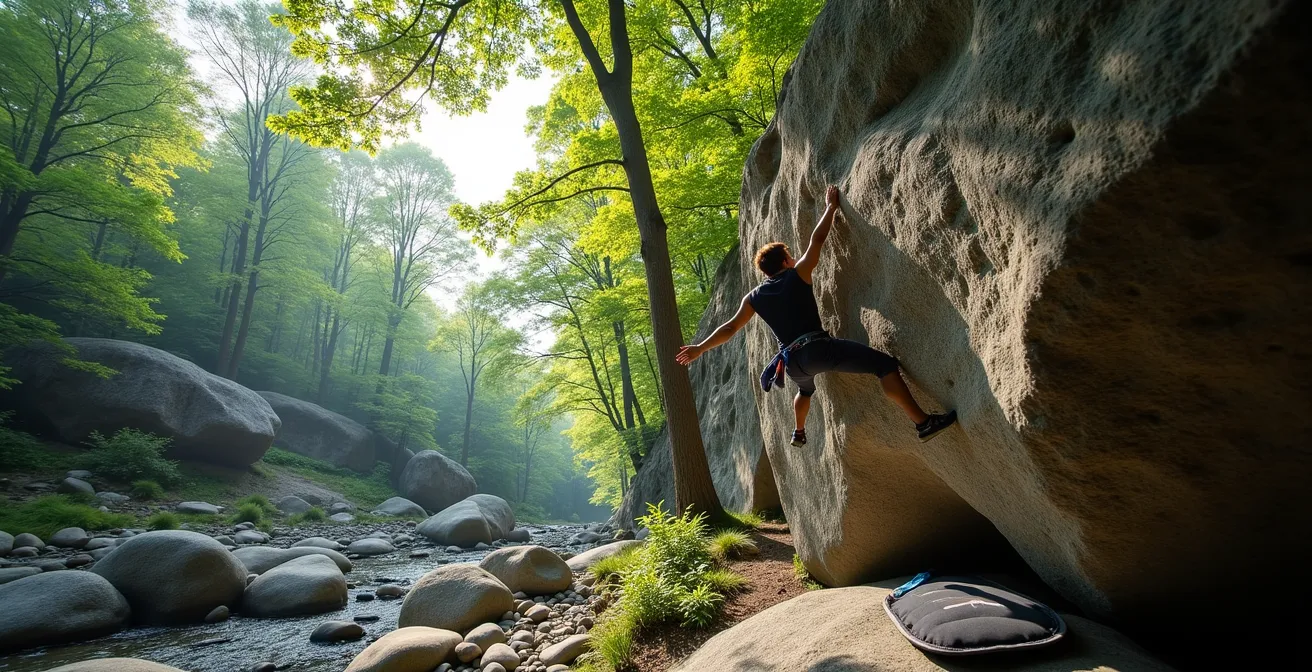
In summary:
- Yes, a bouldering permit is mandatory for every climber at Niagara Glen to support conservation.
- Safety is paramount; the area has known rockfall hazards, and adherence to rules is not optional.
- The local dolostone rock is soft and easily damaged; specific “Leave No Trace” ethics, like cleaning chalk, are enforced.
- Rope climbing of any kind is strictly prohibited; it is a bouldering-only area.
- Your actions directly impact the future of climbing access in this unique and fragile environment.
The first time you descend the metal staircase into Niagara Glen, the scale of the place is breathtaking. Massive, ancient boulders, remnants of the waterfall that once carved this gorge, are scattered through a lush Carolinian forest. For a climber, it’s a natural paradise. The immediate question for any visiting boulderer is logistical: “Do I need a permit?” The simple answer is yes. But this question is the gateway to a much deeper conversation. Most online forums or guides will give you the basic rules, tell you to be careful, and send you on your way.
This approach misses the entire point of what makes the Glen special and what threatens its future. The rules here aren’t arbitrary red tape. They are a direct response to the area’s unique geological fragility and its immense popularity. Understanding *why* the rock is so polished, *why* helmets are a smart idea even for belayers, and *why* your chalk brush is your most important tool is the difference between being a tourist and being a steward. This isn’t just about avoiding a fine; it’s about becoming part of the community that protects this world-class Canadian bouldering destination for generations to come.
This guide moves beyond a simple list of regulations. We will explore the geological soul of the Niagara Escarpment, connect it to the specific climbing ethics required here, and provide the practical knowledge you need to climb safely and responsibly. By understanding the context behind the rules, you not only ensure your own safety but also play an active role in preserving access for everyone.
Summary: A Climber’s Guide to Niagara Glen Bouldering Regulations
- Why Is Limestone Often Polished and Slippery on Popular Routes?
- How to Brush Chalk Off Holds to Respect the “Leave No Trace” Ethic?
- The Rockfall Hazard: Why Is Helmets Mandatory Even for Belayers?
- Soft vs. Stiff Climbing Shoes: Which Is Better for Limestone Edges?
- Rest Day Activities: Where to Stretch and Recover in the Niagara Region?
- Why Does Limestone Rock Quality Matter for Your Safety on a Scramble?
- Silurian vs. Ordovician: Which Rock Layers Are Visible at the Whirlpool?
- The Scramble Rating System: Is the Crypt Lake Trail Too Dangerous for Beginners?
Why Is Limestone Often Polished and Slippery on Popular Routes?
If you’ve ever hopped on a classic problem at the Glen and felt your foot skate off a hold that looks positive, you’ve encountered the area’s infamous polish. This isn’t standard wear-and-tear; it’s a direct consequence of the rock type and the area’s popularity. The boulders here are not actually limestone but a harder cousin called dolostone, part of the Silurian-era caprock of the Niagara Escarpment. While tougher than the underlying shale, dolostone is significantly softer than granite or quartzite found in other climbing areas. Every foot smear, every hand slap, and every gritty climbing shoe grinds away microscopic particles of the rock surface.
Over decades of intense traffic from climbers across Canada and the US, the most popular hand and foot holds have been burnished to a glass-like finish. As noted by climbers familiar with the area’s history, some problems have become ‘polished to the point of being glassy‘ due to the combination of high traffic and the soft nature of the rock. This irreversible damage not only increases the difficulty and danger of a climb but also permanently alters the natural state of these ancient geological formations. Understanding this process is the first step toward responsible climbing. It reframes the permit not just as an access fee but as a contribution to the conservation efforts needed to manage this high-impact activity in a fragile environment.
How to Brush Chalk Off Holds to Respect the “Leave No Trace” Ethic?
The polish on the rock is a permanent problem, but the visual impact of chalk is one we can—and must—actively manage. Chalk is essential for grip, but leaving thick white patches caked on holds is a major violation of the Leave No Trace (LNT) ethic that governs access to the Glen. It detracts from the natural beauty of the area for other users (hikers, birdwatchers, etc.) and, in some cases, can even accelerate rock weathering by trapping moisture. The Niagara Parks Commission (NPC) is clear: cleaning your chalk marks is a mandatory part of your climbing session.
Effective cleaning goes beyond a quick, lazy flick. It requires a proper boar’s hair brush and diligent effort. After you’re done with a problem, take the time to thoroughly brush all the holds you used, removing as much residue as possible. Pay special attention to tick marks; erase them completely. The goal is to leave the boulder looking as if you were never there. This small act of stewardship is a sign of respect for the environment and for the next climber. The official bouldering rules explicitly state that climbers must:

The LNT principles are not mere suggestions; they are conditions for our continued access. According to the NPC’s official guidelines, climbers are expected to stay on marked trails, avoid disturbing any vegetation, and pack out everything they bring in. Reporting violations is also part of this shared responsibility. If you see someone neglecting these principles, a friendly and educational conversation can make a world of difference in preserving the Glen’s climbing culture.
The Rockfall Hazard: Why Is Helmets Mandatory Even for Belayers?
While bouldering is the only climbing permitted, the principles of overhead safety remain critical at Niagara Glen. The very same geological forces that created these magnificent boulders are still at work today. The Glen was formed by the erosion of soft shale and limestone layers from beneath the hard dolostone caprock. This process of undercutting caused massive blocks of dolostone to break off the main escarpment and tumble into the gorge. This process has not stopped. The constant freeze-thaw cycles of Southern Ontario winters continue to pry rocks loose from the escarpment cliffs above and from the boulders themselves.
This creates an ongoing and unpredictable rockfall hazard. A small stone dislodged from the top of the escarpment can gain dangerous velocity by the time it reaches the bouldering areas. Even on the boulders themselves, holds can break. For this reason, many local climbers and the NPC advocate for helmet use, not just for the climber, but for spotters and anyone spending time in the fall zone. While you are bouldering, you are still at the base of a massive, dynamic cliff system. The official rules emphasize personal accountability, with the Niagara Parks Commission stating that climbers must “exercise all appropriate safety measures” and adhere to the principle of ‘your safety is your responsibility‘.
Boulders must exercise all appropriate safety measures during bouldering must adhere to the principle of ‘your safety is your responsibility’
– Niagara Parks Commission, Official NPC Bouldering Rules
Wearing a helmet is one of the most straightforward “appropriate safety measures” you can take. It’s a small inconvenience that mitigates a potentially fatal risk. Thinking about your spotter’s safety is just as important as thinking about your own fall. In an environment this complex, a comprehensive approach to safety is the only responsible one.
Soft vs. Stiff Climbing Shoes: Which Is Better for Limestone Edges?
Your choice of footwear can dramatically impact both your performance and your effect on the rock at Niagara Glen. The dolostone here is characterized by small, sharp edges, pockets, and crimps rather than the friction-dependent slopers common on granite. This requires a shoe that allows for precise footwork and power transfer onto tiny footholds. This is where the debate between soft and stiff climbing shoes comes into play.
Stiff-soled shoes are generally superior for the predominant style of climbing at the Glen. A rigid platform provides the support needed to stand on minuscule edges without your foot tiring or the shoe deforming. It allows you to concentrate all your force onto a very small point, giving you the confidence to trust your feet on delicate sequences. While soft shoes are excellent for smearing and “feeling” the rock, they can be painful and ineffective on the sharp, positive edges found on many of the Glen’s classic problems. A stiffer shoe acts as a better lever, translating power from your leg directly to your big toe.
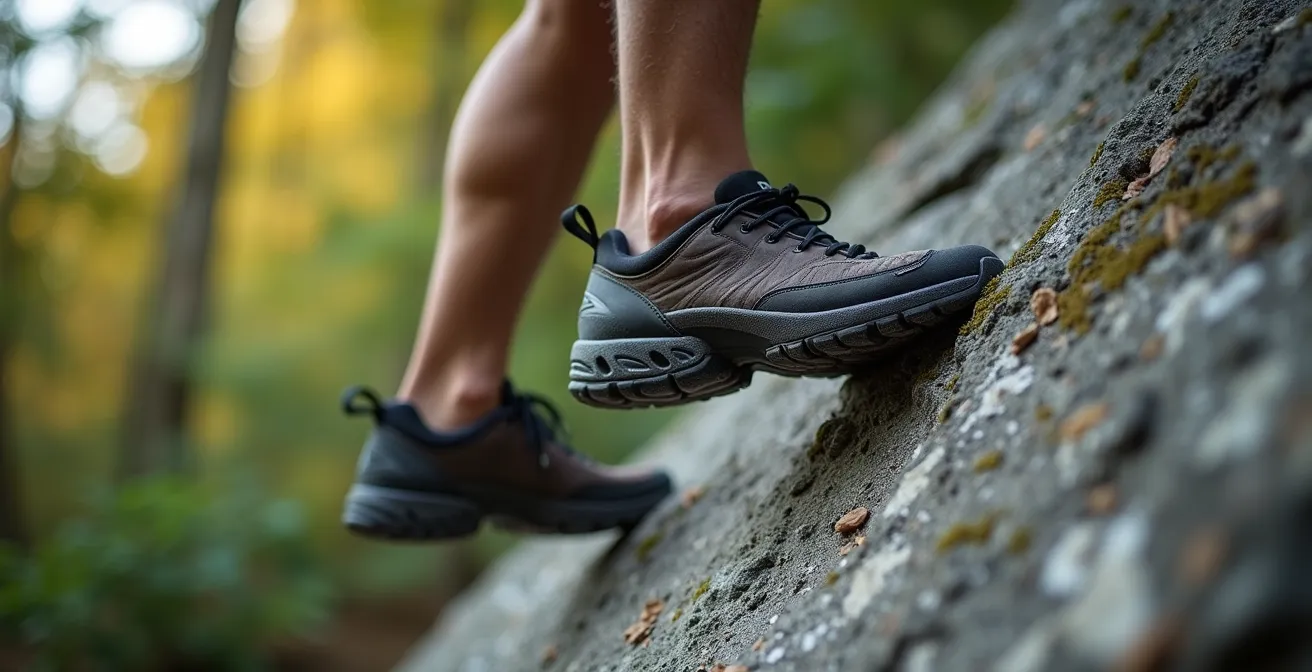
Furthermore, from a conservation standpoint, precise footwork enabled by stiffer shoes can be less damaging than the foot-scraping and smearing that often accompanies the use of overly soft shoes on this type of rock. Learning to place your foot deliberately once, rather than grinding it around to find purchase, minimizes your impact. Ultimately, the best shoe is one that fits you well and gives you the confidence to execute precise, controlled movements, respecting both the challenge and the fragility of the rock you’re climbing.
Rest Day Activities: Where to Stretch and Recover in the Niagara Region?
A successful climbing trip isn’t just about sending hard; it’s also about effective recovery. Pushing yourself day after day on the sharp, powerful moves at Niagara Glen is a recipe for injury. Building in a rest day allows your muscles and tendons to heal, ensuring you can perform at your best for the duration of your visit. Luckily, the Niagara Region offers plenty of options for active recovery that keep you moving without stressing your climbing muscles.
The most obvious choice is to explore the extensive trail network within the Niagara Glen Nature Centre itself. Sticking to the less-strenuous upper trails offers a chance for a gentle hike with beautiful gorge views, perfect for flushing lactic acid from your legs. For a longer, flatter walk or a light bike ride, the Niagara River Recreation Trail runs parallel to the parkway and offers miles of paved path. It’s an excellent way to see more of the river and keep your body moving. If you’re looking for something more educational, a visit to the Butterfly Conservatory or taking the Journey Behind the Falls tour can provide a fascinating look at the area’s ecology and geology from a different perspective.
Planning these rest days is also a good time to handle logistics. The bouldering permit, which is essential, can be purchased at the Nature Centre. According to the latest information from Niagara Parks, the current bouldering permit prices are $28 CAD for a single day or $50 CAD annually, with both options including parking. On weekends, the parking lot often fills by 11 a.m., so planning to arrive early or visit on a weekday is a smart strategy to avoid frustration. Remember, if the Nature Centre is closed, permits can be redeemed at the Butterfly Conservatory, a short drive away.
Why Does Limestone Rock Quality Matter for Your Safety on a Scramble?
Your safety at Niagara Glen begins the moment you leave the parking lot, long before you pull on your climbing shoes. The approach to all bouldering areas involves a significant descent into the gorge via a steep metal staircase and a network of rugged, stone-lined trails. While the approach is rated as easy and typically takes only 5-10 minutes, the quality of the rock underfoot is a critical safety consideration. The same dolostone and limestone that make up the boulders also form the trail bed, which can be incredibly slippery when wet, covered in leaves, or worn smooth by foot traffic.
Assessing rock quality is a continuous process. You must be mindful of loose stones, slick surfaces, and uneven footing throughout the scramble down. A twisted ankle on the approach can end your climbing day just as surely as a fall from a boulder. The Alpine Club of Toronto notes in its safety briefings that while falling is the largest risk during bouldering itself, a huge part of risk mitigation is being aware of your surroundings at all times, including on the approach and descent. This is particularly true in a dynamic environment like the Glen, where trail conditions can change daily.
This initial scramble serves as a perfect introduction to the nature of the Glen’s rock. It teaches you to be deliberate, to test your footing, and to respect the environment’s inherent hazards. It underscores the core principle of self-reliance. You are entering a wild, natural space with limited cell reception and potential dangers. Carrying your permit, being prepared, and moving with caution from the very first step are all part of the responsibility that comes with the privilege of climbing here.
Silurian vs. Ordovician: Which Rock Layers Are Visible at the Whirlpool?
To truly appreciate Niagara Glen, you need to think in geological time. The landscape you’re climbing on is a story written over 400 million years. The visible rock layers in the Niagara Gorge expose two distinct geological periods: the upper, younger layers from the Silurian Period and the lower, more ancient layers from the Ordovician Period. The boulders you are climbing on are almost exclusively from the Silurian era—specifically, the hard, erosion-resistant Lockport Dolostone that forms the caprock of the Niagara Escarpment.
This hard dolostone layer acts like a protective helmet for the softer layers beneath it. Below the dolostone caprock lie more fragile layers of limestone, shale, and sandstone. The Niagara River, over millennia, has relentlessly chewed away at these softer under-layers. This undercutting is what caused the Niagara Falls to retreat 11 km upstream from its original location near Lewiston. The Glen itself is the ancient, abandoned riverbed the falls occupied roughly 6,500 years ago, when Niagara Falls was located at the current Glen location. The massive boulders scattered throughout the forest are the direct result of this process: huge chunks of the Silurian dolostone caprock collapsing as the Ordovician shale beneath them washed away.
When you stand at the edge of the Whirlpool, just north of the main bouldering area, you can see this cross-section of Earth’s history laid bare. The deep, vertical walls of the gorge showcase the distinct bands of rock, telling a dramatic story of erosion and resistance. Understanding this distinction is key to understanding the Glen’s hazards. The hard boulders are (relatively) stable, but the cliffs they broke away from are a layer cake of hard and soft rock, constantly subject to the forces of erosion that created this entire landscape.
Key Takeaways
- Stewardship is non-negotiable: Your permit fee funds conservation, and cleaning chalk is a mandatory act of respect.
- Safety is your responsibility: The geological risks of rockfall are real; helmets and cautious movement are essential.
- Respect the rock’s fragility: The soft dolostone polishes easily. Use proper technique and stiff shoes to minimize your impact.
The Scramble Rating System: Is the Crypt Lake Trail Too Dangerous for Beginners?
While a formal scramble rating system is often applied to high-altitude mountain trails like Alberta’s Crypt Lake, the core principles of assessing risk and difficulty are directly applicable to the descent into Niagara Glen. For many visiting climbers, especially beginners or those with children, the primary question is: “Is the approach dangerous?” The answer depends entirely on preparation and conditions. The approach is not a simple walking path; it’s a rugged, technical descent that demands your full attention.
The main hazard is the potential for slips and falls. The metal staircase can be extremely slick when wet, and the stone-lined paths below are often covered in damp leaves or worn smooth. Good, sturdy approach shoes are a must. Trying to navigate this terrain in flip-flops or casual sneakers is asking for trouble. It’s also crucial to remember that this is a bouldering-only area. As a strict safety and conservation measure, official Niagara Parks regulations state there is 100% prohibition on all rope climbing. This means you must be able to get yourself and your gear—including bulky crash pads—down and back up the scramble without the aid of ropes.
For a beginner, the approach can be intimidating but is perfectly manageable with caution. Move slowly, maintain three points of contact on steeper sections, and be aware of other people on the trail. Your descent is the perfect time to run through a final mental safety check before you start climbing, ensuring you are prepared for the unique challenges of the Glen.
Your Pre-Descent Safety Checklist
- Check Conditions: Note if the metal staircase and stone paths are wet or leafy, and adjust your pace accordingly.
- Verify Your Permit: Ensure you have your bouldering permit physically with you or accessible on your phone, as you may be asked to show it.
- Confirm Gear: Do you have a helmet, a proper brush, sufficient water, and a crash pad? All are essential for a safe session.
- Assess Your Route: Know which area you’re heading to (e.g., Central, Wonderland, Land of Oz) so you can follow the correct path after the main descent.
- Cell Service Check: Be aware that cell reception is notoriously poor to non-existent at the base of the gorge, so don’t rely on it for emergencies.
Embracing the role of a steward is the final, most important piece of gear to bring to Niagara Glen. By understanding the geology, respecting the rules, and leaving the area better than you found it, you do more than just follow regulations—you become an active partner in protecting one of Canada’s most cherished climbing resources. Start by getting your permit, and let that be the first step in a mindful and rewarding climbing experience.