In summary:
- Moose are taller than your headlights, so look for dark shapes and silhouettes, not just eye-shine.
- The extreme danger comes from the moose’s height and weight, causing it to crash through the windshield, not onto the hood.
- In a crisis, brake hard in a straight line. Swerving is often more deadly as it can lead to a secondary collision with traffic or a rock cut.
- Your biggest enemies are monotony (highway hypnosis) and unpredictability (rutting season), so stay alert and be prepared for the remote stretches.
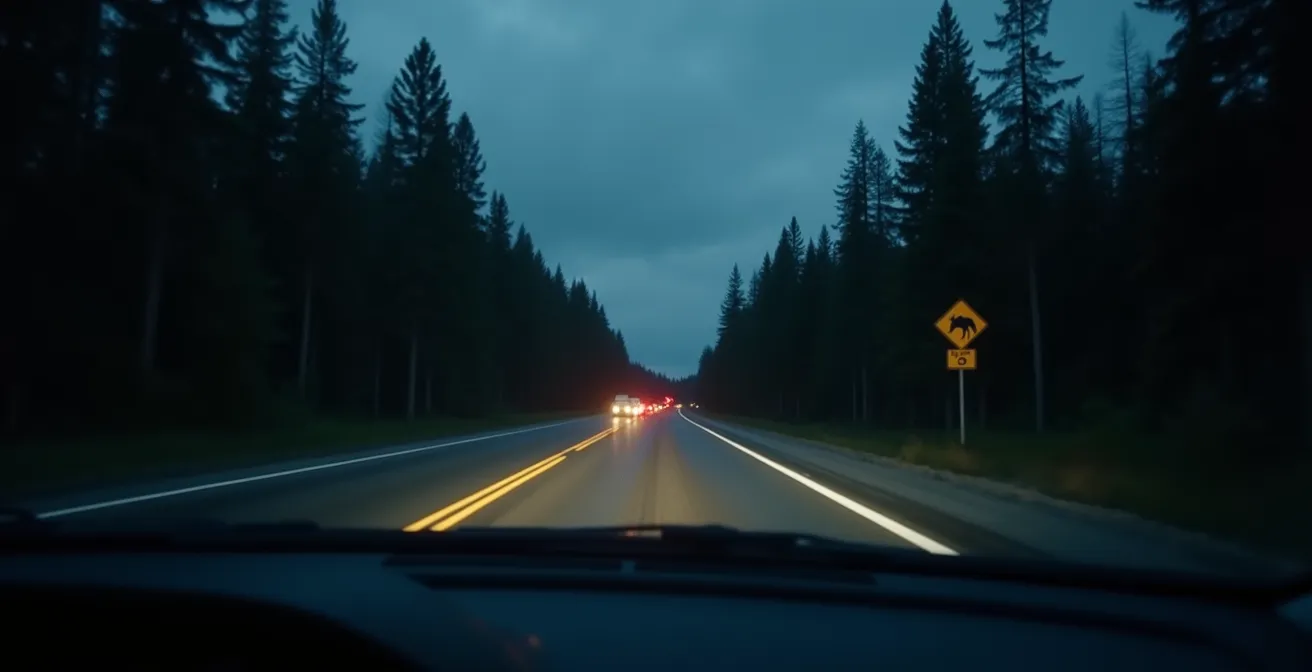
The stretch of the Trans-Canada north of the Sault, especially at night, feels like driving into a black hole. It’s just you, your headlights, and miles of dark, dense bush. If you’re a four-wheeler, your knuckles are probably white on the steering wheel, and every shadow looks like a one-thousand-pound problem waiting to happen. I get it. After twenty years and a couple million accident-free kilometres hauling freight up and down Highways 11 and 17, I can tell you that fear is healthy. But it can’t paralyze you.
Most guides will give you the same old advice: slow down, be alert at dusk and dawn. That’s not wrong, but it’s incomplete. It won’t save you when a bull moose decides to cross the road two hundred feet in front of you. Surviving that encounter isn’t about luck; it’s about understanding the brutal physics of the potential impact and training your eyes to see what isn’t obvious. It’s about developing a professional-grade awareness that turns panic into a planned reaction.
This isn’t just about avoiding a dent in your fender. A moose collision is a fundamentally different and more lethal event than hitting a deer. Forget everything you think you know. We’re going to cover how to use your lights correctly, understand the animal’s behaviour, know the physics of the crash, and execute the right maneuver when seconds count. This is the stuff that keeps you alive on the long, dark stretches of the north.
This guide breaks down the essential knowledge you need to navigate moose country safely. From understanding your vehicle’s lighting to making split-second decisions, each section builds on the last to give you a complete survival strategy.
Summary: Navigating the Dangers of Moose Alley
- High Beams vs. Fog Lights: Which Is Better for Illuminating Fur?
- Rutting Season: Why Are Moose More Likely to Run onto Roads in Autumn?
- The Windshield Impact: Why Are Moose Collisions More Fatal Than Deer?
- Brake or Swerve: What Is the Correct Reaction at 90 km/h?
- Moose Crossing Signs: Are They Placed Where Accidents Actually Happen?
- Why Is “Highway Hypnosis” Dangerous on the Prairies Straight Roads?
- Why Are Wildlife Corridors Essential for Grizzly Bear Survival in Parks?
- Driving the Trans-Canada Highway: How to Plan Fuel Stops in Remote Areas?
High Beams vs. Fog Lights: Which Is Better for Illuminating Fur?
The first mistake drivers make is thinking they’ll see the glint of glowing eyes. You might with a deer, but with a moose, you’re looking for the wrong thing. The problem is simple geometry. As wildlife collision research shows, moose eyes are often above the headlight beam of most cars. Their long legs put their entire body and head much higher than a deer’s. Your low beams are aimed down at the road, so they’ll illuminate the legs, but the massive, dark body above them will remain invisible until you’re dangerously close.
This is why your high beams are your single most important tool for spotting a moose. They cast a longer, higher beam of light, giving you a chance to see the animal’s entire silhouette against the treeline. Forget fog lights; they are designed to cut under fog and illuminate the road surface directly in front of you. In moose country, they are worse than useless—they provide a false sense of security while leaving the real danger zone in complete darkness.
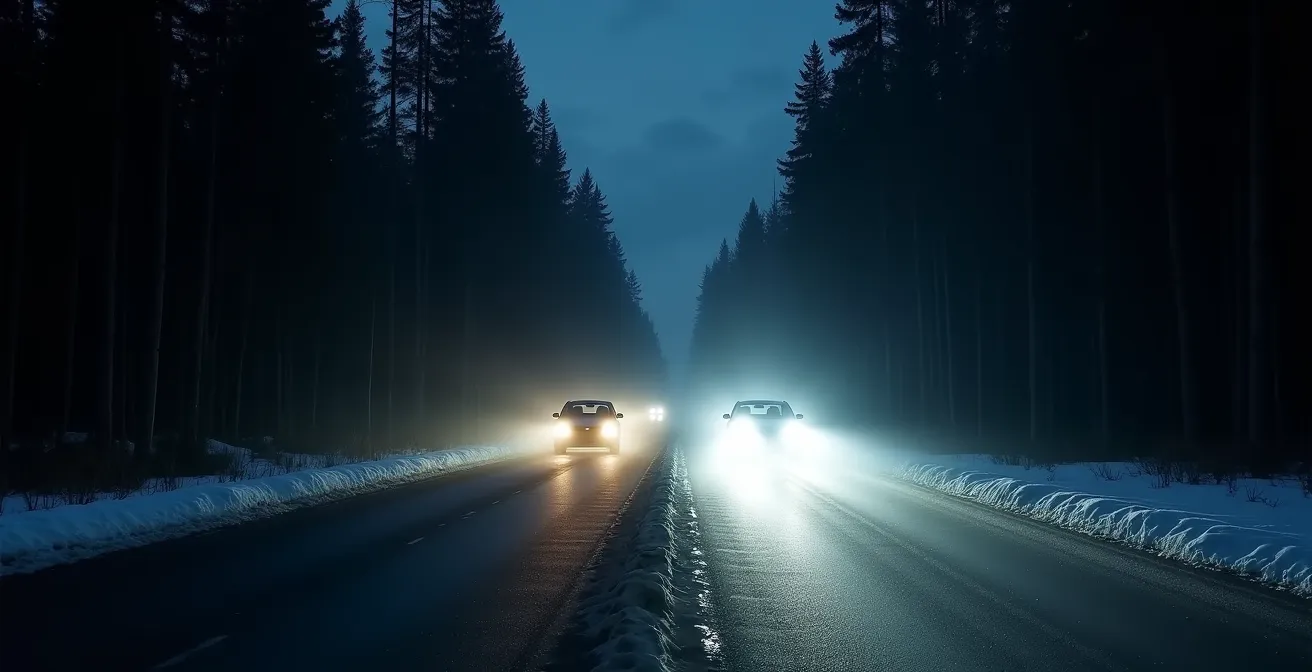
Your job isn’t to look for eyes; it’s to scan for shapes that don’t belong. Look for a dark, vertical mass at the edge of the road. Your high beams will help you identify a break in the pattern of the forest. You must train your eyes to perform this “predictive scanning” continuously, sweeping from the ditch on one side to the ditch on the other. Always use your high beams when there’s no oncoming traffic. It’s not just a suggestion; it’s a critical survival technique.
Rutting Season: Why Are Moose More Likely to Run onto Roads in Autumn?
Understanding *when* a moose is most likely to be on the road is as important as knowing how to see it. While you can encounter one at any time of year, certain seasons dramatically increase the risk. The two most dangerous periods are late spring and, most notoriously, autumn. In late spring (May and June), young moose are driven away by their mothers to fend for themselves. Confused and inexperienced, they wander unpredictably, often onto highways.
However, the most dangerous time is the fall rutting season, which peaks from September through October. During the rut, bull moose are driven by hormones, focused on finding mates, and are far less cautious than usual. They will travel long distances, often crossing highways without a second thought, and can be extremely aggressive and unpredictable. A bull moose in rut might stand its ground in the middle of the road or even charge a vehicle.
While wildlife safety data confirms that collisions peak in fall and late spring, it’s a year-round threat in the north, with many incidents also occurring in the summer months of June, July, and August. The hours around dawn and dusk are peak activity times for moose, as they are most active in low light. But on the dark northern highways, you should consider any time after sunset and before sunrise to be a high-risk period. This seasonal knowledge isn’t about being scared in October; it’s about raising your baseline alertness to its highest level during these critical months.
The Windshield Impact: Why Are Moose Collisions More Fatal Than Deer?
A lot of drivers think, “I’ve seen what happens when a car hits a deer; a moose can’t be that much worse.” This is a fatal miscalculation. Hitting a moose is a completely different physical event. A deer collision typically involves the animal hitting the bumper and grille, with the force directed into the engine block. A moose collision is an event of vertical impact. An adult moose has incredibly long legs and a top-heavy body.
According to the Wildlife Roadsharing Resource Centre, a mature moose can weigh up to 1,000 pounds with 4-foot tall legs. When a car strikes a moose, the bumper hits its legs, and the massive weight of the body continues moving forward directly into the passenger compartment. As the experts at the Traffic Injury Research Foundation (TIRF) state, “The full weight of the moose’s upper body instead impacts the windshield and roof of the vehicle.” This crushes the A-pillars and the roof, a part of the car with minimal structural protection, leading to catastrophic injuries or death for the occupants.
The difference in outcome is not marginal; it’s an order of magnitude more severe. The data makes this brutally clear.
| Factor | Moose Collision | Deer Collision |
|---|---|---|
| Average Animal Weight | 1000 lbs (450 kg) | 150-200 lbs (70-90 kg) |
| Impact Zone | Windshield/Roof | Hood/Bumper |
| Seatbelt Effectiveness | 8x higher injury risk without | Standard protection applies |
| Fatal Collision Rate | 13x more likely | Baseline |
Understanding this “collision physics” is not about scaring you. It’s about respecting the animal and the situation. This knowledge is what informs the correct, and often counter-intuitive, reaction you must have in a split-second crisis.
Brake or Swerve: What Is the Correct Reaction at 90 km/h?
This is the moment of truth. A dark shape materializes in your headlights. Your instincts will scream at you to swerve. You must fight that instinct with everything you have. On the narrow, shoulder-less roads of Northern Ontario, bordered by rock cuts, dense forest, and oncoming traffic (often a semi-truck like mine), swerving is frequently more deadly than the initial impact. Many of the worst accidents aren’t from hitting the moose, but from the driver veering into an oncoming lane or an immovable object.
The professional, trained response is to maintain control and brake hard in a straight line. Your goal is to scrub off as much speed as possible before impact to reduce the force of the collision. If a crash is unavoidable, you are better off hitting the animal with a controlled, head-on impact than losing control of your vehicle. The Ontario Provincial Police (OPP) have a clear protocol for this exact situation. It’s not a list of suggestions; it’s a procedure born from analyzing countless tragic accidents.
Action Plan: The OPP Emergency Response Protocol
- Stay on the road and maintain a strong, firm grip on the steering wheel with both hands.
- Brake firmly and decisively in a straight line. If possible, steer toward where the animal came from, not where it is going.
- Lay on your horn. The loud noise can sometimes startle the animal into moving or changing direction.
- Activate your emergency flashers immediately to warn any vehicles that might be behind you.
- If impact is absolutely imminent, instruct passengers to duck down toward the floor to get below the main impact zone of the windshield.
This is a hard choice to make in a terrifying moment. But a “controlled impact” where you remain in your lane is survivable. A loss of control at 90 km/h is often not. Practice visualizing this scenario, so if it happens, your training can override your panic.
Moose Crossing Signs: Are They Placed Where Accidents Actually Happen?
Those yellow diamond-shaped moose crossing signs are a familiar sight on northern roads, but you can’t rely on them as your sole indicator of risk. While they are placed in areas with known moose populations and historical accident data, they have a major limitation: driver habituation. After seeing a dozen of these signs over a hundred kilometers, drivers tend to stop paying attention to them. The warning loses its impact, a phenomenon known as “sign fatigue.”
Moose, of course, don’t read signs. Their crossing patterns are dictated by food sources, water, and seasonal migration or rutting routes, which can shift over time. A sign marks a general area, not a specific, guaranteed crossing point. You should treat the *entire* stretch of a northern highway as a potential crossing zone, not just the 500 meters after a sign.
The future of wildlife warnings lies in more advanced, dynamic systems. These systems use sensors (like infrared cameras or break-beam detectors) to detect when a large animal is actually near the road. When triggered, they activate flashing lights to provide an immediate, urgent warning to drivers. This type of active alert is far more effective because it signals a real-time threat, eliminating sign fatigue. In fact, Ontario data shows a 74% reduction in moose-vehicle collisions in areas where these dynamic systems have been installed. Until these are everywhere, treat the static signs as a gentle reminder that you are in hostile territory, and keep your guard up at all times.
Why Is “Highway Hypnosis” Dangerous on the Prairies Straight Roads?
While the title mentions the Prairies, Northern Ontario has its own potent and dangerous form of highway hypnosis. It’s not born from flat, straight roads, but from monotony. Driving for hours on Highway 11 or 17 at night creates what one expert called “the endless, dark ‘tunnel’ of trees.” Your world shrinks to the bubble of your headlights, with a repetitive, unchanging wall of black spruce on either side. Your brain can switch to autopilot.
This state of highway hypnosis is a silent killer. Your reaction time plummets. Your peripheral vision narrows. You are technically awake, but your level of active engagement with the driving task is dangerously low. You might be staring straight ahead, but you are not truly *seeing* or *scanning*. This is the state where a moose can step out from the “shadow box”—the area just beyond your headlights—and you won’t even register it until it’s too late to react.
Fighting this hypnotic state requires a conscious, deliberate effort. It’s about actively managing your alertness.
- Break the monotony: Plan your stops in towns like Hearst, Nipigon, or White River. Don’t try to be a hero and push through. Every two hours, get out, walk around, and reset your brain.
- Engage your passengers: If you’re not driving alone, make them active participants. Task them with scanning one side of the road specifically for wildlife.
- Manage your environment: Keep the cab cool, play engaging music or a podcast, and avoid getting too comfortable.
- Adjust your speed: When you feel the hypnosis setting in, slowing down by 10 km/h can give you that extra split-second of reaction time you desperately need.
This isn’t about being tired; it’s about your brain checking out from a repetitive task. Actively fighting it is a core professional driving skill.
Why Are Wildlife Corridors Essential for Grizzly Bear Survival in Parks?
The ultimate solution to wildlife collisions isn’t just about making drivers better; it’s about designing roads and landscapes that keep animals and vehicles separate. This is the principle behind wildlife corridors. While often discussed for grizzly bears in the Rocky Mountains, the concept is just as vital for moose, deer, and other large animals here in Ontario. Highways act as impassable barriers, fragmenting habitats and forcing animals to make deadly crossings to find food or mates.
A wildlife corridor provides a safe route for animals to cross a highway, typically in the form of an overpass (a bridge covered in soil and native vegetation) or an underpass. These structures, combined with extensive fencing along the highway to funnel animals toward them, are incredibly effective. They reconnect ecosystems and drastically reduce collisions.
A prime example is right here in Ontario on Highway 69/400. After the installation of wildlife overpasses and fencing, the results were immediate and dramatic. Moose, deer, and even lynx quickly learned to use the safe crossings. The success is measured in two ways: by the animals who use it and the accidents that no longer happen. For instance, the Highway 69 wildlife bridge recorded over 1,000 animal crossings in its first three years alone. More importantly, collisions reported by the OPP in that corridor dropped by over 70%. This isn’t a theoretical solution; it’s a proven engineering strategy that saves the lives of both wildlife and people. Supporting the development of more of these corridors is the best long-term investment in highway safety we can make.
Key Takeaways
- Your high beams are for spotting the whole moose silhouette, not just its eyes, which are often too high to be seen.
- The danger of a moose collision is its height and weight, causing it to crash through the windshield, unlike a deer which goes under the car.
- The correct, life-saving reaction is almost always to brake hard in a straight line; swerving can lead to a more fatal secondary impact.
Driving the Trans-Canada Highway: How to Plan Fuel Stops in Remote Areas?
Planning your fuel stops along the Trans-Canada isn’t just about not running out of gas. It’s a critical part of a broader survival strategy for navigating one of the most remote territories in the country. The stretch of Highway 17 between White River and Longlac, for example, is notorious for its lack of services, no cell reception, and high density of moose. Hitting a moose here means you are completely on your own, potentially for hours.
Being prepared for that worst-case scenario is not optional. Your vehicle should be equipped with a comprehensive emergency kit designed for a remote northern environment. This goes far beyond a simple first-aid kit. A collision can leave your vehicle disabled and you injured in freezing temperatures with no way to call for help. Your planning must account for self-rescue and survival until help can arrive.
A professional’s emergency kit for the northern roads should include:
- A satellite messenger device (like a Garmin InReach or SPOT) to call for help when there is no cell service.
- High-visibility vehicle markers and road flares to warn other traffic.
- Thermal emergency blankets to fight off hypothermia.
- A trauma-focused first-aid kit.
- Downloaded offline maps of the region.
- Emergency water and non-perishable food for at least 24 hours.
- A powerful flashlight with extra batteries.
Planning your fuel stops in Wawa, White River, and Terrace Bay becomes part of this. Each stop is a chance to check your vehicle, rest your mind, and confirm you are prepared for the next long, dark, and isolated leg of the journey.
Ultimately, driving safely in moose country comes down to a professional mindset. It’s about respecting the environment, understanding the physics, and replacing panic with a trained, deliberate plan. Stay alert, be prepared, and drive smart.