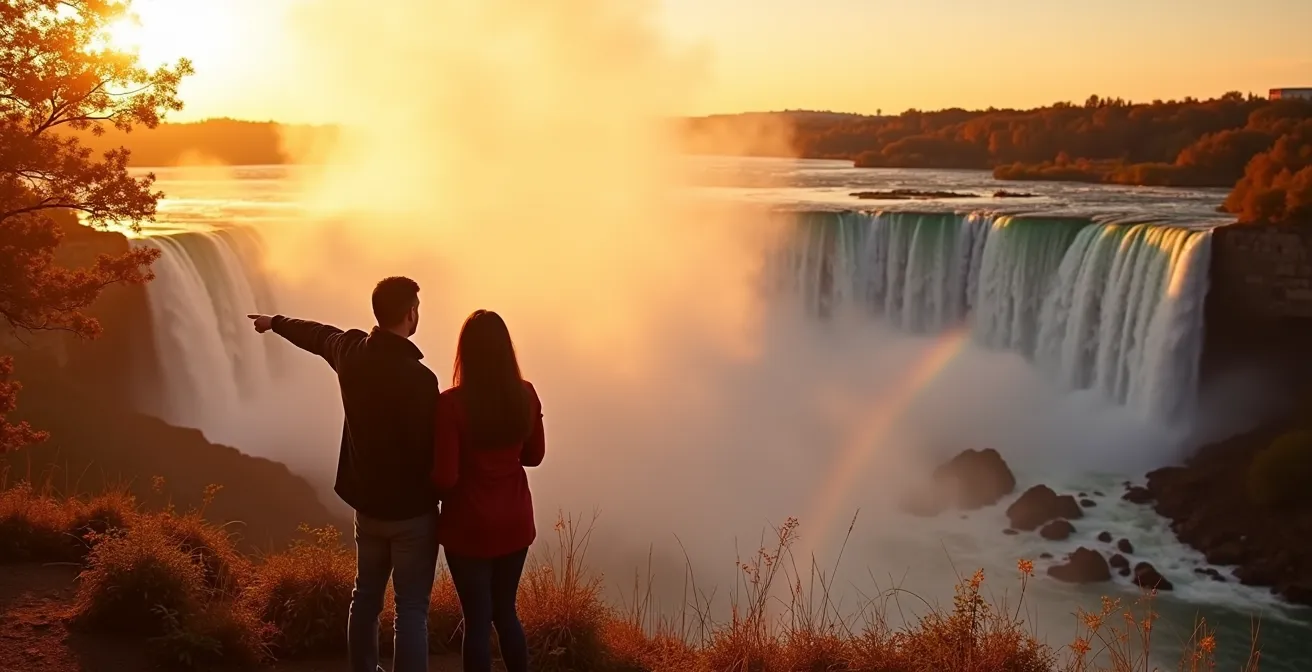
The perfect Niagara romantic getaway isn’t about choosing between Niagara-on-the-Lake and Niagara Falls—it’s about strategically blending both.
- Base yourselves in the serene, romantic atmosphere of Niagara-on-the-Lake for charm and world-class wineries.
- Plan a curated day trip to Niagara Falls to experience the spectacle without getting caught in the tourist traps.
Recommendation: Use insider logistical knowledge—from bypassing traffic to smart booking—to create a seamless trip that combines the best of both worlds.
For couples planning a romantic escape to Niagara, the central question always seems to be a stark choice: the thundering, glittering spectacle of Niagara Falls or the quaint, vineyard-draped charm of Niagara-on-the-Lake? The common narrative paints a simple picture: Niagara Falls is the high-energy, casino-driven tourist hub, while NOTL is its sophisticated, tranquil counterpart, defined by wineries and theatre. This binary choice, however, misses the true potential of the region.
Most guides will give you a list of attractions for each, forcing you to pick a side. But what if the most memorable romantic getaway isn’t about choosing one over the other? As a romance travel concierge specializing in this incredible part of Ontario, I advise couples to think differently. The secret to an unforgettable trip lies not in an “either/or” decision, but in the art of strategic blending. It’s about establishing a serene home base and then curating excursions to experience the highlights of the entire region, spectacle included.
The real challenge isn’t deciding where to go, but *how* to do it seamlessly. This guide moves beyond the surface-level debate. We will delve into the logistical mastery required to craft the perfect itinerary—from navigating the QEW nightmare to knowing which attractions are genuine fun and which are money pits. By understanding the region’s unique rhythm, you can create a curated experience that balances the awe of the Falls with the peaceful romance of wine country.
This guide is designed to be your inside source, providing the strategic advice needed to navigate the region like a seasoned local. We’ll explore everything from the practicalities of bike rentals and traffic avoidance to the deep geological stories that shaped this world-renowned landscape.
Summary: Niagara for Couples: A Strategic Itinerary
- How to Rent Bikes for a Winery Tour Without Getting Stranded?
- The QEW Nightmare: How to Bypass Toronto Traffic on Friday Afternoons?
- Clifton Hill Attractions: Which Are Genuine Fun and Which Are Money Pits?
- Why Is the Niagara Peninsula Able to Grow Peaches and Grapes?
- Shaw Festival Season: When Do the Best Plays Usually Sell Out?
- Why Does the Horseshoe Falls Recede by 30cm Every Year?
- Canola Fields in Bloom: When Is the Best Week to See Yellow Fields?
- Driving the Niagara Parkway: Where to See the Best River Carving Geology?
How to Rent Bikes for a Winery Tour Without Getting Stranded?
A bicycle tour through Niagara-on-the-Lake’s wineries is the quintessential romantic activity. The image is perfect: you and your partner gliding past rows of vines under a summer sun. The reality, however, can involve logistical headaches—juggling bike rentals, navigating gentle but persistent inclines, and figuring out how to transport the bottles you purchase. So, how do you ensure the experience is blissful, not burdensome?
The first piece of advice I give couples is to choose your rental company wisely. The game-changer is a company that offers a wine pickup service. Reputable operators like Zoom Leisure and Tour de Vine offer this complimentary service, transporting any bottles you buy directly back to their shop. This frees you from cycling with a clanking backpack, transforming your tour from a chore into a carefree exploration.
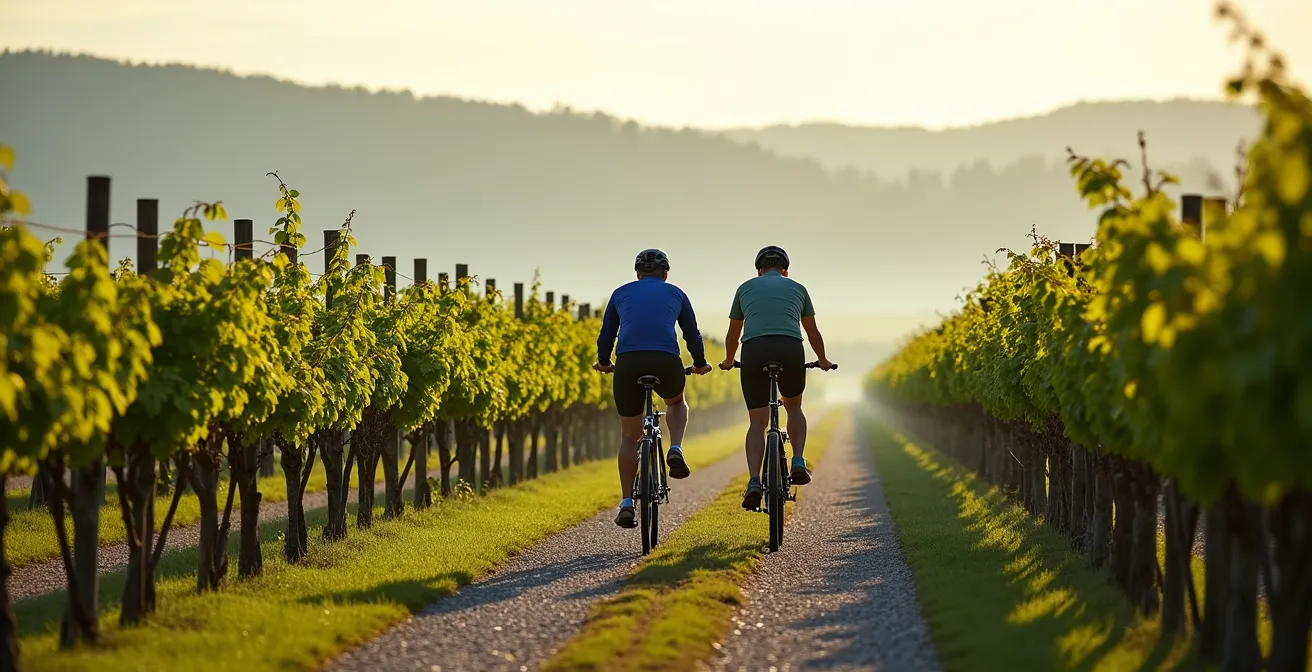
Secondly, embrace the e-bike. While the Niagara-on-the-Lake terrain is often described as flat, there are enough gentle slopes, especially along the Niagara Escarpment, to make pedal-assist a welcome luxury, particularly after a few wine tastings. It ensures the focus remains on the scenery and the experience, not on your exertion level. For a truly intimate experience, keep your group small (ideally just the two of you) and limit your stops to three or four wineries for a half-day tour. This allows for unhurried tastings and prevents the day from feeling like a race.
The QEW Nightmare: How to Bypass Toronto Traffic on Friday Afternoons?
The journey to Niagara can either be the serene start to your romantic weekend or a frustrating, gridlocked nightmare. For anyone leaving the Greater Toronto Area on a Friday afternoon, the Queen Elizabeth Way (QEW) often feels more like a parking lot than a highway. This is the first test of any couple’s patience, but it’s one you can easily pass with a little insider knowledge.
Instead of battling the main artery, the secret is to exit early and transform the bypass into part of the experience. The concierge’s route is Highway 8 through the Niagara Benchlands. By exiting the QEW around Grimsby, you can take this scenic route through charming towns like Beamsville and Jordan. This isn’t just a detour; it’s a prelude to wine country. This road is the backbone of the Twenty Valley wine region, home to over 50 wineries that are often smaller and more intimate than their NOTL counterparts. It’s a chance to discover hidden gems before you even check into your hotel.
This strategic detour, which you can explore as part of the broader Benchlands wine tour area, turns a potential 3-hour crawl into a beautiful 1.5-hour drive through rolling vineyards and orchards. For those who want to avoid driving altogether, VIA Rail and GO Transit offer weekend service from Toronto to Niagara Falls, where you can connect to local transit. But for the flexibility a romantic getaway deserves, mastering the scenic backroads is the ultimate power move.
Clifton Hill Attractions: Which Are Genuine Fun and Which Are Money Pits?
No trip to Niagara is complete without witnessing the sheer power of the Falls, but that often means a visit to the adjacent Clifton Hill. For a couple seeking romance, this buzzing street of wax museums, haunted houses, and arcades can feel overwhelming and even a bit tacky. The key is to be selective and identify the attractions that offer genuine value for a couple, rather than just being money pits designed for mass tourism.
Think of it as a curated experience. You’re not there to do everything; you’re there to pick the one or two things that will add a playful, memorable moment to your trip. The Niagara SkyWheel, for instance, is a clear winner. It offers breathtaking, panoramic views of the Falls from a private, climate-controlled gondola. It’s especially magical in the evening when the Falls are illuminated, making it one of the most romantic experiences in the area. In contrast, the various wax museums offer a generic experience you could find in any major tourist city and are best skipped.
The following table breaks down some of the most popular attractions, analyzing them from a couple’s perspective to help you decide where to invest your time and money. This analysis, based on visitor feedback and romantic appeal, is a quick guide to navigating the neon-lit landscape.
| Attraction | Cost Range | Duration | Couples Value | Evening Appeal |
|---|---|---|---|---|
| Niagara SkyWheel | $15-20 | 15-20 min | High – Romantic views | Excellent – Illuminated falls view |
| Wax Museums | $10-15 | 30-45 min | Low – Generic experience | Poor – Daytime only |
| Niagara Speedway | $12-15 | 10 min | Medium – Unique scale | Good – Open till dusk |
| Ghost Tours (alternative) | $25-30 | 90 min | High – Local history | Excellent – Evening only |
As the comparative value suggests, an alternative like a local ghost tour often provides a much richer, story-driven evening activity that connects you to the area’s history, offering more substance than a typical midway attraction.
Why Is the Niagara Peninsula Able to Grow Peaches and Grapes?
As you sip a world-class Cabernet Franc in Niagara-on-the-Lake, it’s easy to take the surrounding vineyards for granted. But a question worth asking is: why here? Why can this specific pocket of Southern Ontario, on the same latitude as southern France, produce such delicate and complex fruit like wine grapes and peaches? The answer is a beautiful story of deep time and geological luck.
The region’s agricultural prowess is due to a unique, localized phenomenon known as a lake-effect microclimate. This is created by two dominant geographical features: the Niagara Escarpment and Lake Ontario. The escarpment, a long ridge of rock, acts as a natural barrier, sheltering the tender fruit lands from harsh prevailing winds. More importantly, the immense body of water in Lake Ontario functions as a massive thermal regulator. In the spring, the cold lake water cools the air, delaying the budding of fruit trees and vines until the risk of a late frost has passed. In the autumn, the lake releases its stored summer heat, extending the growing season and allowing grapes to ripen fully.
This perfect combination of factors is the result of an incredible geological history. The Niagara Peninsula’s unique microclimate developed over 12,500 years, following the retreat of the last glaciers. This ancient past created the ideal conditions for viticulture, a potential that has been perfected by modern science. Canadian institutions like the Vineland Research and Innovation Centre and Brock University’s CCOVI have been instrumental in helping vintners identify and cultivate grape varietals that thrive in this specific environment. So, every glass of Niagara wine is, in a sense, a taste of geology and innovation.
Shaw Festival Season: When Do the Best Plays Usually Sell Out?
A cornerstone of any romantic trip to Niagara-on-the-Lake is an evening at the Shaw Festival. This world-class theatre festival, celebrating the works of George Bernard Shaw and his contemporaries, adds a touch of intellectual and cultural elegance to your getaway. However, showing up and expecting to get tickets to the most popular shows is a recipe for disappointment. The festival’s popularity is surging, with the Shaw Festival reporting a remarkable ticket sales growth of 40% year-over-year recently.
Logistical mastery is key. The best seats for the most anticipated productions, especially the large-scale musicals at the main Festival Theatre, are often gone months in advance. Weekend performances during the peak summer season (July and August) are particularly competitive. So, when should you book? The simple answer is: as early as possible. For devoted theatre lovers, becoming a Friend of the Festival for presale access is the surest way to secure prime seating.
For everyone else, a clear booking strategy is essential to avoid being shut out of a highlight of your trip. The process isn’t complicated, but it does require planning ahead. Following a strategic timeline can mean the difference between seeing the play of the season from a perfect vantage point or settling for a less popular show. Here is a practical checklist to guide your booking process.
Your Action Plan: Shaw Festival Booking Strategy
- Early Bird Advantage: Book by January 31 for early bird pricing and the best selection of seats before the general public rush.
- Member Access is Key: Recognize that members get presale access, meaning the very best seats are often sold before you can even see them.
- Prioritize Big Musicals: Target the major musicals at the Festival Theatre months in advance, as these are the first to sell out, especially for weekend dates.
- Look for Last-Minute Gems: For more spontaneous trips, the experimental shows at the smaller Jackie Maxwell Studio Theatre often have better last-minute availability.
- The 24-Hour Check: Check the box office 24 hours before a performance for returned or exchanged tickets; seats frequently become available at the last minute.
Why Does the Horseshoe Falls Recede by 30cm Every Year?
Watching the colossal volume of water crash over the crest of the Horseshoe Falls is a mesmerizing, almost hypnotic experience. It feels timeless and permanent, yet the Falls are a living, dynamic geological feature. They are in a constant, slow-motion process of retreat, eating their way backward up the Niagara River. For centuries, this erosion was dramatic, but today, it has been slowed to a crawl. But why does it happen at all?
The process is a classic example of differential erosion. The top layer of rock at the falls’ edge is a hard, resistant slab of Lockport dolostone. Beneath it lie softer layers of shale and sandstone. The powerful plunge of the water scours away these softer layers at the base of the falls, creating an undercut. Eventually, the unsupported top layer of dolostone collapses under its own weight, and the falls have moved a little further upstream. This process, repeated over millennia, is how the Niagara Gorge was carved.
Historically, the recession rate was as high as 1 to 1.5 metres per year. Today, however, that rate has been drastically reduced. Thanks to the 1950 International Niagara Treaty between Canada and the United States, a significant portion of the river’s flow is diverted before it reaches the Falls to power massive hydroelectric plants, like the Sir Adam Beck stations in Ontario. This diversion is increased at night during the off-peak tourist season. By essentially “turning down the tap,” the erosive force on the falls is lessened, and the current recession rate is now managed to be much slower. The International Joint Commission reports the current recession rate has been reduced to approximately 0.1 metres (or about 30 cm) per year.
Canola Fields in Bloom: When Is the Best Week to See Yellow Fields?
While wineries and waterfalls are the headline acts, one of the most breathtakingly romantic sights in the Niagara region is also one of its most fleeting: the canola fields in full bloom. For a few short weeks in late spring, vast agricultural landscapes are transformed into brilliant seas of electric yellow under an open sky. For couples looking for a unique photo opportunity and a scenic drive, timing a visit to coincide with this bloom is an insider’s secret to a truly memorable trip.
The peak bloom is a brief spectacle, typically occurring for just two to three weeks between late May and early June. The exact timing varies slightly each year depending on the spring weather, but this window is your best bet. To find these stunning vistas, you need to venture away from the main tourist corridors. The best viewing is found on the quiet back roads of the southern and western parts of the region, specifically around West Lincoln, Wainfleet, and the areas near the Binbrook Conservation Area. Driving along Caistorville Road during this period is almost guaranteed to reward you with incredible views.
When you find these fields, it’s crucial to be respectful. These are not public parks; they are the livelihood of local farmers. As the Ontario By Bike Tourism Board wisely advises, the etiquette is simple and non-negotiable:
The ‘Look, Don’t Touch’ etiquette is crucial – these are working Canadian farms, not public parks.
– Ontario By Bike Tourism Board, Rural Tourism Guidelines 2024
Always photograph from the safety of the roadside and never walk into the fields. The best shots often come during the “golden hour”—early in the morning or late in the afternoon—when the soft light makes the yellow hues even more vibrant, often contrasted against the fresh green of neighbouring corn or soybean fields.
Key Takeaways
- The best Niagara romantic trip combines a serene base in NOTL with curated, strategic visits to the Falls.
- Logistical mastery—bypassing traffic, smart booking for shows, and choosing the right tours—is more important than just picking attractions.
- Appreciating the region’s deep geological and agricultural story enhances the entire experience, turning a simple visit into a richer exploration.
Driving the Niagara Parkway: Where to See the Best River Carving Geology?
The Niagara Parkway, famously called the “prettiest Sunday afternoon drive in the world” by Winston Churchill, is more than just a scenic route. It’s a rolling, 55-kilometre museum of geological history. For a couple interested in the story behind the scenery, driving the Parkway is the perfect way to cap off your trip, as it traces the 12,000-year journey of Niagara Falls from its birthplace to its current location.
To truly appreciate the river’s immense power, your drive should follow a “geologist’s itinerary.” Start your journey north at Queenston Heights Park. This historic park sits atop the Niagara Escarpment and marks the original location of the Falls after the last ice age. From this vantage point, you can gaze down the gorge and imagine the immense erosive journey that has taken place over millennia.
Driving south along the parkway, your essential stop is the Niagara Glen Nature Centre. This is your best opportunity to descend into the gorge itself via well-marked trails. Here, you can walk among massive, moss-covered boulders tossed aside by the ancient falls and see geological features like “potholes” drilled into the bedrock by swirling, stone-filled whirlpools. Further south, the Whirlpool Aero Car viewpoint provides a stunning look at the 90-degree turn in the river and the violent Class 6 rapids—a direct result of the gorge intersecting with an ancient, buried riverbed. Finally, end your drive at the present-day Falls, where you can observe the modern erosion patterns and fully comprehend the scale of the 11.4-kilometre journey you just traced by car.
By shifting your perspective from a simple “this or that” choice to a curated exploration, you can craft a Niagara getaway that is both spectacular and serene. The next logical step is to start sketching out your own personalized itinerary based on these insider strategies.