
The key to an authentic trip to Quebec City isn’t a secret list of places, but a new way of seeing.
- Most “hidden gems” are just less-crowded tourist spots. True authenticity lies in understanding the complex history behind even the most famous attractions.
- Commercial tours often simplify or romanticize history. Learning to spot these narratives and look for deeper, untold stories is the crucial skill.
Recommendation: Adopt a historian’s mindset. Question the surface, research primary sources before you go, and learn how to engage with locals intentionally to uncover the city’s true character.
There’s a unique kind of disappointment a culture-focused traveler feels when a place of deep historical significance feels more like a theme park. You arrive in Quebec City, a jewel of North American history, expecting to connect with the past, but find yourself navigating crowds and souvenir shops selling mass-produced trinkets. The air is thick with history, yet the experience can feel surprisingly hollow, a curated performance rather than a genuine encounter. Many guides suggest the solution is to “get off the beaten path” or “wander the side streets,” but this often leads to quieter, yet still commercialized, areas.
The common approach is to search for a better list of places—the “real” hidden gems. But what if the most authentic experience isn’t about *where* you go, but *how* you look? What if the real skill is learning to read the history embedded in the very stones of the most famous sites, and deconstructing the tourist-friendly stories layered on top? This requires a shift from being a passive tourist to an active investigator. It involves developing a form of historical literacy, allowing you to see beyond the beautifully restored facades and understand the complex, and often contradictory, forces that shaped them.
This guide is not another list of “secret spots.” Instead, it’s a manual for adopting a historian’s mindset. We will explore the paradox of heritage preservation, learn how to ask questions that unlock genuine local insight, and discover how to use archival tools to build a truly personal connection with the city’s past. By the end, you will have the framework to deconstruct the tourist narrative and find authenticity not by avoiding the landmarks, but by understanding them more deeply than anyone else.
To help you navigate this new approach, this article is structured to build your skills as a historical detective. The following sections will equip you with the critical perspective and practical tools needed to transform your visit to Quebec City.
Summary: A Historian’s Method for Uncovering Quebec’s True Heritage
- Why Does UNESCO Heritage Status Change Property Values in Old Districts?
- How to Ask Locals for Recommendations Without Getting Generic Answers?
- Guided Walking Tour vs. Self-Guided App: Which Offers Better Historical Insight?
- The Revisionist History Trap: What Many Tour Guides Get Wrong About New France
- Researching Before You Go: How to Use Local Archives Online for Trip Planning
- Investing in Indigenous Economies: How Your Tourism Dollars Create Impact
- Why Were Fresnel Lenses Revolutionary for Atlantic Navigation?
- Old Montreal vs. Distillery District: Which Historic Quarter Fits Your Vibe?
Why Does UNESCO Heritage Status Change Property Values in Old Districts?
The designation of the Historic District of Old Québec as a UNESCO World Heritage Site in 1985 was a crucial step in its preservation. It cemented the city’s global importance and unlocked significant resources for restoration. However, for the traveler seeking authenticity, it also created what can be called the “preservation paradox.” This status, intended to protect historical integrity, often accelerates the very commercialization that can dilute it. The international recognition increases tourist demand, which in turn drives up property values and commercial rents. This economic pressure can push out long-term residents and small, local businesses in favour of high-turnover souvenir shops and chain restaurants.
This process is managed through a complex web of agreements. As the official UNESCO report notes, the Quebec government and the City of Québec enter into cultural development agreements that provide grants for restoration. While these funds are vital for maintaining the physical heritage, they also incentivize a certain kind of “perfection” that can feel sterile. The authentic patina of age—weathered stone, faded paint, worn-down doorsteps—is often replaced with a pristine, camera-ready version of history. This creates a visually stunning but sometimes soul-less environment, where the line between a living historic district and an open-air museum becomes blurred.
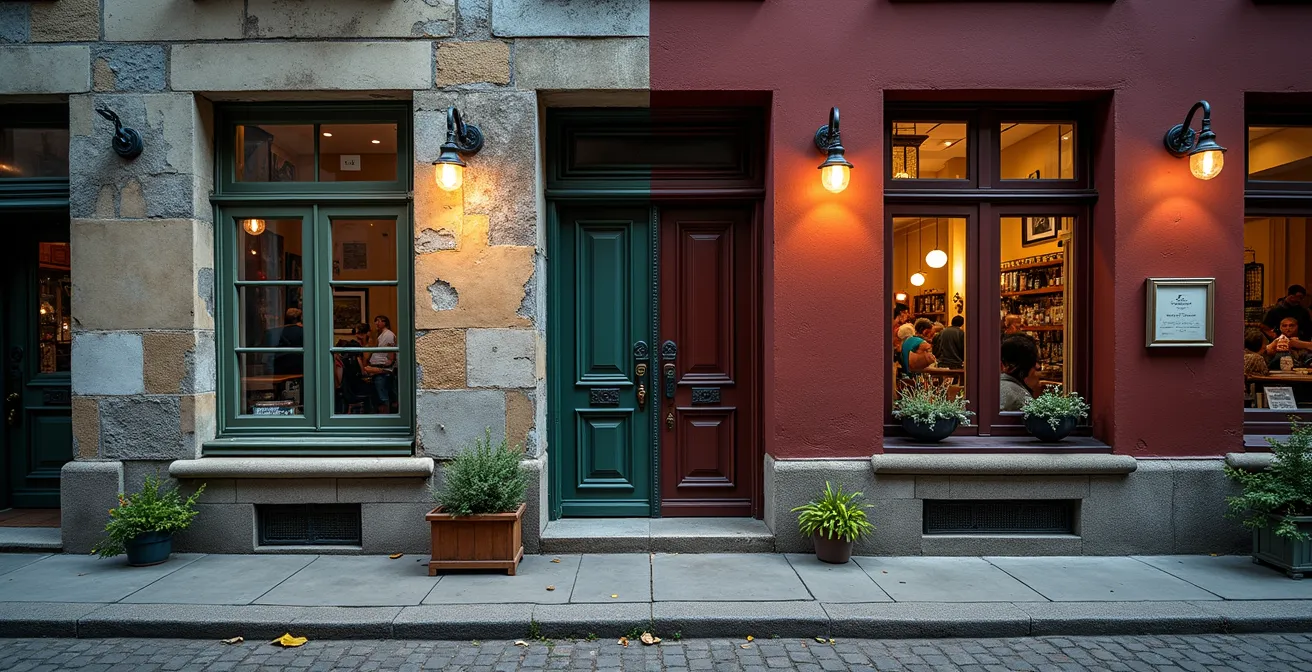
As you walk through areas like the Petit-Champlain district, observe this paradox in action. Notice the contrast between buildings that retain a sense of their lived-in past and those that have been restored to a state of idealized perfection. This visual tension is a key part of the city’s modern story. A prime example of a nearby heritage area balancing this tension differently is the Île d’Orléans, where ancestral homes coexist with a vibrant artisan economy. The island demonstrates how heritage can be a living part of the local economy without succumbing entirely to mass-market tourism.
How to Ask Locals for Recommendations Without Getting Generic Answers?
The most common travel advice is “talk to the locals,” but this often results in well-intentioned but generic suggestions pointing you back to the main tourist circuit. Why? Because the question “What should I see?” naturally elicits a “greatest hits” list. To get authentic recommendations, you must practice intentional inquiry—asking questions that signal you’re not a typical tourist. This means shifting the focus from “what” to “why” and “how.” Instead of asking for a place, ask for a story.
The goal is to connect with people who are not just residents, but storytellers. These are often lifelong locals who hold a deep, personal connection to the city’s history, far beyond the standard guidebook narrative. As one traveler noted after a tour with a renowned local guide, Samuel Dubois: “Our guide Samuel was extremely eloquent and entertaining and whilst hitting the highlights of Quebec also delivered against his promise of showing us facets of Quebec we would not see on a coach trip.” This highlights the difference: a good local connection doesn’t just show you a place, they reveal a new layer of it. This is the kind of insight you want to tap into.
To do this, you need to change your approach. Start conversations by acknowledging your awareness of the tourist bubble. A question like, “I’ve seen the Frontenac and walked the main streets, but I have a feeling the real stories of this neighbourhood are hidden. What’s a piece of history around here that most visitors walk right past?” This signals a deeper interest and invites a more thoughtful response. Visiting community hubs like a neighbourhood *dépanneur* (corner store) or a local microbrewery in Saint-Roch or Limoilou, away from the Old City, can also provide opportunities for more organic conversations.
Action Plan: Eliciting Genuine Local Recommendations
- Acknowledge Limits: Start by admitting that you know the city has secrets that even some locals might not know. Frame your conversation with genuine curiosity about lesser-known history, not as a demand for a “secret spot.”
- Seek Storytellers: Connect with lifelong residents, shopkeepers in older neighbourhoods, or even local historians. Ask for personal anecdotes or fascinating facts about their area, rather than just a restaurant name.
- Ask “Beyond”: Frame your questions specifically to avoid the obvious. Instead of “What’s good?”, try “What’s a fascinating spot that lies in the shadow of the Frontenac Castle?”
- Specify Your Interest: Be specific. “I’m fascinated by the city’s maritime past. Is there a street or building that tells a story about the port that most people miss?” is much better than a generic query.
- Visit Organic Hubs: Go to where community life happens. Local markets, neighbourhood cafés, or small microbreweries are places where information is exchanged naturally, and you’re more likely to get an unguarded recommendation.
Guided Walking Tour vs. Self-Guided App: Which Offers Better Historical Insight?
Choosing how to explore the city presents a classic dilemma: the structured narrative of a guided tour versus the freedom of a self-guided app. From a historian’s perspective, neither is inherently superior; their value depends entirely on your goal. Are you seeking a compelling, curated story, or are you looking for clues to begin your own investigation? The fact that Quebec City is the only fortified city in North America recognized by UNESCO means there is a massive market for tours of all kinds, so choosing wisely is paramount.
A great guided tour, led by a true storyteller, offers something an app cannot: a human connection and curated insight. A passionate guide can bring the Battle of the Plains of Abraham to life, share anecdotes about the first jail, and adapt their narrative to the group’s interest. Some tours even offer exclusive access to sites like a soldier’s casemate within the fortifications, which are otherwise closed to the public. However, you are bound to a fixed route and the guide’s interpretation. This is where narrative deconstruction becomes important—listening critically and understanding that you’re hearing one version of a complex story.
A self-guided app, on the other hand, provides a framework of information while giving you complete autonomy. You can explore at your own pace, linger where you wish, and use the app’s information as a starting point for your own observations. The best apps cover both major landmarks and lesser-known sites, often with offline maps and GPS. This format is ideal for the traveler who has already done some preliminary research and wants to cross-reference historical maps with the modern layout or investigate a specific theme.
The following table breaks down the key differences, including a third option for the truly dedicated researcher: hiring an accredited historian for a private, customized tour. This offers unparalleled depth but requires significant investment.
| Tour Type | Historical Depth | Flexibility | Unique Features |
|---|---|---|---|
| Guided Walking Tour | Narrator shares stories about Battle of Plains of Abraham, evolution of fortifications, oldest house and first jail in North America | Fixed schedule and route | Access to soldiers’ casemate only open for guided tours |
| Self-Guided App | Covers 400 years of history, visits most important sites and lesser-known ones | Explore at your own pace | Download app for offline use, follow GPS navigation |
| Independent Scholar Option | Academic-level expertise from historians | Customizable topics | Hire accredited historians from Université Laval or Société historique de Québec |
The Revisionist History Trap: What Many Tour Guides Get Wrong About New France
The story of New France is the bedrock of Quebec’s identity. As the Encyclopedia of French Cultural Heritage notes, Quebec City was the administrative centre of a vast territory stretching from Labrador to Louisiana. This grand narrative of exploration, settlement, and cultural diffusion is powerful and essential. However, it also creates a “revisionist history trap,” where complex, difficult, or less glamorous parts of the past are smoothed over or omitted entirely in favour of a more romantic and heroic tale for tourist consumption.
Many commercial tours focus on the “great men” of history—Champlain, Frontenac, Montcalm, Wolfe—and the military conflicts that defined the city. While important, this focus often marginalizes other critical narratives. The role of women, the history of medicine and social care, the complex and often fraught relationships with Indigenous nations, and the daily lives of ordinary artisans, labourers, and farmers can be pushed to the background. An authentic historical understanding requires actively seeking out these less-told stories. It means questioning who is being celebrated and, more importantly, whose voices are absent from the main narrative.
A powerful way to escape this trap is to focus on institutions that represent a different kind of history—one of care, science, and community resilience. These stories are less about conquest and more about the enduring human spirit.
Case Study: The Augustinian Nuns’ 400-Year Medical Heritage
A compelling counter-narrative to the military history of Quebec is the story of the Augustinian Nuns. In 1639, they built the continent’s first hospital north of Mexico, the Hôtel-Dieu de Québec. For nearly 400 years, these women dedicated their lives to caring for people with both physical and mental illnesses, playing a foundational role in the development of modern medicine and social welfare in North America. Their story is one of science, faith, and unwavering service, offering a profound perspective on the city’s history that has nothing to do with battles or fortifications. Visiting the Monastère des Augustines provides a direct connection to this incredible 400-year legacy of care.
Researching Before You Go: How to Use Local Archives Online for Trip Planning
The ultimate tool for the historical detective is the archive. Engaging in primary source tourism—using historical documents to guide your exploration—is the most effective way to forge a personal and unique connection with the past. Before you even set foot in Quebec City, you can begin your journey by exploring the rich digital collections of local institutions. This proactive research allows you to arrive not with a list of sights, but with a list of questions and stories you want to investigate on the ground. This is especially rewarding in a city where, according to Parks Canada, close to half the buildings in the Historic District were built before 1850.
Imagine standing on a street corner, looking at a 19th-century map on your tablet, and seeing how the cityscape has changed—or, more fascinatingly, how it has remained the same. Or tracing the history of a single building through old notarial acts, discovering the names and professions of the people who lived there 200 years ago. This is a level of engagement far beyond what any tour can offer. Quebec’s major archival institutions have made a wealth of this material available online, offering a treasure trove for the curious traveler.
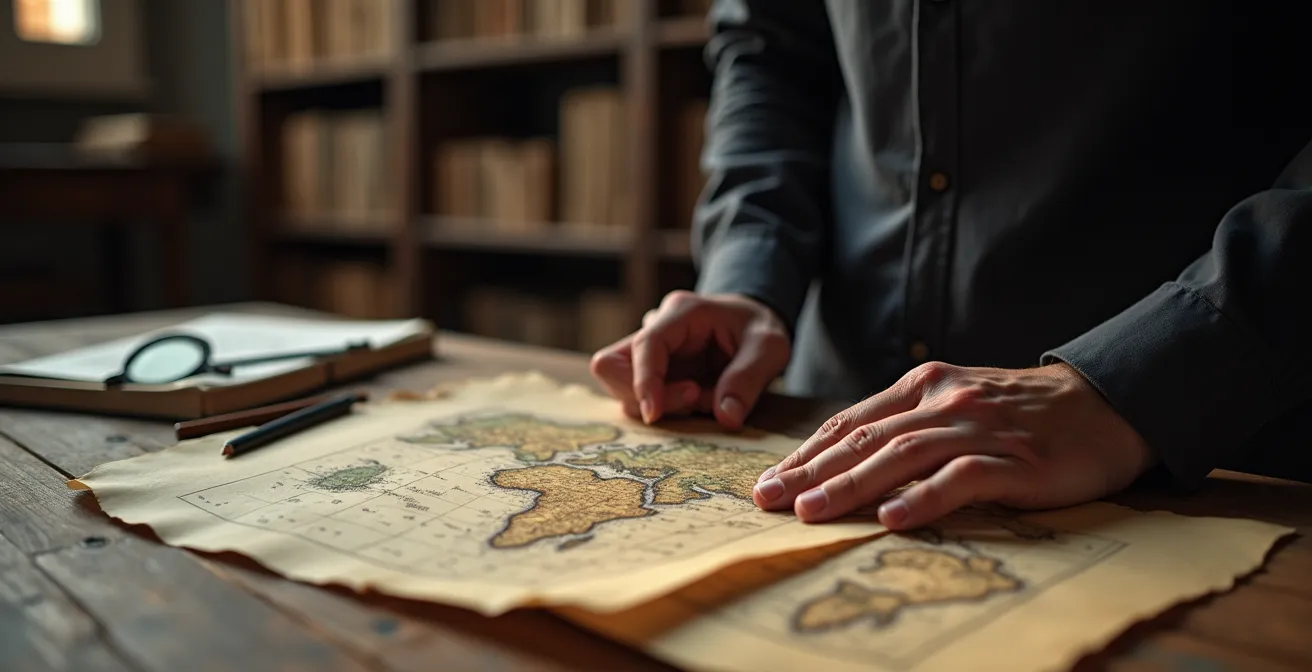
Diving into these archives transforms your trip from a passive viewing experience into an active investigation. Here is a step-by-step guide to get you started on using Quebec’s key digital resources:
- Access BAnQ’s Portal: Begin at the Bibliothèque et Archives nationales du Québec (BAnQ). Its digital portal is the main gateway to countless digitized historical maps, photographs, and official documents.
- Compare Historical Maps: Search for 19th-century neighbourhood maps of areas like Saint-Jean-Baptiste or Saint-Roch. Compare these with a modern map to identify historical street names, lost buildings, or surviving structures.
- Explore Genealogy: Use the Drouin Institute Collection (often accessible via BAnQ or other genealogical sites) to research common Quebecois surnames like Tremblay or Gagnon. You can trace family histories tied to specific parishes.
- Consult University Research: Check the online publications and digital exhibits from Université Laval’s history department. This gives you access to cutting-edge academic research that hasn’t yet made it into popular guidebooks.
- Search Notarial Acts: For a deep dive into daily life, search for “greffe de notaire.” These notarial acts, central to Quebec’s civil law system, record everything from marriage contracts to property sales, offering incredible details about the lives of ordinary people.
Investing in Indigenous Economies: How Your Tourism Dollars Create Impact
An authentic exploration of Quebec City’s history is incomplete without acknowledging the land’s original inhabitants and their enduring presence. For centuries, the dominant narrative has been a colonial one, focusing on European arrival and settlement. A truly conscious traveler must look beyond this and seek opportunities to engage with and support the region’s Indigenous communities, particularly the Huron-Wendat Nation, whose ancestral territory, Nionwentsïo, includes Quebec City.
Investing in Indigenous-led tourism is not just an ethical choice; it is one of the most powerful ways to access an authentic, living history that predates European contact by millennia. This means moving beyond purchasing generic, mass-produced “Indigenous-style” crafts in Old Quebec’s souvenir shops—which often provide no benefit to the communities they claim to represent. Instead, it involves making a conscious decision to direct your time and money towards enterprises that are owned and operated by Indigenous people.
The premier destination for this is Wendake, a vibrant and welcoming urban reserve of the Huron-Wendat Nation located within Quebec City’s limits. Here, you can visit the Huron-Wendat Museum, a world-class institution that tells the nation’s story from their own perspective. You can dine at restaurants like La Traite, which incorporates traditional ingredients into modern cuisine, and stay at the Hôtel-Musée Premières Nations. Every dollar spent here directly supports the community’s economic self-determination, cultural preservation, and the continuation of their storytelling traditions. This is not a historical re-enactment; it’s an encounter with a resilient, thriving culture.
Why Were Fresnel Lenses Revolutionary for Atlantic Navigation?
While Quebec City’s history is often told through its fortifications and churches, its very existence is owed to the St. Lawrence River. The story of this vital waterway is a tale of treacherous currents, dense fog, and the constant struggle for safe navigation. A key chapter in this maritime history is the technological marvel of the Fresnel lens. Understanding its impact provides a tangible connection to the science and engineering that made modern Quebec possible.
Invented by French physicist Augustin-Jean Fresnel in the 1820s, the lens was a revolutionary breakthrough in lighthouse technology. Before Fresnel, lighthouses used simple mirrors to reflect light, a highly inefficient method that produced a weak, diffuse beam. The Fresnel lens, however, was a masterpiece of optical design. It consisted of a series of concentric glass prisms and a central lens, all precisely cut and arranged to capture, refract, and focus light from a single lamp into a powerful, concentrated beam that could be seen from dozens of miles away. It was significantly thinner, lighter, and vastly more efficient than any previous system.
For the St. Lawrence River and the Gulf of St. Lawrence—one of the world’s most dangerous bodies of water—this was a game-changer. The implementation of Fresnel lenses in lighthouses along the coast and riverbanks dramatically reduced the number of shipwrecks. This made shipping safer, trade more reliable, and ultimately facilitated the immigration and commerce that allowed Quebec and Canada to grow. The Pointe-au-Père lighthouse, now a national historic site downriver from Quebec City, housed a massive Fresnel lens and is a testament to this era.
Key Takeaways
- Authenticity is a mindset, not a location. It’s about learning to deconstruct tourist narratives and read the complex history behind the facades.
- UNESCO status is a double-edged sword, preserving buildings while sometimes accelerating the commercialization that erodes a district’s living character.
- True historical insight comes from seeking out marginalized stories—those of women, Indigenous peoples, artisans, and caregivers—to balance the dominant military and political narratives.
Old Montreal vs. Distillery District: Which Historic Quarter Fits Your Vibe?
To deepen your understanding of what you seek in a heritage experience, it’s useful to compare Quebec City’s historic core to other renowned Canadian sites. While Old Quebec is unique, contrasting it with places like Old Montreal and Toronto’s Distillery District can help you identify your personal “heritage vibe.” This self-awareness is a key tool for a culture-focused traveler, allowing you to make more intentional choices on future trips.
Old Montreal shares a strong French colonial heritage with Old Quebec. It is a labyrinth of cobblestone streets, grand 19th-century banking halls, and the stunning Notre-Dame Basilica. The vibe here is one of romantic, European-style urbanism. Like Old Quebec, it grapples with the preservation paradox, balancing its role as a living neighbourhood with its status as a top tourist magnet. If you are drawn to the feeling of being transported to a different century, the architectural grandeur, and the palpable connection to New France, then Old Montreal’s atmosphere will feel familiar and appealing.
Toronto’s Distillery District, by contrast, offers a completely different flavour of heritage. This area preserves the largest collection of Victorian-era industrial architecture in North America. Once home to the massive Gooderham & Worts distillery, its red-brick warehouses and factory buildings have been transformed into a pedestrian-only village of galleries, theatres, boutiques, and restaurants. The vibe is post-industrial chic, celebrating a history of manufacturing, innovation, and labour rather than colonial administration or religious orders. It’s a story of commerce and production, and its preservation feels more like an adaptive reuse project than a museum piece.
Ultimately, transforming your visit from a standard tour into a genuine historical inquiry is a choice. It requires curiosity, a bit of preparatory work, and a willingness to look beyond the perfect postcard view. By questioning the narratives presented to you, seeking out the untold stories, and engaging with the city on a deeper level, you move from being a mere spectator to an active participant in its history. Armed with this new perspective, you are no longer just visiting Quebec City—you are uncovering it.