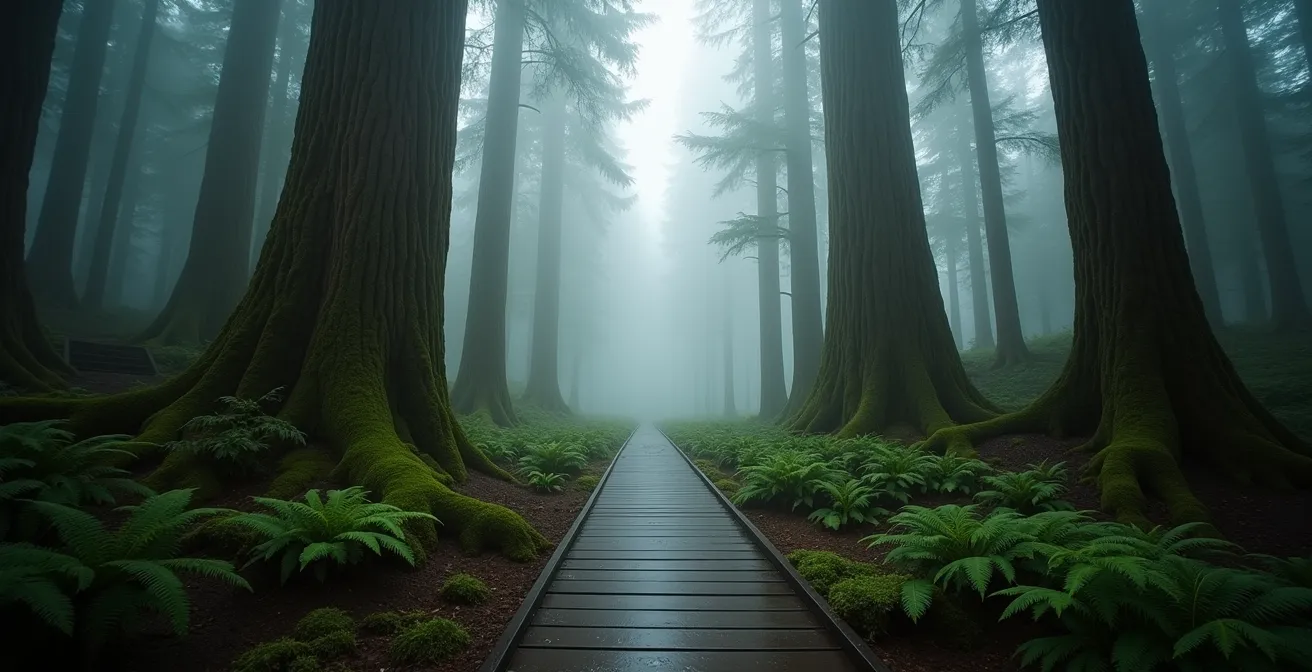
Forget the summer crowds and sun-drenched clichés. The conventional wisdom that Tofino’s best side is its sunny side is a myth. The true soul of this Vancouver Island sanctuary awakens in October, when the fog rolls in and the storms begin to rage. This guide reveals why the moody, atmospheric conditions of autumn aren’t a drawback but are the main attraction, offering a deeply sensory and mystical experience that sunnier months simply cannot match.
Most travel guides paint a picture of Tofino centred around summer sun, surfing, and sandy toes. They advise you to visit between June and August, promising long days and pleasant weather. But for a certain kind of traveller—one who seeks atmosphere over amenities and soul-stirring solitude over bustling crowds—this advice misses the point entirely. What if the constant drizzle, the low-hanging clouds, and the dramatic crash of waves weren’t things to be endured, but the very reasons to make the pilgrimage to this wild edge of Canada?
The secret is that Tofino’s magic doesn’t fade with the summer sun; it transforms. October marks the beginning of the storm watching season, a time when the Pacific Ocean flexes its power and the temperate rainforest comes alive in a symphony of scents and sounds. This is not about tolerating the rain; it is about embracing an aesthetic of ‘wet weather travel,’ finding beauty in the grey, and discovering a profound connection to nature when it is at its most raw and untamed.
But if the true key to unlocking Tofino’s heart isn’t avoiding the rain, but chasing the storm, how does one do it? This journey will guide you through the atmospheric alchemy of an autumn visit. We will explore why the rain is a life force, how the fog becomes a photographer’s best friend, and why a walk in a damp forest can be a scientifically-proven boost to your well-being. We will uncover the secrets to navigating misty trails and reward ourselves with the uniquely Canadian comfort that follows a day spent in the embrace of the storm.
This guide provides a complete roadmap for experiencing the enchanting, moody beauty of Tofino in the fall. Below, you will find a detailed table of contents outlining each step of your atmospheric adventure, from the science behind the storms to the best places to find ancient trees in peaceful solitude.
Table of Contents: A Guide to Tofino’s Mystical Autumn
- Why Does “Storm Watching” Attract Tourists to the Pacific Northwest?
- How to Shoot in High Humidity Without Fogging Your Lens?
- Rainforest A or Beach B: Which Trail is More Mystical in the Fog?
- The Boardwalk Danger: How to Walk on Wet Cedar Planks Without Falling?
- Post-Hike Recovery: Where to Find the Best Hot Chocolate in Tofino?
- Why Does It Rain 3,000mm a Year on Vancouver Island’s West Coast?
- Why Do Phytoncides from Cedars Boost Your Immune System?
- Where to See 800-Year-Old Cedars on Vancouver Island Without Crowds?
Why Does It Rain 3,000mm a Year on Vancouver Island’s West Coast?
To understand Tofino in October, one must first understand the rain. It’s not just weather; it’s the lifeblood of the entire ecosystem. The west coast of Vancouver Island is one of the wettest places in North America, with regional weather data confirming that Tofino and Ucluelet receive up to 3,000 mm (118 inches) of rain annually. This immense precipitation is the architect of the lush, emerald world that draws visitors—the very reason the temperate rainforest exists.
Much of this rainfall arrives via a phenomenon well-known to West Coast Canadians: the Pineapple Express. This is a type of “atmospheric river” that carries a long, narrow band of warm, subtropical moisture all the way from the waters near Hawaii. When this moisture-laden air mass hits the Vancouver Island Ranges, the mountains act as a colossal barrier. The air is forced to rise, cool, and release its staggering volume of water in a process called orographic lift. One local analogy perfectly describes it as a “giant sponge squeezer,” creating the exact conditions needed for one of Earth’s rarest and most magical ecosystems to thrive.
This isn’t just a downpour; it’s a delivery of life. The rain nourishes the ancient cedars, swells the creeks, and blankets the forest floor in a carpet of moss and ferns. For the visitor, it creates a world of heightened senses, where the colours of the forest become more saturated, the air smells of rich earth and wet cedar, and the sound of water is a constant, soothing companion. Embracing the rain is the first step to truly experiencing Tofino.
Why Does “Storm Watching” Attract Tourists to the Pacific Northwest?
What was once considered the “off-season” has become Tofino’s most iconic experience: storm watching. This is not a passive activity but an intentional pilgrimage to witness the sublime power of nature. It’s the thrill of watching 10-metre waves crash against the shoreline, feeling the wind rattle the windows, and experiencing the awe-inspiring blend of terror and beauty that only a Pacific storm can deliver. According to tourism data, the coastline is battered by 15 to 20 mega storms between October and March, turning the ocean into a dramatic theatre of raw energy.
The concept was pioneered by Charles McDiarmid, owner of the Wickaninnish Inn, who saw the potential in the region’s wild winters. As he explained in an interview with the Toronto Star, “Nature was our entertainment, and we thought, maybe there are other crazy people like us who would love to be here in a big storm.” This idea transformed Tofino’s economy, giving birth to a unique form of tourism.
The Wickaninnish Inn, opened in 1996, was designed specifically to showcase these tempests. Its rooms feature massive windows built to withstand hurricane-force winds, cozy fireplaces, and wool blankets. This curated experience of watching the maelstrom from a place of safety and comfort created the concept of “Pacific Northwest Hygge.” It’s the profound satisfaction of being warm and secure while witnessing nature’s untamed spectacle—a feeling that defines the romantic allure of a Tofino autumn. The storm is no longer an inconvenience; it is the main event.
Why Do Phytoncides from Cedars Boost Your Immune System?
A walk in Tofino’s misty, ancient rainforest is more than just a visual delight; it’s a therapeutic experience, backed by science. The air, thick with the scent of cedar and damp earth, is rich in airborne compounds called phytoncides. These are antimicrobial essential oils released by trees, particularly conifers like the giant Western Red Cedars of the Pacific Rim, to protect themselves from insects and decay. When we inhale these compounds, we receive profound health benefits.
The practice of “forest bathing” or *Shinrin-yoku* has been studied extensively in Japan, and the results are remarkable. Research reported by NPR shows that spending time in a forest can lead to a 40-50% increase in the activity of natural killer (NK) cells—a type of white blood cell that fights off infection and tumour formation—with the effects lasting for over a week. But here’s what makes a Tofino hike in October uniquely potent. Dr. Qing Li, a leading researcher in the field, notes, “The rain and high humidity actually aerosolize the phytoncides more effectively, making a damp Tofino hike a more potent immune-boosting experience.”
This modern science beautifully aligns with ancient wisdom. As Stanford research confirms, inhaling phytoncides decreases stress hormones like cortisol while boosting our immune system. This echoes the traditional use of Cedar as the “Tree of Life” for medicine and wellness by the Nuu-chah-nulth First Nations, the traditional guardians of this land. The damp, foggy air of October acts as a natural diffuser, delivering a powerful dose of tranquility and health with every breath.
Rainforest A or Beach B: Which Trail is More Mystical in the Fog?
In Tofino, the fog is not a blanket that obscures; it is a curtain that reveals. It performs a kind of atmospheric alchemy, transforming familiar landscapes into otherworldly scenes. Both the ancient rainforest and the sprawling coastline offer profoundly mystical experiences in the mist, but each has its own distinct character and sensory profile. Choosing between them depends on the kind of magic you seek.
Local photographer Jen McLeod, who moved to the coast from the prairies, describes fog as her favourite condition to shoot in, noting, “She is available year-round on the west coast, in all weather.” The fog creates an intimate, transformative quality, whether you are under a canopy of giants or standing at the edge of the world. As a Parks Canada analysis shows, the sensory experience differs dramatically between the two environments.
The following table, based on information from interpretive data for Pacific Rim National Park Reserve trails, breaks down the unique qualities of each foggy landscape.
| Sensory Element | Rainforest Trail (Pacific Rim) | Long Beach / Schooner Cove |
|---|---|---|
| Visual Effect | Cathedral Effect: fog trapped by 800-year old cedar canopy creates enclosed sacred space | Infinity Illusion: fog merges sea and sky into seamless empty canvas |
| Soundscape | Dampened forest sounds, rhythmic water drops from canopy, muffled footsteps on boardwalk | Muffled wave crashes, distant fog horns, wind whistling through driftwood |
| Smell-scape | Rich petrichor, wet cedar aromatics, mushroom earthiness | Briny salt air, kelp tang, marine minerals |
| Touch Sensation | Cool moisture on skin, smooth wet boardwalk underfoot | Salt spray mist, sand between toes, wind chill factor |
| Mystical Quality | Intimate enclosure, vertical mystery, ancient presence | Vast solitude, horizontal endlessness, temporal dissolution |
The rainforest offers an experience of intimate enclosure and ancient presence, as if you’ve stepped into a sacred, silent cathedral. The beach, by contrast, provides a feeling of vast solitude, where the fog erases the horizon and dissolves your sense of time and scale, leaving you alone with the rhythmic breath of the ocean.
How to Shoot in High Humidity Without Fogging Your Lens?
For photographers, the misty conditions of a Tofino October are a creative dream, offering soft, diffused light and a moody aesthetic that sunny days can’t replicate. However, the high humidity and temperature changes present a significant technical challenge: lens fog. Moving from a warm car or cabin to the cold, damp air can instantly cover your lens in condensation, ruining a perfect shot. The key is not just to fight the fog, but to manage it—and sometimes, even to use it creatively.
This requires a specific toolkit of professional techniques. Proper preparation can mean the difference between a frustrating outing and a portfolio of ethereal, atmospheric images. It’s about acclimatization, specialized gear, and strategic planning.

As the image above suggests, protecting your gear is paramount. But beyond physical covers, mastering the environment is key. Here are some professional techniques for shooting in Tofino’s signature fog:
- Apply the Acclimatization Method: When moving between warm and cold environments, keep your camera in a sealed bag for 15-20 minutes. This allows the equipment to equalize its temperature slowly, preventing condensation from forming on the glass.
- Embrace the “Bloom” Technique: Instead of fighting all fog, use it. A small amount of intentional lens fog, shot at a wide aperture like f/1.8, can create a natural, soft-focus “bloom” effect that enhances the dreamy, ethereal quality of the scene.
- Prepare West Coast-Specific Gear: Standard cloths won’t cut it. Use high-performance microfiber cloths designed for marine environments. Consider applying an anti-fog solution, like those used for diving masks, to your lens filter (never directly on the lens), and use rain covers even on weather-sealed bodies for extra security.
- Plan Shooting Times Strategically: The fog has its own rhythm. While August is locally known as “Fogust” for its predictable morning fog, October combines fog with the dramatic light of incoming storms, offering more varied and dynamic atmospheric effects throughout the day.
The Boardwalk Danger: How to Walk on Wet Cedar Planks Without Falling?
The iconic boardwalks that wind through Tofino’s rainforests are essential for protecting the fragile ecosystem, but in the wet months, they present their own unique challenge. As weather data shows, October rainfall increases progressively throughout the month, keeping the cedar planks in a near-constant state of dampness. This moisture encourages the growth of a slippery, invisible biofilm—a mix of algae, fungi, and bacteria—that can make the surface as treacherous as ice.
Navigating these trails safely requires more than just good boots; it demands a change in how you walk. Rushing is the enemy. Instead, you must adopt a mindful, deliberate gait, paying close attention to the texture and condition of the wood underfoot. Shaded sections, areas where the boardwalk changes elevation, and planks without handrails are particular danger zones that require heightened awareness.

To move with confidence, locals and seasoned hikers employ specific techniques, many of which will feel familiar to anyone who has navigated a Canadian winter. Here are the essential safety methods for wet boardwalk navigation:
- Choose Appropriate Footwear: Your choice of shoe is critical. Select hiking boots with a soft, grippy rubber compound like Vibram Megagrip or Arctic Grip. These are specifically designed for traction on wet wood and far outperform the hard rubber of rock scrambling boots.
- Practice the “Boardwalk Shuffle”: Keep your center of gravity low and shorten your stride to about half its normal length. Most importantly, maintain flat-footed contact with the planks rather than walking heel-to-toe. This maximizes the surface area of your boot’s grip.
- Implement the “Penguin Walk”: For especially slick sections, turn your feet slightly outward and keep your arms away from your body for balance. Shift your weight slowly and deliberately from one foot to the other, minimizing the time each foot is in the air.
Key Takeaways
- October’s fog and rain are not obstacles but the very source of Tofino’s mystical, atmospheric beauty.
- The damp air enhances the health benefits of the rainforest by aerosolizing immune-boosting phytoncides from cedar trees.
- Embracing “Pacific Northwest Hygge”—the cozy recovery after a dramatic, stormy hike—is a core part of the authentic Tofino experience.
Where to See 800-Year-Old Cedars on Vancouver Island Without Crowds?
Standing in the presence of an 800-year-old cedar is a humbling, almost spiritual experience. These ancient giants are the silent elders of the rainforest, and finding them in solitude is the ultimate reward for the atmospheric traveller. While popular trails like Cathedral Grove can be overrun, the Tofino-Ucluelet area offers quieter sanctuaries, especially during the misty weekdays of October when you can feel like the only person in the world.
The key is to practice what can be called “temporal solitude”—visiting popular spots at off-peak times—or to venture slightly further afield to trails protected and maintained by the local First Nations. A visitor to one such trail on Meares Island shared their experience: “The Big Tree Trail was superb. Exactly what I imagined a northern hemisphere rainforest to be… The boat taxi owner told us it would be muddy. It was, and then some. Worth every penny though.” This captures the essence of the adventure: the reward is directly proportional to the effort.
Respect is paramount when visiting these sacred groves. The shallow root systems of ancient cedars are incredibly fragile. Staying strictly on the boardwalks is not just a rule; it is a vital act of conservation to ensure these giants can stand for another 800 years.
Your Action Plan: Finding Solitude Among Giants
- Visit the Big Tree Trail on Meares Island: Charter a water taxi from the Tofino harbour. This short boat ride takes you to the Tla-o-qui-aht Tribal Park, where a 2.4km boardwalk loops through some of the most magnificent and accessible old-growth cedars in the region, far from the highway crowds.
- Explore the Wild Pacific Trail: Based in Ucluelet, this stunning trail system offers numerous sections that dip into pockets of old-growth forest between dramatic coastal viewpoints. The misty conditions of October make it especially peaceful.
- Practice Temporal Solitude: If you must visit the popular Rainforest Trails (Loops A & B) in the Pacific Rim National Park Reserve, go on a foggy weekday morning. Arrive early, and you may be granted a precious hour alone with the trees before others arrive.
- Follow Old-Growth Leave No Trace: The most crucial step. Never step off the boardwalk to get closer to a tree base. Trampling the ground compacts the soil and irreparably damages the delicate, shallow roots that sustain these ancient beings.
- Check Local Conditions: Always check with local visitor centres or Parks Canada for trail conditions, especially after a major storm, as boardwalks can sometimes be damaged or temporarily closed for repair.
Post-Hike Recovery: Where to Find the Best Hot Chocolate in Tofino?
After a day spent exploring misty trails and braving the coastal winds, the ritual of warming up is an essential part of the Tofino experience. It’s the satisfying conclusion to the day’s adventure, the moment of “Pacific Northwest Hygge” where you trade damp clothes for dry comfort. While a steaming mug of hot chocolate is a classic choice, Tofino offers a whole culture of post-hike recovery, with options to match any mood, from a quick buzz to a contemplative cocktail.
For the purist, The Beach Shack at Cox Bay elevates the simple hot chocolate into a West Coast art form, with creative twists like smoked sea salt or foraged spruce tips. But the warming ritual extends far beyond cocoa. At the Wickaninnish Inn, you can settle into the On The Rocks Bar for a cedar-infused old-fashioned, watching the last of the storm pass. Alternatively, the Great Room at Long Beach Lodge Resort offers panoramic ocean views to accompany a locally-roasted coffee, providing a perfect perch to continue your storm watching in comfort.
The choice of venue often depends on the energy of your group and the vibe you’re seeking. Local recommendations offer a clear guide. For a quick, energizing refuel, locals point to Tofino Coffee Roasting Company for the best coffee to shake off the chill. If the hike was a celebratory triumph with friends, the courtyard at Tofino Brewing Company is the perfect spot to raise a glass. And for a more sophisticated, contemplative end to the day, the acclaimed cocktails and refined atmosphere at The Wolf in the Fog provide the ideal setting to reflect on the wild beauty you’ve just witnessed.