
In summary:
- Running from a grizzly triggers its predatory chase instinct; stand your ground and prepare your deterrents.
- The noise from rushing rivers creates “acoustic masking,” hiding your presence and a bear’s approach, demanding heightened visual awareness.
- Bear spray effectiveness is heavily influenced by wind and distance. Master deployment techniques before you need them.
- A bear’s intent (defensive vs. predatory) can often be read in its body language, particularly its ears, which informs your reaction.
- Avoid riverbanks entirely during peak salmon runs when bears are in a state of intense feeding (hyperphagia).
The rhythmic sound of a Canadian river is a balm for any angler or paddler. It’s the sound of solitude, of nature undisturbed. But in that constant rush of water lies a hidden danger. Imagine standing mid-stream, focused on your line, when a flicker of movement on the bank resolves into the powerful form of a grizzly bear. Your heart hammers against your ribs. The instinct to turn and flee is overwhelming, a primal scream in your mind. This is the single most critical moment of the encounter, and giving in to that instinct is the most dangerous mistake you can make.
Standard advice for bear country—make noise, carry spray, don’t run—is a good starting point, but it’s dangerously incomplete for a riparian environment. The very element that draws you to the river also masks your sound, creating a scenario where surprise encounters at close quarters are far more likely. A bear foraging along the bank may not hear your calls or footfalls over the roar of the rapids. Likewise, you won’t hear its approach. Safety here isn’t just about reacting correctly; it’s about proactively understanding the unique sensory world of the riverbank and how a bear perceives it.
This guide moves beyond the basics. We will deconstruct the dynamics of a riverbank encounter from an expert’s perspective. The real key to survival is not a louder voice, but superior awareness. It’s about learning to see the river not just as a fishing spot, but as a complex “threat topography,” recognizing the dangers of acoustic masking, and mastering your tools before you are ever tested. We will analyze the mechanics of bear spray in unpredictable winds, how to interpret a bear’s subtle cues, the crucial rules of distance, and what essential gear you must have to turn a potentially fatal encounter into a non-event.
To navigate these critical topics, this guide is structured to build your expertise progressively. Below is a summary of the key areas we will cover, from understanding your equipment to reading the environment and the animal itself.
Summary: Grizzly Encounter Safety for Riparian Environments
- Bear Spray Mechanics: How Does Wind Affect Spray Range Near Water?
- Predatory vs. Defensive: How to Identify a Bear’s Intent by Its Ears?
- The 60-Meter Rule: How Far Should You Camp from the Water’s Edge?
- The Water Noise Danger: Why Rushing Rivers Hide Your Sound from Bears?
- Salmon Run Season: When Should You Avoid River Banks Completely?
- The 100-Meter Rule: What Happens If You Get Too Close to an Elk?
- How to Deploy Bear Spray Without Blinding Yourself in the Wind?
- Wilderness Survival Kits: What 5 Items Must You Carry in Canadian Forests?
Bear Spray Mechanics: How Does Wind Affect Spray Range Near Water?
Bear spray is your most effective non-lethal deterrent, but it is not a magic bullet. Its performance is governed by physics, with wind being the most critical and unpredictable variable in a river valley. A river corridor often acts as a wind tunnel, creating complex drafts that can dramatically alter the trajectory and range of the spray. Understanding these mechanics is not optional; it’s fundamental to your safety. The active ingredient, capsaicin, needs to reach the bear’s face—specifically its eyes and nose—to be effective. Wind can cause the spray to “blow back” towards you or drift harmlessly away.
The effective range is typically advertised as 5 to 10 metres, but this is under ideal, windless conditions. In a crosswind, you must aim slightly upwind of the bear to allow the cloud to drift into its path. In a headwind, the range is severely reduced, and the risk of blowback is high, which is why proper deployment technique is crucial. Conversely, a tailwind can extend your range but may also disperse the cloud too quickly. According to a 2020 publication in the Journal of Wildlife Management, bear spray remains an effective deterrent even in adverse conditions like wind and cold, but its performance is undeniably influenced by them.
It’s vital to recognize that factors like rain and freezing temperatures can also impact effectiveness. Rain can wash the spray away more quickly, and cold can reduce canister pressure, slightly decreasing range. Despite these variables, bear spray has a proven track record. The key is not to rely on its maximum advertised potential but to train for its real-world application, anticipating the influence of your immediate environment. This means practicing with inert training canisters to understand how wind affects the spray pattern in a safe setting.
Predatory vs. Defensive: How to Identify a Bear’s Intent by Its Ears?
Not all bear encounters are the same. The most crucial distinction you must make in a split second is whether you are facing a defensive bear or a predatory one, as your response must differ. A defensive bear is one that has been surprised, feels threatened, or is protecting its cubs or a food source. A predatory bear is exceedingly rare but is one that sees you as potential prey. Body language is your only guide, and a bear’s ears are one of the most reliable indicators of its state of mind.
A defensive bear will often display a series of stress signals. It may woof, huff, clack its jaw, or perform bluff charges—running at you and then veering away at the last second. In this state, its primary goal is to increase the distance between you and it. As Parks Canada experts note, a defensive reaction often involves the bear laying its ears back flat against its head. This is a sign of agitation and fear, not necessarily aggression. The bear is saying, “You are too close, you are a threat, back off.” Your response should be to appear non-threatening: speak in a calm, low voice and slowly back away.

In contrast, a predatory bear is often silent and deliberate. Its head will be up, and its ears will be forward, focused intently on you. It may approach slowly and persistently, without the noisy displays of a defensive bear. It is not trying to scare you away; it is assessing you. This is the most dangerous type of encounter. You must not back away or play dead. You must stand your ground, make yourself look as large as possible, and prepare to fight for your life, using your bear spray as the primary weapon. Recognizing the difference in ear position—ears back for defense, ears forward for predation—is a critical survival skill.
The 60-Meter Rule: How Far Should You Camp from the Water’s Edge?
Proactive safety in bear country is about managing attractants and location. The “60-Meter Rule” is a guideline that encapsulates a core principle: create a buffer zone between your campsite and high-traffic animal corridors. Riverbanks and shorelines are natural highways for wildlife, especially for bears who use them to travel, drink, and forage for food. Camping too close to the water’s edge places you directly in their path, dramatically increasing the likelihood of a surprise nocturnal encounter.
While a specific 60-meter rule might vary by park regulation, the philosophy behind it is universal. Your goal is to establish your sleeping and cooking areas well away from these natural travel routes. Parks Canada’s successful ‘Bare’ Campsite Program, implemented across mountain national parks like Banff and Jasper, is built on this philosophy of minimizing human-wildlife conflict. It requires that all food, garbage, and scented items be stored in a vehicle or a provided bear-proof locker, ensuring your site offers no reward for a curious bear.
The distance rule complements this by reducing the chance of an encounter in the first place. You should set up your tent at least 60 to 70 metres (about 200 feet) from the water. Furthermore, your cooking and food storage area should be another 60 to 70 metres away from your tent, creating a “triangle” layout. This ensures that any bear attracted by cooking odours will investigate your food storage area, not your sleeping quarters. By respecting these distances, you are not only protecting yourself but also helping to keep the park’s wildlife wild and safe from habituation to human food sources.
The Water Noise Danger: Why Rushing Rivers Hide Your Sound from Bears?
The single greatest risk factor in a riparian environment is a phenomenon I call acoustic masking. The constant, low-frequency roar of a rushing river effectively drowns out other sounds within a certain radius. For anglers and paddlers, this is a double-edged sword. It masks the sounds of your approach—your wading, your casting, your conversation—preventing a bear from hearing you coming. Simultaneously, it masks the sound of a bear moving along the bank, preventing you from hearing it. This sets the stage for a sudden, close-quarters surprise encounter, the most dangerous scenario possible.
In a quiet forest, a bear can hear a snapping twig from hundreds of metres away, giving it ample time to avoid you. Near a turbulent river, you could be just 30 metres apart and neither of you would know it. Bear bells are utterly useless in this environment; their gentle tinkle is immediately swallowed by the river’s noise. Your voice is your best tool, but you must use it loudly and frequently. As you move along the river, especially around blind corners, through dense vegetation, or near berry patches, you should be actively calling out, clapping your hands, or singing loudly. This isn’t about being obnoxious; it’s about penetrating the acoustic mask to announce your presence.
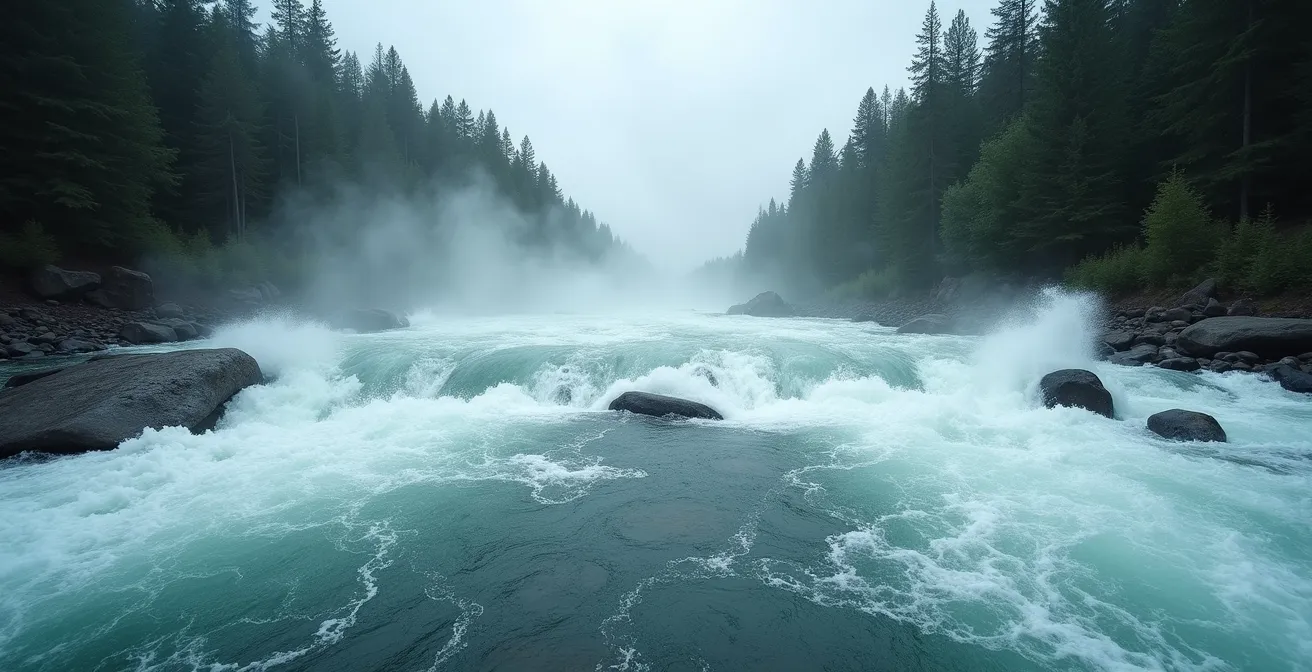
Because your hearing is compromised, your other senses must be heightened. This means constant visual scanning of your surroundings. Look for fresh bear signs: tracks in the mud, fresh droppings (scat), overturned rocks, or logs torn apart. These are clear indicators that a bear is active in the area. Travelling in a group is always safer, as more eyes and voices increase the chances of detecting a bear or being detected by one. In a high-noise river environment, you must shift from a passive hiker to an active scanner, consciously compensating for the sensory deficit created by the water.
Salmon Run Season: When Should You Avoid River Banks Completely?
There are times when the risk of a bear encounter on a riverbank is so high that the only safe strategy is avoidance. This is never truer than during the annual salmon run. This period triggers a state in bears known as hyperphagia—a biological drive to consume massive amounts of calories in preparation for winter hibernation. During this time, a grizzly’s behaviour changes. They become intensely focused on fishing and are less tolerant of disturbances. A single bear must consume over 20,000 calories daily, and a river teeming with salmon is the most efficient place to do so.
This intense feeding drive leads to high concentrations of bears along specific river systems. An area that was quiet in July can become a hub of grizzly activity in September. For an angler, this means you are not only increasing your chance of an encounter, but you are also potentially competing with a bear for its most critical food source—a recipe for conflict. The risk is simply not worth the reward. Responsible wilderness travel means recognizing when to cede the territory to wildlife.
Knowing the regional timing of these runs is essential for planning any trip. While it varies by location and species of salmon, the peak season in many of Canada’s prime grizzly habitats occurs in the late summer and early autumn. The following table provides a general guide to peak salmon run times in key Canadian bear-viewing regions, where bear activity will be at its absolute maximum.
| Region | Peak Salmon Run | Bear Activity Level | Risk Assessment |
|---|---|---|---|
| British Columbia Coast | Late August – Early October | Maximum – Hyperphagia | Extreme – Avoid riverbanks |
| Vancouver Island Rivers | August – Mid-October | High – Feeding concentrations | High – Guided tours only |
| Great Bear Rainforest | Late August – October peak | Very High – Multiple bears | Extreme – Professional guides required |
| Bella Coola Valley | September – October | High – River congregation | High – Maintain distance |
The 100-Meter Rule: What Happens If You Get Too Close to an Elk?
While this guide focuses on grizzlies, a true expert in riparian safety understands that a bear does not exist in a vacuum. The behaviour of other large animals, particularly elk, can be a powerful indicator of a predator’s presence. In Canadian national parks like Banff and Jasper, the official guideline is to remain at least 100 metres (about 330 feet, or the length of a football field) from any bear. But what does this have to do with elk?
Think of the ecosystem as an information network. Nervous, agitated behaviour in a herd of elk is often a signal that a predator is nearby. If you see elk that are tightly bunched, wide-eyed, and constantly scanning their surroundings, it’s a red flag. They may have scented or seen a bear or a wolf that you have not. Approaching them not only puts them under further stress but also places you squarely in a potential conflict zone. If you are close enough to an elk to make it nervous, you are almost certainly too close to whatever is making *it* nervous.
This concept of using prey animals as an early warning system is a key component of advanced situational awareness. The 100-meter rule for bears is a reactive boundary for when you’ve already seen one. Watching elk behaviour allows you to be proactive. If you see a kill site or notice a herd of elk giving a wide berth to a certain thicket or bend in the river, you should do the same. Respecting the space of all large wildlife, not just predators, is part of a holistic safety strategy that keeps both you and the animals safe. Getting too close to an elk is a mistake not just because the elk itself can be dangerous, but because it signals a breakdown in your situational awareness of the entire environment.
How to Deploy Bear Spray Without Blinding Yourself in the Wind?
Knowing that wind affects bear spray is one thing; knowing how to physically deploy it to compensate for that wind is another. The goal is to create a barrier of concentrated spray between you and the bear, and to do so without incapacitating yourself in the process. This requires a specific, practiced technique, especially in the swirling winds common along a river.
The first step is to adopt a stable stance. Many experts recommend taking a knee. This lowers your center of gravity and, more importantly, brings the spray nozzle closer to the ground, where wind speeds are often lower. This reduces the chance of the spray cloud blowing straight back into your face. It also presents a smaller target to a charging bear. From this braced position, you can deploy the spray with more accuracy. Aim low, towards the front of the bear, not high into the air. The spray forms a cone that expands as it travels; aiming at the bear’s chest or front legs will cause the upper part of the cone to envelop its face.
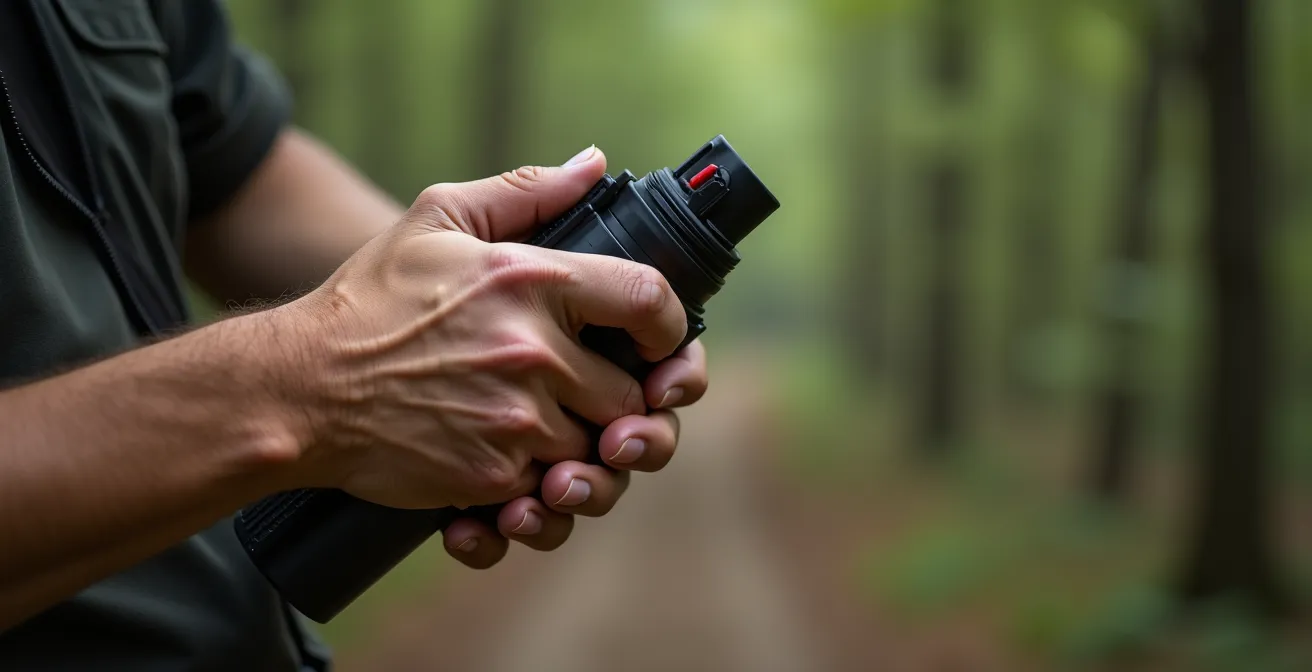
Deploy the spray in short, 1-2 second bursts, not one continuous spray. This conserves your deterrent, allowing for multiple bursts if the bear continues to approach or if the wind changes. After the initial burst, you should immediately begin moving. Do not turn and run. Back away slowly, moving laterally and upwind if possible, to get out of the spray cloud. This puts you in a better position to see the bear’s reaction and deploy another burst if necessary. Practice removing the safety clip with one hand so you can do it instantly under pressure. Your canister should be immediately accessible on your belt or chest holster, not buried in a backpack.
Your Post-Encounter Action Plan
- Immediate Action: Deploy short 2-second bursts of spray while continuing to back away slowly. Never turn your back.
- Manoeuvre: Immediately after spraying, move laterally (sideways) and upwind to clear the spray cloud and maintain a visual on the bear.
- Exit the Area: Once the bear has retreated or moved on, leave the area calmly but quickly. Do not run.
- Report the Incident: As soon as you are safe, report all bear encounters involving spray deployment to the local park authority, such as Banff National Park Dispatch at 403-762-1470.
- Document Details: Note the GPS coordinates, time of the incident, and a description of the bear and its behaviour to provide a complete report to authorities.
Key takeaways
- Your primary survival tool is awareness, not just equipment. Understand how a river’s noise masks sound for both you and the bear.
- Interpret bear body language, especially ear position, to differentiate between a defensive (scared) and predatory (dangerous) encounter.
- Master your bear spray: practice deployment in windy conditions and understand its limitations on range and blowback.
Wilderness Survival Kits: What 5 Items Must You Carry in Canadian Forests?
Knowledge and awareness are your primary survival tools, but they must be supported by the right physical equipment. For an angler or paddler operating in the remote river valleys of Canada, a standard hiking daypack is not enough. Your kit must be specifically tailored for the unique risks of a riparian bear encounter. While many items are useful, five are absolutely essential. Missing even one can turn a manageable incident into a life-threatening emergency.
First and foremost is your bear spray. This should be a canister of at least 225ml containing 0.75%-1% capsaicin, as recommended by Parks Canada. It must be carried on your body in an accessible holster, not in your pack. Second, given that many of Canada’s best fishing rivers are in valleys with no cell service, a satellite messenger (like an InReach or SPOT device) is critical for calling for help. Third, because of the high risk of spray blowback in windy conditions, an emergency eye wash kit (a small bottle of sterile saline solution) is a wise and lightweight addition.
Fourth, a loud, pea-less safety whistle serves a different purpose than your voice. It is used to alert others in your party or nearby groups to danger *after* an encounter, or to help rescuers locate you. Finally, a small, laminated emergency protocol card can be a lifesaver when adrenaline makes it hard to think. This card should have key contact numbers (like local park dispatch), a reminder of post-spray protocol, and instructions on how to communicate your GPS coordinates. With a grizzly population estimated at 27,000 to 29,000 individuals across Canada, primarily in B.C., the Yukon, and Alberta, being properly equipped is a sign of respect for the wildness of the places you explore.
Your safety in the Canadian wilderness depends on shifting your mindset from a passive visitor to a proactive, situationally-aware operator. By understanding the sensory world of the bear, respecting the environmental dangers like acoustic masking, and mastering your tools, you can continue to enjoy the wild rivers with confidence and respect. The next logical step is to ensure your kit is complete and your skills are practiced before your next trip.