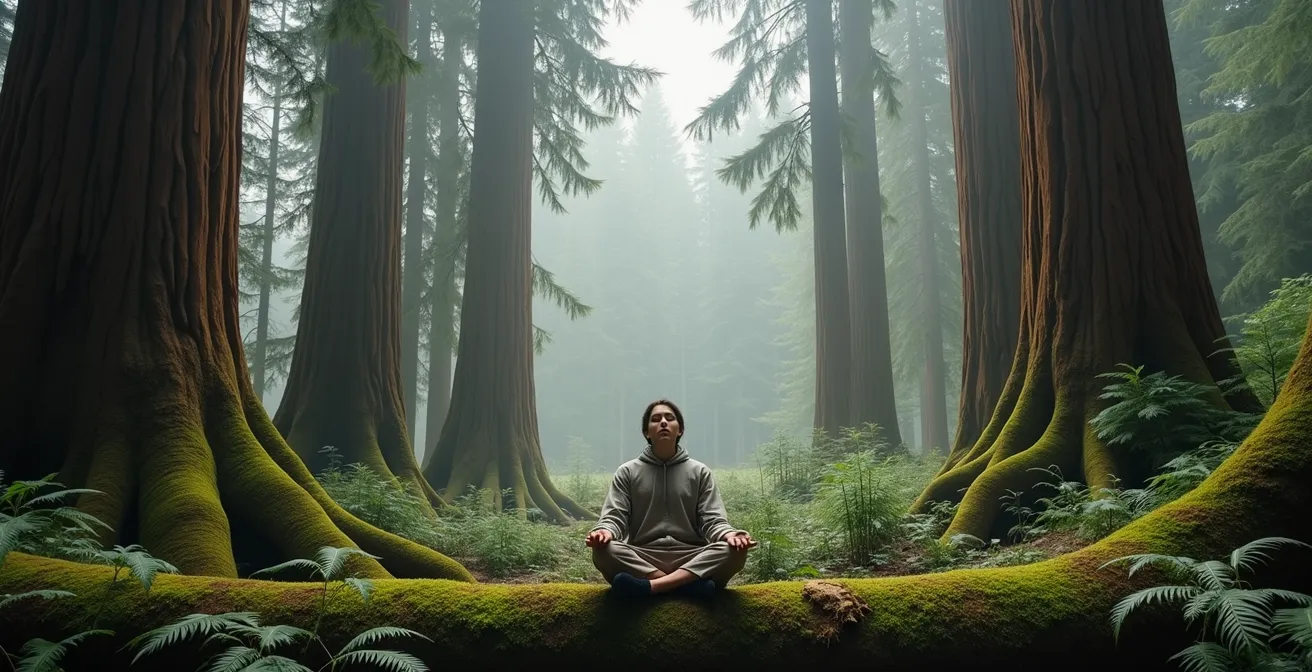
The persistent hum of urban anxiety isn’t solved by a simple walk; it requires a deliberate, sensory dialogue with nature to truly find relief.
- The air in British Columbia’s old-growth forests is rich with immune-boosting compounds called phytoncides, which are scientifically proven to reduce stress.
- An effective practice demands intentional techniques to disconnect from digital devices and ground yourself in the present moment, transforming a walk into a therapeutic session.
Recommendation: Begin with a 20-minute session of intentional stillness, focusing on your sensory input, to measurably lower your body’s stress hormones and start your healing journey.
For the stressed urbanite, the advice is often the same: “go for a walk,” “get some fresh air.” You may have tried hiking the trails around Vancouver or finding a quiet corner in a city park, only to find your mind still racing, tethered to the endless notifications and pressures of modern life. This feeling is common because the simple act of being outdoors isn’t always enough to combat deep-seated anxiety. We often treat nature like an outdoor gym, a place to conquer trails and count steps, rather than a space for genuine connection and healing.
But what if the key wasn’t about moving faster or going further, but about slowing down and listening? What if the forest itself was an active partner in your well-being? This is the core principle of Shinrin-yoku, or forest bathing. It’s not a hike; it’s a profound, sensory immersion into the forest atmosphere. It’s a practice rooted in science that demonstrates how a conscious dialogue with the natural world—especially the ancient, vibrant ecosystems of British Columbia—can be a powerful antidote to anxiety.
This guide moves beyond generic advice. As a certified forest therapy guide, I will walk you through the specific mechanisms that make BC’s forests so potent for healing. We will explore the science behind the trees, the practical methods for disconnecting, the difference between a solitary walk and a guided session, and even the subtle risks to be aware of. Prepare to transform your relationship with nature from a passive backdrop to an active source of calm and resilience.
To help you navigate this journey from stressed urbanite to mindful naturalist, this guide is structured to answer your most pressing questions. We will delve into the science, practice, and unique context of forest bathing in British Columbia’s remarkable landscapes.
Summary: Forest Bathing in BC: A Guide to Shinrin-Yoku for Anxiety Relief
- Why Do Phytoncides from Cedars Boost Your Immune System?
- Digital Detox: How to Resist Checking Your Phone When You Have Signal?
- Guided Therapy vs. Solo Walk: Which Is More Effective for Beginners?
- The Disassociation Risk: Can You Get Too Deeply Absorbed in Solitude?
- The 20-Minute Rule: How Long Must You Sit Still to Lower Cortisol?
- Carbon Sentinels: Why Are Old-Growth Forests Crucial for BC’s Climate?
- Why Does “Rural Quiet” Lower Cortisol Levels Faster Than City Parks?
- Farm Stays in Manitoba: How to Disconnect Digitally for a Weekend?
Why Do Phytoncides from Cedars Boost Your Immune System?
When you step into an old-growth forest in British Columbia, you are not just entering a quiet space; you are entering a complex biochemical environment. The crisp, earthy scent is more than just “fresh air”—it’s a cloud of volatile organic compounds called phytoncides. These are the natural oils that trees, especially conifers like cedar and pine, release to protect themselves from insects and disease. When we inhale them, we are engaging in a form of silent, cross-species communication that has profound effects on our physiology.
Research has shown that inhaling these compounds can lead to a significant increase in natural killer (NK) cell activity by up to 50%. These NK cells are a vital part of your immune system, responsible for fighting off tumors and virus-infected cells. In essence, the forest’s immune system is bolstering your own. This isn’t just a feeling of well-being; it’s a measurable, physiological upgrade.
In British Columbia, this effect is particularly potent thanks to our majestic conifer forests. The Western Redcedar, for instance, holds deep cultural and practical significance. As noted by Parks Canada, it is BC’s provincial tree and has a sacred status among coastal First Nations, who know it as the “Tree of Life.”
The Western Redcedar (Thuja plicata), BC’s provincial tree, known as the ‘Tree of Life’ by coastal First Nations.
– Parks Canada, Parks Canada Nature and Science
By consciously breathing in the presence of these ancient trees, you are not just relaxing; you are absorbing a form of natural medicine that reduces stress hormones, lowers blood pressure, and activates your body’s best defenses. It’s the first and most fundamental reason Shinrin-yoku is so effective for anxiety.
Digital Detox: How to Resist Checking Your Phone When You Have Signal?
One of the biggest obstacles to finding peace in nature is the digital tether in your pocket. Even in a remote BC forest, the faint glow of a screen or the phantom buzz of a notification can instantly pull your awareness out of the present moment and back into the cycle of anxiety. A true digital detox during forest bathing isn’t about willpower; it’s about creating a structure for intentional disconnection. It’s a conscious choice to give yourself the gift of being fully present.
This goes beyond simply silencing your phone. The temptation to check for a signal, take a photo, or look up a plant name can fragment your attention. The key is to replace the digital urge with an analog engagement. Before you even leave, prepare for an offline experience. Download offline maps and inform someone of your route, then switch your phone to airplane mode. This preserves its function as a safety tool while eliminating the distractions.

As the image above illustrates, embracing analog tools can profoundly deepen your connection. Instead of reaching for a plant ID app, bring a pocket guide to the ‘Birds of British Columbia’ or a simple nature journal. The act of sketching a flower or noting the texture of moss forces a level of observation that a quick photo can never replicate. This practice also hones your situational awareness, a critical skill in bear and cougar country. Resisting the phone becomes a form of mental training for mindfulness in the wild.
Guided Therapy vs. Solo Walk: Which Is More Effective for Beginners?
Embarking on your Shinrin-yoku journey presents a fundamental choice: should you venture out alone or seek the help of a certified guide? For a stressed urbanite new to the practice, a solo walk can feel intimidating. The pressure to “do it right” can paradoxically create more anxiety. While solitude offers freedom, a guided experience provides something crucial for beginners: a “safe container” for exploration. A guide’s role is to remove the mental burden of planning and navigation, allowing you to fully immerse yourself in the sensory experience.
A certified guide, like those trained by the Association of Nature & Forest Therapy (ANFT), structures the session with a series of gentle “invitations” designed to awaken your senses. These are not tasks to be completed but opportunities to connect. For example, a typical guided walk is intentionally slow. As one of BC’s pioneering guides, Haida Bolton, explains, her walks often last 2.5 hours but may cover only one kilometre. This deliberate slowness is the antithesis of a goal-oriented hike and is central to the therapeutic effect.
For those starting out in British Columbia, several options are available, each with its own benefits. A certified guide offers the most structured support for managing anxiety, while group walks or ranger-led programs can provide a sense of safety and community. The table below breaks down the primary choices for a beginner.
| Option | Cost | Benefits | Best For |
|---|---|---|---|
| Certified ANFT Guide (Haida Bolton) | $60-120 per session | BC’s first Forest Therapy Guide certified by the Association of Nature & Forest Therapy, provides ‘safe container’ for anxious beginners | Those needing structure and anxiety management |
| Alpine Club of Canada Groups | $0-30 membership | Safety in numbers, social support, local knowledge | People with social anxiety preferring group dynamics |
| BC Parks Ranger-Led Walks | Free | Educational component, safety guidance, accessible | Budget-conscious beginners wanting expert guidance |
| Solo Forest Bathing | Free | Complete freedom, personal pace, solitude | Experienced outdoors people comfortable in wilderness |
Ultimately, the “best” option depends on your comfort level. A guided session can provide the foundational skills and confidence to eventually practice on your own, making it an invaluable investment for any beginner seeking genuine anxiety relief.
The Disassociation Risk: Can You Get Too Deeply Absorbed in Solitude?
While Shinrin-yoku is about deep immersion, there is a subtle risk for beginners, especially those dealing with anxiety: disassociation. In the profound quiet of a vast BC provincial park, it’s possible to become so absorbed in your internal world that you lose connection with your physical surroundings. This isn’t just a matter of daydreaming; it’s a mental state where you feel detached from your body and the environment. This is the counter-intuitive challenge of the practice: finding the balance between mindful absorption and situational awareness.
Getting lost in your thoughts can increase the risk of getting physically lost. As safety organizations rightly point out, maintaining your orientation is paramount in the wilderness.
The sheer vastness of a BC provincial park can be overwhelming. Frame the risk as getting metaphorically ‘lost’ in one’s mind, which increases the danger of getting physically lost.
– BC AdventureSmart, Safety Advisory for BC Provincial Parks
The solution is not to avoid solitude but to practice sensory anchoring. This involves using tangible, physical sensations to keep your awareness grounded in the here and now. Instead of letting your mind drift aimlessly, you intentionally direct your focus to the sensory input the forest provides. This proactive grounding is a core skill taught in guided forest therapy. For your solo practice, having a set of techniques is essential for safety and effectiveness.
Your Grounding Plan for BC Forest Environments
- Physical Contact: Consciously touch the rough, grooved bark of a Douglas Fir or the cool surface of a mossy stone to anchor yourself to the physical place.
- Time Awareness: Set a gentle, vibrating timer on a watch for 20-minute intervals to maintain a sense of time without a jarring alarm.
- Sensory Inventory (5-4-3-2-1): Actively identify 5 things you can see, 4 things you can hear (the wind, a bird), 3 things you can feel (the ground under you), 2 you can smell (damp earth, cedar), and 1 you can taste (the air itself).
- Shared Presence: For your first few solo sessions, consider bringing a trusted companion who understands your goal is quiet immersion, not conversation.
- Spatial Orientation: Always stay on marked trails within BC Parks or designated areas to maintain a clear sense of direction and prevent disorientation.
The 20-Minute Rule: How Long Must You Sit Still to Lower Cortisol?
For the anxious mind, the idea of “sitting still” can be daunting. How long is enough? Is there a magic number? While the benefits of forest bathing are cumulative, research points to a surprisingly accessible starting point. The so-called “20-minute rule” isn’t a rigid law but a guideline based on studies measuring cortisol, the body’s primary stress hormone. The key isn’t just the duration but the practice of intentional stillness—a state of quiet observation without a goal.
Studies have found that time in nature has a direct, measurable impact on stress physiology. One review highlighted that forest bathing can lead to a 12-16% reduction in cortisol levels compared to being in an urban environment. Participants often report lower heart rates and blood pressure after as little as 15-20 minutes of quiet immersion. This suggests that even a short, dedicated session during a lunch break can be enough to interrupt your body’s stress response.
In British Columbia, this practice can be adapted to our famously variable weather. You don’t need a perfect sunny day. In fact, the temperate rainforest is often most alive during a light drizzle, with scents becoming more pungent and colours more vibrant.
Case Study: BC Weather-Adapted Forest Bathing
Forest therapy guide Haida Bolton, who runs sessions on BC’s Sunshine Coast, demonstrates that practice is not weather-dependent. Her two-hour sessions, which can be taken on consecutive days for maximum benefit, are adapted to the elements. During rainy days, she leads participants in “20-minute slow meanders” under the dense, protective canopies of Sitka spruce or finds sheltered spots for quiet sitting, proving that the forest offers a therapeutic embrace in any condition.

Whether you’re sitting on a driftwood log in Tofino watching the sunset or finding shelter under a giant cedar in a downpour, the principle is the same. Committing to just 20 minutes of uninterrupted sensory awareness is a powerful, science-backed first step to reclaiming your calm.
Carbon Sentinels: Why Are Old-Growth Forests Crucial for BC’s Climate?
The therapeutic power of British Columbia’s forests is inseparable from their ecological health. Old-growth forests are not merely collections of large trees; they are complex, ancient ecosystems that act as ecological sentinels for our planet’s climate. Their immense, undisturbed biomass makes them incredibly effective at capturing and storing atmospheric carbon, playing an irreplaceable role in mitigating climate change. When we advocate for their protection, we are also advocating for the preservation of these vital spaces for human well-being.
The biodiversity within these forests is staggering. An old-growth ecosystem supports a web of life far more intricate than a younger, managed forest. As Parks Canada notes, this biodiversity is a treasure in itself: “A Garry oak ecosystem harbours more plant species than any other land ecosystem in coastal British Columbia.” This richness isn’t just an abstract ecological fact; it directly enhances the Shinrin-yoku experience. A more diverse environment offers a richer tapestry of sights, sounds, textures, and smells, providing more opportunities for sensory connection and mindfulness.
Case Study: Fairy Creek and the Shinrin-Yoku Connection
The conservation efforts around areas like Fairy Creek on Vancouver Island highlight this link. Initiatives like the Sunshine Coast Trail were born from a desire to preserve BC’s treasured coastal temperate rainforests. These ancient forests provide the richest ‘biophony’ for forest bathing—the complex symphony of bird songs, insect sounds, and wind through diverse foliage. This natural soundscape is essential for a deep mindfulness practice, offering a stark contrast to the noise pollution of urban life. Protecting these forests is synonymous with protecting our access to profound healing.
Therefore, practicing Shinrin-yoku in an old-growth forest is an act of reciprocity. As you receive the calming, immune-boosting benefits from the forest, your presence and appreciation contribute to the growing movement to protect these critical carbon sentinels for generations to come. Your personal healing is connected to planetary healing.
Why Does “Rural Quiet” Lower Cortisol Levels Faster Than City Parks?
Not all quiet is created equal. While a city park can offer a welcome respite from traffic, the “quiet” it provides is often layered with the constant, low-frequency hum of urban life. This is the core difference between the quiet of a place like Vancouver’s Pacific Spirit Park and the profound silence of Haida Gwaii. Soundscape ecologists call this the distinction between anthropophony (human-made sounds) and biophony (the collective sound of a natural environment).
Your nervous system is exquisitely sensitive to this difference. Even if you aren’t consciously aware of it, the background noise of a city keeps your body in a state of low-level alertness. In contrast, the pure biophony of a remote rural or wilderness area—the wind, the rustle of leaves, distant bird calls—signals safety to your brain at a primal level. This allows your parasympathetic nervous system (the “rest and digest” system) to fully activate, leading to a faster and more significant drop in cortisol levels.
Case Study: Pacific Spirit Park vs. Haida Gwaii Soundscapes
A comparison of the soundscapes in Vancouver’s beloved Pacific Spirit Park and the remote trails of Haida Gwaii reveals this starkly. In the city park, the beautiful biophony of birds and wind is frequently interrupted by anthropophony like sirens, air traffic, and distant construction. In Haida Gwaii, the soundscape is almost pure biophony. It is this absence of human-generated noise that allows the mind to truly unwind. Forest therapy has been proven to lower cortisol, and the deep quiet of an undisturbed natural environment dramatically accelerates this process, promoting a profound sense of calm.
The impact of this deep quiet is not fleeting. The restorative effects of a single, immersive forest bathing session can be surprisingly long-lasting. Research suggests that the health benefits can last for as long as 30 days. This makes a monthly trip to a truly quiet, rural location a powerful and efficient strategy for managing chronic stress.
Key takeaways
- True anxiety relief from forest bathing comes from intentional, sensory practice, not just walking.
- BC’s conifer forests release phytoncides that scientifically boost your immune system and lower stress.
- Even 20 minutes of intentional stillness in a natural setting is enough to measurably reduce cortisol levels.
Farm Stays in Manitoba: How to Disconnect Digitally for a Weekend?
The desire for a complete digital detox has fueled a rise in unique travel experiences, such as booking a weekend at a farm stay in the prairies of Manitoba to truly unplug. The appeal is clear: trading screen time for wide-open spaces and simple, grounding tasks. However, you don’t need to leave British Columbia to find equally profound opportunities for disconnection. Our province’s diverse landscape of agritourism and remote retreats offers a rich palette for practicing mindfulness beyond the forest trail.
The principle is the same: replacing digital stimulation with tangible, sensory experiences. This can be achieved through what is known as “gustatory mindfulness” on a Fraser Valley organic farm, where the focus is on the taste and texture of food straight from the earth. It can be found in the focused, creative flow of a pottery workshop on the Gulf Islands or a meditative walk through the vineyards of the Okanagan wine country. These experiences quiet the mind by engaging the hands and senses.
For those seeking a structured digital detox, many BC destinations now offer packages specifically designed for this purpose. These options combine comfortable accommodation with guided mindful activities. For example, the Tigh-Na-Mara seaside resort on Vancouver Island offers a “Reconnect Package” that includes accommodation, a guided forest bathing tour, and access to their mineral pool. Studies have found that immersive nature experiences like this can deliver a significant 40% immune system boost that lasts for up to seven days.
Here are just a few ways to experience an agritourism-style digital detox within BC:
- Book a farm stay in the Okanagan wine country for vineyard meditation walks.
- Choose Gulf Islands artisanal farms for pottery and cheese-making mindfulness sessions.
- Stay at Fraser Valley organic farms to practice ‘gustatory mindfulness’ through farm-to-table experiences.
- Try remote, off-grid cabins in the Kootenays, some of which are accessible only by boat.
Your journey into the restorative power of the forest begins not with a long trip, but with a single, intentional step. Start today by finding a quiet green space, leaving your phone in your pocket, and dedicating 20 minutes to simply being present with the world around you. This simple act is the foundation of a practice that can transform your relationship with stress and anxiety.