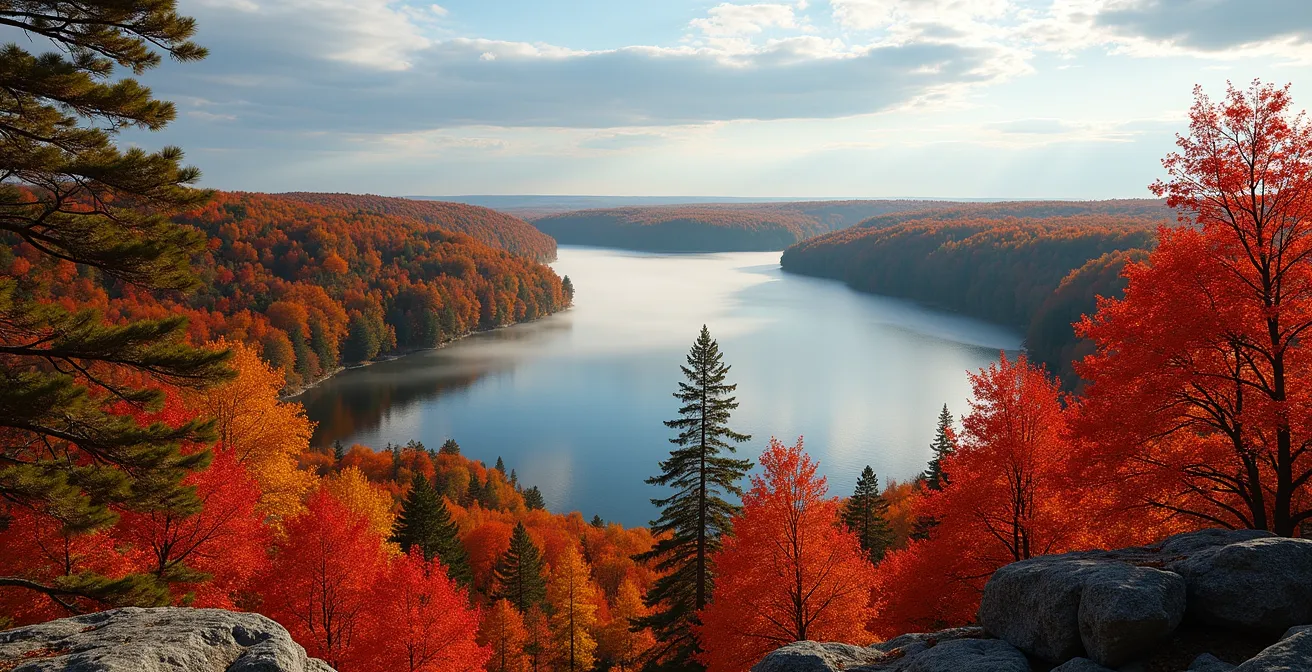
In summary:
- Peak fall colour is a scientific process triggered by cool nights and sunny days; warm weather can significantly delay it.
- Use a combination of official park reports, live webcams, and social media geotags to track the “colour front” in real time.
- Overcast days are often better than bright sun for capturing deep red maple leaves, as the clouds act as a natural softbox.
- Respect for private property is paramount; trespassing on farms for photos is illegal and carries heavy fines in Ontario.
- The best viewpoint depends on your goal: Dorset Tower offers epic panoramas but has long queues, while Algonquin’s trails provide immersive experiences.
Every autumn, a familiar anxiety settles in for photographers and nature lovers across Canada: have I missed it? Booking a trip to witness Ontario’s world-famous fall foliage can feel like a gamble. Arrive a week too early, and the forests are still a sea of green. A week too late, and the best leaves are a damp carpet on the ground. Many guides offer the generic advice to simply “visit in early October” or “go to Algonquin Park,” but this advice fails to account for the season’s variability and the specific needs of someone aiming for that perfect, jaw-dropping photograph.
The frustration of a mistimed trip stems from treating the fall colour change as a fixed calendar date rather than what it truly is: a complex biological and meteorological event. The key to moving from hopeful tourist to confident photographer isn’t about luck; it’s about understanding the underlying mechanisms. It requires a shift in perspective, viewing the season through the dual lenses of a phenologist—one who studies seasonal natural phenomena—and an artist.
What if the secret wasn’t just knowing *where* to go, but *why* the colours appear when they do? This guide goes beyond simple recommendations. We will delve into the science of anthocyanin production in maples, explore the modern technology used to track the colour front as it moves south, and discuss the critical ethics of landscape photography. Finally, we’ll analyze the physics of light to understand how to make those colours truly pop, compare iconic locations, and broaden our view to other spectacular seasonal displays across Canada.
This article provides the framework to not just see the colours, but to anticipate, track, and capture them at their absolute peak. Follow along as we break down the art and science of chasing autumn.
Summary: A Photographer’s Guide to Canada’s Seasonal Colours
- How Does Temperature Drop Trigger the Anthocyanin Production in Maples?
- Satellite Imagery: How to Use Apps to Track the Color Front in Real Time?
- The Instagram Trespass: Why Are Farmers Closing Access to Private Lanes?
- Golden Hour vs. Overcast: Which Light Makes Red Leaves Pop More?
- Dorset Lookout Tower vs. Algonquin Trails: Which Offers Better Panorama?
- Why Is the “Blue Hour” Longer in Northern Canada Than in the Tropics?
- Canola Fields in Bloom: When Is the Best Week to See Yellow Fields?
- Capturing the Rockies: The 3 Best Spots for Golden Hour Photography
How Does Temperature Drop Trigger the Anthocyanin Production in Maples?
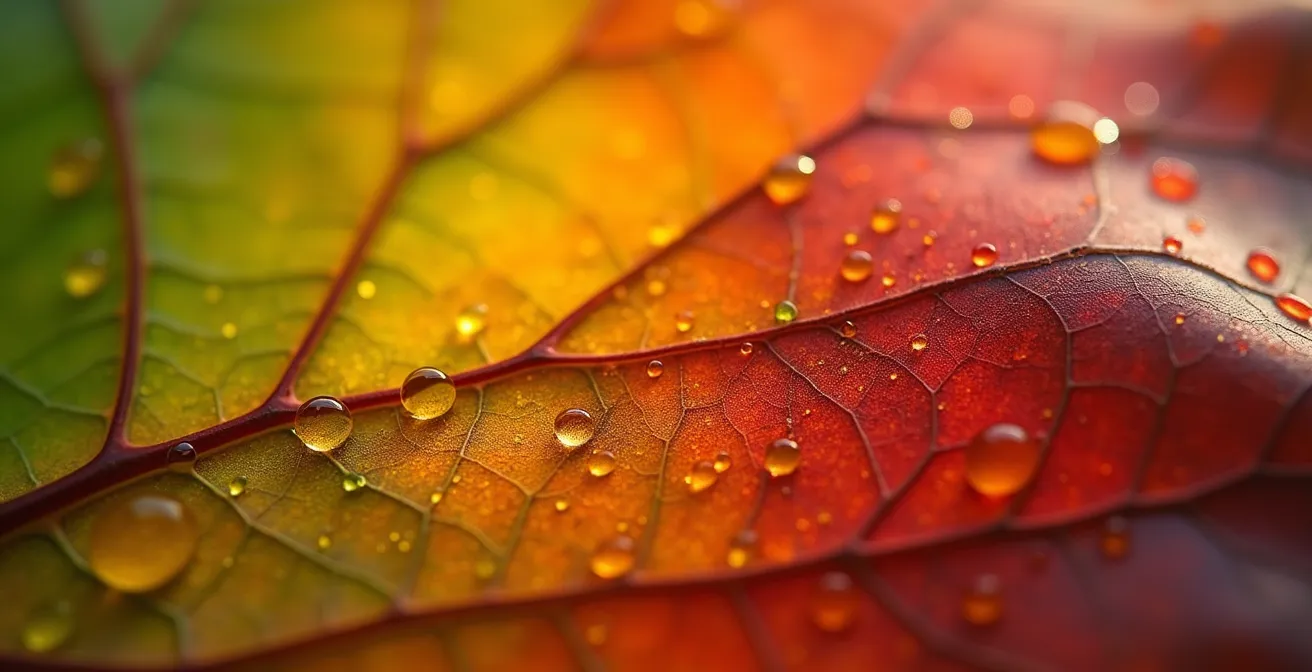
The vibrant crimson of a sugar maple is not an arrival of colour, but the unmasking of it. The entire process is a delicate dance between chemistry and climate. Throughout the summer, leaves are rich in chlorophyll, the pigment that captures sunlight for photosynthesis and gives them their green hue. As days shorten and nights cool, trees prepare for dormancy. The chlorophyll, no longer needed, begins to break down. This is when the magic happens. The breakdown reveals the yellow and orange pigments (carotenoids) that were present all along. But the brilliant reds and purples are different; they are actively produced.
This production is driven by a group of pigments called anthocyanins. The ideal recipe for intense red colour is a series of warm, sunny days and cool, crisp nights that dip near, but not below, freezing. The sunny days provide the sugars in the leaf sap, which are the building blocks for anthocyanin. The cool nights prevent these sugars from flowing out of the leaf, trapping them and concentrating the fuel needed for the chemical reaction. Warm autumn weather can significantly disrupt this. For instance, the 2024 season saw a delayed peak; an analysis shows mid-September temperatures of 27°C slowed the process, pushing the peak to October 4, 2024 – one week later than the 50-year average of September 27.
A hard frost, however, will kill the leaf tissue, halting anthocyanin production and causing the leaves to wither and drop prematurely. Understanding this balance is the first step for a photographer. It means you should be monitoring not just the date, but the specific weather patterns: the nightly temperature drops and daytime sun exposure. This scientific understanding transforms your trip planning from a date-based guess into a weather-based prediction.
Satellite Imagery: How to Use Apps to Track the Color Front in Real Time?
Once you understand the science, the next step is to track its effect on the landscape. Predicting the peak is no longer just about folklore and calendar dates; it’s about real-time data surveillance. Think of the colour change not as a static event, but as a “colour front” that sweeps down from Northern Ontario, moving south at a measurable pace. Your mission as a photographer is to intercept this front at the perfect location and time. Luckily, a suite of digital tools has made this easier than ever.
Start with the official sources, as they aggregate data from professionals on the ground. The Ontario Parks Fall Colour Report is the gold standard, providing a map with colour-coded icons that indicate the percentage of colour change and leaf fall at each provincial park. Algonquin Park offers an even more detailed report, complete with a live webcam from its visitor centre, giving you an immediate, unfiltered view of the current conditions. By checking these sources daily, you can calculate the “velocity” of the change—how many kilometres the peak colour is moving south each day—and extrapolate its arrival in your target region.
However, official reports can sometimes lag by a day or two. To get the absolute latest information, cross-reference this data with social media. Searching Instagram for location tags of popular spots like ‘Dorset Lookout Tower’ or hashtags like #AlgonquinFall provides ground-truth verification from people who are there *right now*. This blend of official data and crowd-sourced imagery gives you the most accurate possible picture of the unfolding season.
Action Plan: Track Ontario’s Fall Colour Front
- Check the Ontario Parks Fall Colour Map for colour-coded icons showing percentage of colour change and leaf drop at each provincial park.
- Access Algonquin Park’s detailed report with its live webcam from the visitor centre for real-time views.
- Monitor the ‘velocity’ of colour progression by tracking how many kilometers the front moves south daily.
- Cross-reference official reports with Instagram location tags like ‘Dorset Lookout Tower’ for real-time ground verification.
- Use historical data to predict peak timing: Northern Ontario typically peaks in late September, while Central Ontario follows in early October.
The Instagram Trespass: Why Are Farmers Closing Access to Private Lanes?
The pursuit of the perfect fall photograph has created an unfortunate side effect: the “Instagram trespass.” While public parks and conservation areas offer vast landscapes, some of the most iconic scenes—a lone red maple, a winding laneway framed by golden trees—are often located on private farmland. The desire to capture these idyllic shots has led to a growing conflict between photographers and landowners, particularly in rural Ontario.
The problem became starkly evident when tourists, ignoring no-trespassing signs, hopped fences to take photos in a Grey County farmer’s canola field. The trampled crops represented a direct financial loss, a destruction of livelihood for the sake of a selfie. This is not a victimless act. As one frustrated farmer noted in a widely shared post, “It’s unfortunate that people don’t see this as someone’s livelihood on private property.” This sentiment is the driving force behind the increasing closure of private farm lanes and fields that were once informally accessible.
It’s unfortunate that people don’t see this as someone’s livelihood on private property.
– Grey County Farmer, Facebook post about canola field trespassing
The legal consequences are also becoming more severe. The province of Ontario has taken a firm stance to protect its agricultural sector. Trespassing on farms or agri-food facilities is a serious offense. The penalties are substantial, with fines of up to $15,000 for a first offence and $25,000 for subsequent offences, as stipulated under Ontario’s Security from Trespass and Protecting Food Safety Act. As photographers and nature enthusiasts, our first principle must be to do no harm. This means shooting from the roadside, using a longer lens to compose your shot, and never, under any circumstances, crossing a fence or ignoring a “No Trespassing” sign. The most beautiful photo is worthless if it comes at the cost of someone else’s livelihood and our community’s trust.
Golden Hour vs. Overcast: Which Light Makes Red Leaves Pop More?
You’ve timed your trip perfectly and found a stunning, publicly accessible location. Now, the final artistic element comes into play: light. Many photographers instinctively hunt for the “golden hour,” the periods shortly after sunrise and before sunset. While this warm, dramatic light is fantastic for many subjects, it’s not always the best choice for capturing fall colours, especially the deep reds of maples. The key is to match the quality of light to the colour of the leaves you’re shooting.
Golden hour light is ideal for yellow and orange leaves, such as those on birch and aspen trees. When backlit by the low-angled sun, these leaves become translucent, glowing from within like stained glass. The warm light enhances their inherent warm tones, creating a vibrant, fiery effect. However, this same direct light can be problematic for deep red maples, often creating harsh reflections (specular highlights) that “clip” the details in your camera’s sensor, turning rich crimson into patches of white.
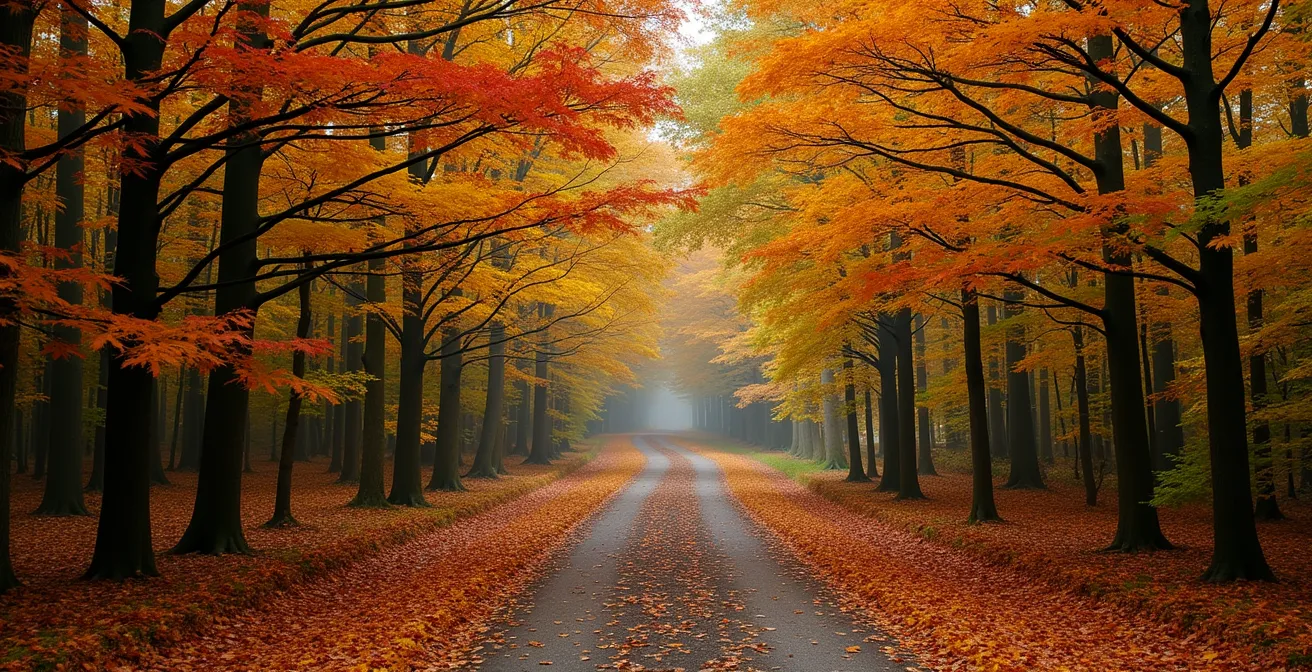
This is where an overcast day, often dismissed as “bad weather,” becomes a photographer’s secret weapon. The cloud cover acts as a giant natural softbox, diffusing the sunlight evenly across the landscape. This soft, cool light eliminates harsh shadows and reflections, allowing the full saturation of the deep red maple leaves to be captured. It prevents highlight clipping and brings out the subtle textures and tones within the colour. Using a Circular Polarizing Filter (CPL) on an overcast day is even more effective, as it cuts through the remaining atmospheric haze and surface glare, making the colours appear even richer and more deeply saturated.
This table summarizes a professional approach to lighting, drawing from an analysis of optimal conditions for fall photography.
| Lighting Condition | Best For | Technical Advantage | Recommended Equipment |
|---|---|---|---|
| Golden Hour | Yellow & orange leaves (birch, aspen) | Backlighting makes leaves glow translucent | No filter needed |
| Overcast | Deep red maples | Natural softbox prevents highlight clipping | Circular Polarizing Filter (CPL) |
| Post-Rain Sheen | All colors | Wet leaves become highly saturated & reflective | CPL essential to cut glare |
Dorset Lookout Tower vs. Algonquin Trails: Which Offers Better Panorama?
In the heart of Ontario’s cottage country, two iconic fall experiences present photographers with a choice: the epic, sweeping vista or the intimate, immersive journey. The Dorset Lookout Tower and the trails of Algonquin Provincial Park both offer world-class foliage, but they deliver fundamentally different photographic opportunities. The “better” option depends entirely on the story you want to tell with your images.
The Dorset Lookout Tower is all about scale. Rising 100 feet above the ground (for a total elevation of 465 feet above the Lake of Bays), it provides an undisputed 360-degree panorama of the Muskoka highlands. From the top, the landscape becomes a vast, rolling tapestry of crimson, gold, and green, dotted with pristine lakes. It’s the ultimate location for a grand, wide-angle landscape shot that captures the immense scale of the season. However, this epic view comes with a significant challenge: crowds. On peak weekends, it’s not uncommon to face 1-2 hour lineups just to climb the tower, making it difficult to shoot during the fleeting light of golden hour.
In contrast, Algonquin’s trails, such as the Lookout Trail or the Centennial Ridges Trail, offer an experience of immersion. While they also provide stunning lookout points, their true strength lies in the journey through the forest. Here, you can shoot compositions that are more intimate and detailed: a fern-lined path carpeted in fallen leaves, the texture of moss on a maple tree, or the reflection of a single colourful branch in a still pond. You are inside the colour, not just observing it from above. While you’ll still encounter other hikers, the vastness of the park allows for more solitude and creative freedom than the single, crowded platform of a tower. The choice is strategic: do you want the one epic, postcard panorama, or a diverse portfolio of intimate forest scenes?
Why Is the “Blue Hour” Longer in Northern Canada Than in the Tropics?
Just as the golden hour is a crucial tool for photographers, so too is its counterpart: the blue hour. This is the period of twilight in the morning and evening when the sun is significantly below the horizon and the indirect sunlight is scattered by the atmosphere, bathing the landscape in a cool, serene blue light. As a phenologist and photographer studying seasonal light, one fascinating observation is that the duration of this magical period varies dramatically with latitude. The blue hour in Northern Canada is noticeably longer than it is in a place like Costa Rica.
The reason is pure orbital mechanics and atmospheric physics. Near the equator, the sun rises and sets at a nearly perpendicular angle to the horizon. It crosses that crucial zone of 6 to 12 degrees below the horizon—the sweet spot for blue hour light—very quickly. In contrast, at higher latitudes like those found in Northern Canada, the sun’s path is much more oblique. It rises and sets at a shallower angle, meaning it spends a significantly longer time traversing that twilight zone. This extended duration gives photographers a wider window to work in.
braiding a river in the foreground against a mountain peak that still holds a touch of alpenglow. The soft, even light is perfect for capturing moody scenes and deep, saturated colours without the harsh contrast of direct sun. For a landscape photographer in Canada, understanding and exploiting the extended blue hour is a distinct home-field advantage.
Canola Fields in Bloom: When Is the Best Week to See Yellow Fields?
While autumn’s reds and oranges dominate the conversation, Canada’s seasonal colour palette is far more diverse. A quintessential summer spectacle, particularly in the Prairies and parts of rural Ontario, is the blooming of canola fields. For a few weeks, the landscape is transformed into an almost impossibly vibrant sea of electric yellow, set against a deep blue sky. For a phenologist, this is another key event in the year’s cycle of colour.
Timing this peak bloom is crucial. Unlike the slow progression of fall foliage, a canola field’s peak is a more concentrated event. Generally, the best time to see and photograph these fields is in mid to late July. The exact week can vary based on the planting schedule and spring weather, but this window is a reliable target. This is the moment when the bloom is most uniform and the colour is at its most intense, before the flowers begin to wilt and the pods form.
When photographing canola, the ethical considerations we discussed earlier are paramount. These fields are a cash crop, and the damage from trespassing is very real. All photography should be done from the public roadsides. A telephoto lens can help isolate patterns and compress the rows of yellow, while a wide-angle lens with a circular polarizing filter is a must. The polarizer will dramatically deepen the blue of the sky, creating a powerful complementary colour contrast with the yellow field, and will cut any glare from the waxy petals. Look for compositions that use leading lines, like a tractor path or a curving fenceline, to guide the viewer’s eye into the expanse of colour.
Key takeaways
- Peak fall colour is a predictable scientific event, not a random occurrence; cool nights and sunny days are the key drivers.
- Successful foliage photography requires a proactive strategy of tracking, not just passive observation, using a mix of official data and real-time social media.
- The best light for photography is context-dependent: overcast skies enhance reds, while golden hour backlighting makes yellows and oranges glow.
Capturing the Rockies: The 3 Best Spots for Golden Hour Photography
While Ontario’s maples provide Canada’s most famous fall colour display, the Canadian Rockies offer a second, equally breathtaking spectacle: the “Larch Madness” of late September. This is when the Larch trees, a unique deciduous conifer, turn a brilliant gold before dropping their needles. This phenomenon, set against the dramatic backdrop of turquoise lakes and jagged, snow-dusted peaks, is a photographer’s dream. Capturing it during the golden hour elevates the scene from beautiful to truly sublime.
Successfully photographing the golden hour in the Rockies is about positioning yourself in locations that are perfectly aligned with the rising or setting sun. It’s not just about being there at the right time, but being in the right place to take advantage of the dramatic light as it rakes across the epic topography. Based on access, light, and composition, here are three of the absolute best spots:
- Larch Valley, Moraine Lake (Banff National Park): This is the epicentre of larch season. The trail from Moraine Lake ascends into a valley that becomes a sea of gold. For a morning golden hour shot, the sun rises behind the Valley of the Ten Peaks, backlighting the larches and making them glow. It is the quintessential Canadian Rockies fall photograph.
- Peyto Lake Lookout (Banff National Park): While famous year-round, this spot is exceptional during the golden hour of a late September evening. The sun sets to the west, casting warm light across the vast, wolf-shaped Peyto Lake and illuminating the forested slopes on the opposite side of the valley. The high vantage point allows for a grand, layered composition.
- Spirit Island, Maligne Lake (Jasper National Park): An evening golden hour shoot at Spirit Island is a true pilgrimage. As the sun sets, it throws its last warm rays directly onto the island and the flanking Queen Elizabeth Ranges. This creates a dramatic “spotlight” effect, isolating the iconic, tree-covered island against a darkening, glacier-carved valley. It is a moment of profound and fleeting beauty.
To truly capture the fleeting beauty of Canada’s seasons, you must move beyond being a tourist and become a student of the landscape. Apply this mindset of scientific understanding, technological tracking, ethical access, and artistic light to your next photographic journey. Plan your adventure, and capture the colour.